Thursday, August 28, 2008
FBI's August 18 Briefing: full text
A transcript of the FBI's scientific (afternoon of Aug. 18, 2008) briefing for media can be found here.


Wednesday, August 27, 2008
Is FDA Interested in the Safety of Anthrax Vaccine?
FDA answered a Freedom of Information Act request for me today. I asked how many adverse event reports had been filed for anthrax vaccine (5,931 reports through July 22, 2008) and how many FDA had designated as SERIOUS (618 reports). Serious reports are those indicating an event requiring hospitalization, a life-threatening event, permanent disability, or loss of life.
I further asked whether FDA has performed any studies to assess causality (i.e., were adverse outcomes a result of the vaccination?) or if FDA has required the manufacturer to do so. The answer was 'No' to both questions.
FDA referred me to CDC. CDC began a clinical trial of anthrax vaccine in 1,564 people in 2002. Subjects were enrolled for 43 months, which theoretically should yield excellent long-term data. But no report from the study has been made public, despite early promises that a preliminary report would be released in 2004, and a final report in 2007.
The CDC's Advisory Committee on Immunization Practices met February 27-28, 2008 and discussed anthrax vaccine and this trial. Slides from every talk except the anthrax vaccine talks were posted by the CDC here. But the slides from each of the 4 talks on anthrax vaccine are listed as "coming soon."
However, I did manage to find this tidbit (see page 155 of the report): in CDC's clinical trial of 1,564 subjects, there were 229 reports of serious adverse events! That means, if you entered the anthrax vaccine trial, you had a greater than 1 in 7 chance of suffering a serious adverse event within the next 43 months. Yet despite failing to cite quantitative data, CDC thought the vast majority of serious events were not related to the vaccine. (But something bad was happening to this cohort of subjects, about 85% of whom received anthrax vaccine.)
Over 2 million people have received more than 7.5 million doses of the Bioport (now Emergent BioSolutions/EBS) anthrax vaccine since 1998, and all deploying soldiers and most contractors must be vaccinated as a condition of employment. Yet no federal public health agency is anxious to release definitive safety/injury data. Wonder why?
I further asked whether FDA has performed any studies to assess causality (i.e., were adverse outcomes a result of the vaccination?) or if FDA has required the manufacturer to do so. The answer was 'No' to both questions.
FDA referred me to CDC. CDC began a clinical trial of anthrax vaccine in 1,564 people in 2002. Subjects were enrolled for 43 months, which theoretically should yield excellent long-term data. But no report from the study has been made public, despite early promises that a preliminary report would be released in 2004, and a final report in 2007.
The CDC's Advisory Committee on Immunization Practices met February 27-28, 2008 and discussed anthrax vaccine and this trial. Slides from every talk except the anthrax vaccine talks were posted by the CDC here. But the slides from each of the 4 talks on anthrax vaccine are listed as "coming soon."
However, I did manage to find this tidbit (see page 155 of the report): in CDC's clinical trial of 1,564 subjects, there were 229 reports of serious adverse events! That means, if you entered the anthrax vaccine trial, you had a greater than 1 in 7 chance of suffering a serious adverse event within the next 43 months. Yet despite failing to cite quantitative data, CDC thought the vast majority of serious events were not related to the vaccine. (But something bad was happening to this cohort of subjects, about 85% of whom received anthrax vaccine.)
Over 2 million people have received more than 7.5 million doses of the Bioport (now Emergent BioSolutions/EBS) anthrax vaccine since 1998, and all deploying soldiers and most contractors must be vaccinated as a condition of employment. Yet no federal public health agency is anxious to release definitive safety/injury data. Wonder why?
Monday, August 25, 2008
Science Magazine/ ANTHRAX INVESTIGATION: FBI Discusses Microbial Forensics--but Key Questions Remain Unanswered
Science 22 August 2008:
Vol. 321. no. 5892, pp. 1026 - 1027
excerpted from the body of the article: (my apologies that a free link is not available)
But Science was no more able to avoid second-guessing the FBI investigation than the rest of us. The journal came up with additional questions for the FBI:...The FBI disclosed earlier that only eight samples had all four mutations; on Monday, it said that all but one of these came from USAMRIID. And all eight could be traced to RMR-1029--the flask of spores under Ivins's charge.
That is as far as the science took them, the FBI conceded; conventional detective work--such as checking lab notebooks and shipment records--helped rule out everyone but Ivins who had access to the spores, says Vahid Majidi, head of the agency's Weapons of Mass Destruction Directorate. He declined to give details. "I'm asking you not to second-guess our investigative approach," he said...
ANTHRAX INVESTIGATION:
Yudhijit Bhattacharjee and Martin Enserink
Six Anthrax Science Questions the FBI Has Yet to Answer
What were the four mutations the FBI says it used to link the anthrax in the envelopes to Bruce Ivins at USAMRIID?
What are the odds of a false positive--that is, the odds that the spore populations in Ivins's flask RMR-1029 and in the envelopes weren't related but shared the same four mutations by chance?
Eight samples had anthrax with all four mutations; one of those came from a lab other than USAMRIID. On what basis was this lab ruled out as the origin of the letters?
How did the FBI rule out the possibility that others at USAMRIID with access to Ivins's lab prepared the envelopes?
How exactly did Ivins, if he was the perpetrator, produce an easily dispersible powder from his anthrax culture?
What led the FBI to suspect Steven Hatfill in the earlier years of the investigation?
Friday, August 22, 2008
Ivins as Stalker?
Excerpt from original story in The Oregonian indicates extensive contacts and debriefs between Haigwood and the FBI over 6 years. Although agents were close-mouthed with almost everyone else during this investigation, they apparently opened their case files for Dr. Haigwood:
A Nature interview with Dr. Haigwood is here."Haigwood, who researches HIV transmission and vaccines, said she contacted the FBI shortly after the American Society for Microbiology asked its members in 2002 to think of possible suspects in the anthrax case. Agents soon interviewed her and have stayed in touch off and on ever since, she said.
FBI officials told her of their plans to accuse Ivins and of his suicide before the news broke, and they will debrief her more in the coming weeks, she said.
Haigwood said FBI agents were "very ethical and above board." And reading their case files convinced her they have the right suspect. "The evidence was compelling," she said.
"I have a tremendous sense of relief, I must say," that Ivins is gone, she said. "But also tremendous sadness. Because I always hoped I was wrong."'
Wednesday, August 20, 2008
The Limits of Forensic Microbiology, or "We prosecute people, not beakers"
The FBI and major media have placed a lot of emphasis on the techniques used to identify the specific batch of Ames anthrax used in the Daschle/Leahy letters. Careful consideration of these methods is certainly important, for their accuracy is critical to the FBI's theory of the case.
However, at the end of the day, the forensics are only one piece of evidence. Much as we may desire a tidy resolution to the case, the forensics simply do not have the power to provide it. They can identify a batch, or a pooled sample, and one or more flasks. But they can never tell you who obtained anthrax from the flasks. The strains found in Ivins' flask had been shared; 100 people had access; and who knows how many more had access to the samples maintained by these 100 people?
At the end of the day, it will be the detective work that solves the crime.
As an article in the August 20 NY Times points out:
How did the FBI get from the beaker to Ivins?
However, at the end of the day, the forensics are only one piece of evidence. Much as we may desire a tidy resolution to the case, the forensics simply do not have the power to provide it. They can identify a batch, or a pooled sample, and one or more flasks. But they can never tell you who obtained anthrax from the flasks. The strains found in Ivins' flask had been shared; 100 people had access; and who knows how many more had access to the samples maintained by these 100 people?
At the end of the day, it will be the detective work that solves the crime.
As an article in the August 20 NY Times points out:
The scientists say they are confident the F.B.I. has identified the source of the anthrax, a flask in the custody of Bruce E. Ivins, whom the F.B.I. considers to have been the perpetrator of the attacks. But almost a hundred other people were known to have had access to cultures from the flask, and the scientists say they have no opinion as to whether Dr. Ivins, who committed suicide last month, was the culprit.And the Nature editorial makes the same point:
I much prefer that analogy to the one about the spore on the grassy knoll. Let's get clear about what the scientific evidence does and does not indicate.... The genetic analysis itself seems quite solid. The FBI has collaborated with some of the best outside scientists on anthrax, and on 18 August convened many of them to answer journalists' questions about the science. The researchers on the panel explained that none of the analysis techniques used in this case is new; just the application to anthrax forensics. Several peer-reviewed papers on the forensic work have already been published, and another dozen or so are anticipated.
Although this openness about the techniques is commendable, neither the conclusions drawn from the scientific analysis, nor such crucial legal elements as the veracity of the provenance and handling of samples, have been tested in court. So far only one side of the story has been heard: that of the prosecution...
The FBI should explain why it thinks the scientific evidence implicates Ivins himself, and not just the flask. As Kemp aptly puts it: "In this country, we prosecute people, not beakers."
How did the FBI get from the beaker to Ivins?
Journal Nature calls for investigation: Case "too important to be brushed under the carpet"
In an editorial published online today, titled "Case Not Closed," Nature noted that "Only full disclosure can lift suspicions that the FBI has again targeted an innocent man:"
... neither the conclusions drawn from the scientific analysis, nor such crucial legal elements as the veracity of the provenance and handling of samples, have been tested in court. So far only one side of the story has been heard: that of the prosecution.
Certainly Ivins's behaviour in the crucial autumn months of 2001 raises questions about his emotional stability, but mental illness does not necessarily a murderer make.
The FBI should explain why it thinks the scientific evidence implicates Ivins himself, and not just the flask. As Kemp aptly puts it: "In this country, we prosecute people, not beakers." The absence of such a full disclosure can only feed suspicions that the FBI has again targeted an innocent man in this case — as it did with former Fort Detrick researcher Steven Hatfill.
This case is too important to be brushed under the carpet. The anthrax attacks killed five people, infected several others, paralysed the United States with fear and shaped the nation's bioterrorism policy. Science and law share a conviction that conclusions require evidence, and that the evidence be debated openly. The FBI says it regrets that Ivins's untimely death has denied it the chance to have its day in court. So presumably the bureau would welcome a full congressional or independent enquiry into this case, as has been called for by Senator Chuck Grassley (Republican, Iowa) and several other lawmakers. It is essential that such an enquiry takes place.(A pdf of the full article is here.)
Papers of Record Unsatisfied
Washington Post and New York Times editorials today find the FBI's revelations unconvincing, and call for an independent, scientific review of the evidence.
Tuesday, August 19, 2008
The vial the FBI destroyed, or why there will always be a spore on a grassy knoll
Does this case hinge on the first samples Ivins gave to the FBI, of which one was sent to Dr. Paul Keim in Arizona? Why does that sample matter, if the flask the FBI later confiscated had the same strain and genetic variability?
Furthermore, if Keim's sample is critical to the case, one must ask, "was Keim its sole custodian?" -- i.e., was it definitely the sample Ivins provided? Is there a bulletproof chain of custody?
Why was the FBI's sample destroyed, while an identical sample was considered adequate to be sent to Keim in Arizona? And if the sample was destroyed, as claimed, because it "would never stand up to scientific or legal scrutiny" then why was Keim's (identical) sample used by FBI?
If, as stated, Ivins helped design the protocol for sample submission, it is bizarre that he would have submitted a sample improperly. Might someone have told him to submit it in a special way? Might he have been misdirected regarding sample submission, in an attempt to set him up as a potential suspect?
And why would Ivins send the FBI a first sample that would help to incriminate himself? And then change the sample to further incriminate himself? He had a security clearance, worked in a high-profile, specialized government biodefense lab, and could have lost his job and reputation if he submitted false samples for the investigation.
The story has now changed: CNN reports that, "They (FBI) at first viewed the change as "deceptive" but said they now consider it as simply "questionable." What??!
I am looking for a solution to this case that has a semblance of rationality. The FBI's WMD Directorate's Assistant Director, Majidi, implies in his "grassy knoll" remark that no matter how much evidence the FBI releases, some people will always suspect a cover-up. I found his remark a very smooth put-down of those who are unsatisfied with the FBI's story. But the holes in this case keep multiplying, despite the brilliant PR.
Furthermore, if Keim's sample is critical to the case, one must ask, "was Keim its sole custodian?" -- i.e., was it definitely the sample Ivins provided? Is there a bulletproof chain of custody?
Why was the FBI's sample destroyed, while an identical sample was considered adequate to be sent to Keim in Arizona? And if the sample was destroyed, as claimed, because it "would never stand up to scientific or legal scrutiny" then why was Keim's (identical) sample used by FBI?
If, as stated, Ivins helped design the protocol for sample submission, it is bizarre that he would have submitted a sample improperly. Might someone have told him to submit it in a special way? Might he have been misdirected regarding sample submission, in an attempt to set him up as a potential suspect?
And why would Ivins send the FBI a first sample that would help to incriminate himself? And then change the sample to further incriminate himself? He had a security clearance, worked in a high-profile, specialized government biodefense lab, and could have lost his job and reputation if he submitted false samples for the investigation.
The story has now changed: CNN reports that, "They (FBI) at first viewed the change as "deceptive" but said they now consider it as simply "questionable." What??!
I am looking for a solution to this case that has a semblance of rationality. The FBI's WMD Directorate's Assistant Director, Majidi, implies in his "grassy knoll" remark that no matter how much evidence the FBI releases, some people will always suspect a cover-up. I found his remark a very smooth put-down of those who are unsatisfied with the FBI's story. But the holes in this case keep multiplying, despite the brilliant PR.
Monday's Briefing
I did not attend either FBI briefing, and the comments below relate to multiple news reports of the briefing.
1. Either one flask or two contained the specific anthrax strain in the letters--it was reported both ways in different newspapers, and apparently there was disagreement at the meeting.
2. Two labs had this strain, but the name of the other lab is still a secret. Why? Was it a lab that manufactures anthrax in powder form, and thus might be easier to link to the crime than the USAMRIID lab, which officially uses liquid anthrax only?
3. Yes, 100 people did have access to the strain--but FBI ruled every one of them out, leaving Ivins as the sole suspect.
4. FBI says it did re-engineer the powder, and it had the same properties as the anthrax found in the Leahy/Daschle letters--but the easily produced, engineered powder did not contain extra silicon, as reported by the Armed Forces Institute of Pathology for the letter anthrax. No explanation was provided, making the FBI claim questionable.
5. No one reported on the mix of B. cereus and B. anthracis that was previously said to provide evidence of where the anthrax came from.
Analysis:
The additional scientific information reported fails to clarify any of the persisting questions in the case. Many other people had access to this strain, and the science is unable to pin it on any one individual.
Maybe the FBI unequivocably ruled out 100 people as the lone suspect, by an inability to place them at the mailing sites, for example. But despite two lame attempts last week to make it appear Ivins could possibly have mailed the letters in Princeton (the first claim putting him at the mailbox too early for the postmark), there has still been no evidence presented establishing he made such a trip.
However, if you concede that the letter attacks are much more likely to have been the work of more than one individual, then the 100 people "ruled out" by FBI (using unreleased criteria) jump back in as suspects. Because perhaps all one of them had to do was to supply a tiny amount of anthrax to someone else who produced the final product. It would be very hard to rule that out.
Furthermore, we know how readily the spores leaked out of envelopes. The person who mailed the Daschle/Leahy letters had to have contaminated themself, simply by the act of placing the letters in a mailbox. This contamination should have extended to their vehicle (unless they showered and changed clothes before driving off), so the lack of contamination is a serious problem in the case against Ivins as sole suspect. Dr. CJ Peters was asked about this issue, and confirmed this point in an August 20 article here.
1. Either one flask or two contained the specific anthrax strain in the letters--it was reported both ways in different newspapers, and apparently there was disagreement at the meeting.
2. Two labs had this strain, but the name of the other lab is still a secret. Why? Was it a lab that manufactures anthrax in powder form, and thus might be easier to link to the crime than the USAMRIID lab, which officially uses liquid anthrax only?
3. Yes, 100 people did have access to the strain--but FBI ruled every one of them out, leaving Ivins as the sole suspect.
4. FBI says it did re-engineer the powder, and it had the same properties as the anthrax found in the Leahy/Daschle letters--but the easily produced, engineered powder did not contain extra silicon, as reported by the Armed Forces Institute of Pathology for the letter anthrax. No explanation was provided, making the FBI claim questionable.
5. No one reported on the mix of B. cereus and B. anthracis that was previously said to provide evidence of where the anthrax came from.
Analysis:
The additional scientific information reported fails to clarify any of the persisting questions in the case. Many other people had access to this strain, and the science is unable to pin it on any one individual.
Maybe the FBI unequivocably ruled out 100 people as the lone suspect, by an inability to place them at the mailing sites, for example. But despite two lame attempts last week to make it appear Ivins could possibly have mailed the letters in Princeton (the first claim putting him at the mailbox too early for the postmark), there has still been no evidence presented establishing he made such a trip.
However, if you concede that the letter attacks are much more likely to have been the work of more than one individual, then the 100 people "ruled out" by FBI (using unreleased criteria) jump back in as suspects. Because perhaps all one of them had to do was to supply a tiny amount of anthrax to someone else who produced the final product. It would be very hard to rule that out.
Furthermore, we know how readily the spores leaked out of envelopes. The person who mailed the Daschle/Leahy letters had to have contaminated themself, simply by the act of placing the letters in a mailbox. This contamination should have extended to their vehicle (unless they showered and changed clothes before driving off), so the lack of contamination is a serious problem in the case against Ivins as sole suspect. Dr. CJ Peters was asked about this issue, and confirmed this point in an August 20 article here.
Monday, August 18, 2008
3 Months Before Anthrax Sent, Daschle Criticized Anthrax Vaccine
Speaking to motive for the Daschle and Leahy letters, there might be multiple motives.
The letters likely influenced their decisions on upcoming legislation like the Patriotic Act, and both had considerable power to promote or suppress legislation. The letters were likely intended to frighten all Congressional Members, whose office buildings were affected, and who, like the rest of us, didn't know what would come next.
Senate Majority Leader Daschle also may have been targeted because of his position regarding the Defense Department's mandatory anthrax vaccine program. In a letter he wrote to Defense Secretary Rumsfeld dated June 21, 2001, Daschle sought to weigh in on an ongoing DoD review of the vaccine program. He criticized the vaccine over its safety and efficacy, as well as persistent problems with its manufacture.
Did someone who read the letter, or was otherwise aware of Daschle's concern about the vaccine, decide that an anthrax letter might shift his thinking on the vaccine -- as well as the Patriot Act and other legislation?
The letters likely influenced their decisions on upcoming legislation like the Patriotic Act, and both had considerable power to promote or suppress legislation. The letters were likely intended to frighten all Congressional Members, whose office buildings were affected, and who, like the rest of us, didn't know what would come next.
Senate Majority Leader Daschle also may have been targeted because of his position regarding the Defense Department's mandatory anthrax vaccine program. In a letter he wrote to Defense Secretary Rumsfeld dated June 21, 2001, Daschle sought to weigh in on an ongoing DoD review of the vaccine program. He criticized the vaccine over its safety and efficacy, as well as persistent problems with its manufacture.
Did someone who read the letter, or was otherwise aware of Daschle's concern about the vaccine, decide that an anthrax letter might shift his thinking on the vaccine -- as well as the Patriot Act and other legislation?
Saturday, August 16, 2008
More details revealed
A local Maryland paper provides new information from a colleague who worked at USAMRIID with Ivins through 2007, and published USAMRIID's official response to questions.
Scientific data so far lacking
Eric Lichtblau (NY Times) and Robert Roos (Center for Infectious Disease Research & Policy ) have written two comprehensive articles discussing the scientific and other evidence that has been presented. Lichtblau also discusses a closed-door FBI briefing that took place on August 14. They conclude the case is found seriously wanting.
Thursday, August 14, 2008
One person or a conspiracy?
David Willman tells us today that the FBI missed Ivins for so many years because it was obsessed with Hatfill. Is this the FBI's apologia?
The FBI is a federal law enforcement agency; it is not a person with feelings and quirks. I don't think we can let the FBI off the hook because of an "obsession."
Definite, critical evidence exists in this case: anthrax letters, and those hoax letters that were sent by the anthrax mailer. We know where and when those letters were mailed. For the hoax letters, we may only know the general area (where they were postmarked), but for the anthrax letters we know the mailbox.
If one individual committed this crime, that person must be able to be placed where and when every one of the letters was mailed. If no single suspect can be shown to have had the opportunity to mail every letter, then more than one person must be involved in the crime.
This is basic criminology. Is there a conspiracy (which, btw, is defined as a secret agreement between two or more people to perform an unlawful act) or not? How has the FBI explored this possibility, which should have been a major consideration throughout its investigation?
The FBI is a federal law enforcement agency; it is not a person with feelings and quirks. I don't think we can let the FBI off the hook because of an "obsession."
Definite, critical evidence exists in this case: anthrax letters, and those hoax letters that were sent by the anthrax mailer. We know where and when those letters were mailed. For the hoax letters, we may only know the general area (where they were postmarked), but for the anthrax letters we know the mailbox.
If one individual committed this crime, that person must be able to be placed where and when every one of the letters was mailed. If no single suspect can be shown to have had the opportunity to mail every letter, then more than one person must be involved in the crime.
This is basic criminology. Is there a conspiracy (which, btw, is defined as a secret agreement between two or more people to perform an unlawful act) or not? How has the FBI explored this possibility, which should have been a major consideration throughout its investigation?
Wednesday, August 13, 2008
News: Analysis of the Spores, and Congressional Investigations
Itching to grapple with the scientific analysis employed by the FBI? Martin Enserink and Yudhijit Bhattacharjee of Science have done the best reporting yet on the kinds of microbial forensic evidence we are likely to see.
Meanwhile, Carrie Johnson reports on House and Senate Judiciary Committee oversight panels, which have proposed September hearings to investigate the case further, and will call on FBI Director Robert S. Mueller to testify.
Meanwhile, Carrie Johnson reports on House and Senate Judiciary Committee oversight panels, which have proposed September hearings to investigate the case further, and will call on FBI Director Robert S. Mueller to testify.
Monday, August 11, 2008
Senator Grassley asks for Answers on Amerithrax Investigation
On August 7, 2008 Senator Grassley wrote to Attorney General Mukasey and FBI Director Mueller asking them to answer 18 excellent questions about their investigation.
Conclusive evidence of means, motive and opportunity are missing
Case Analysis in a Nutshell
1. Ivins cannot be placed at the Princeton mailbox at either of the two times he would have to have been there.
2. There are additional hoax letters that have not been discussed by FBI in the information released Wednesday; may we assume Ivins could not be placed at those mailbox locations during the requisite windows of opportunity?
3. No official evidence has come forward indicating the nature of the Daschle/Leahy spore preparation, nor whether Ivins possessed the knowledge regarding its production, or access to the necessary equipment.
4. No convincing motive has been presented, although a variety of implausible motives have been suggested.
5. Although many other people with a strong motive can be identified, there is no evidence they were investigated by FBI and exculpated
6. "The FBI sought out the best experts in the scientific community and, over time, four highly sensitive and specific tests were developed that were capable of detecting the unique qualities of the anthrax used in the 2001 attacks." However, details about the microbial forensic analysis have not been released, and may not be available for months or years pending publication. Scientists doubt that any forensic analysis can do more than identify the precise strain of anthrax.
7. The pre-franked envelopes could not be identified as coming from Ivins' post office, as initially claimed, but were instead sold in multiple post offices, none of which was definitely in Frederick.
8. Ivins was not the "sole custodian" of the RMR-1029 strain; over 100 people had access to it and they may have shared it with others. How was Ivins selected as a suspect and the others exonerated?
9. Handwriting analysis has not linked him to the crime.
10. He could not be linked to the Quantico letter that fingered Dr. Assaad. He could not be linked to any efforts to finger Dr. Hatfill.
11. No physical evidence links him to the crime: this includes the tape on the letters, fibers, human DNA, spores in his car, home or personal effects, evidence of any kind he travelled to the areas where the letters were mailed, including purchasing enough gasoline for a 7 hour trip to Princeton, twice.
12. He passed two polygraph examinations at Fort Detrick.
13. Since the FBI has been unable to build a convincing case against any one individual in the 7 years since the letters were sent, why didn't it focus on identifying a conspiracy of individuals who together may have been able to perform the complex actions required to send the anthrax letters and hoax letters?
1. Ivins cannot be placed at the Princeton mailbox at either of the two times he would have to have been there.
2. There are additional hoax letters that have not been discussed by FBI in the information released Wednesday; may we assume Ivins could not be placed at those mailbox locations during the requisite windows of opportunity?
3. No official evidence has come forward indicating the nature of the Daschle/Leahy spore preparation, nor whether Ivins possessed the knowledge regarding its production, or access to the necessary equipment.
4. No convincing motive has been presented, although a variety of implausible motives have been suggested.
5. Although many other people with a strong motive can be identified, there is no evidence they were investigated by FBI and exculpated
6. "The FBI sought out the best experts in the scientific community and, over time, four highly sensitive and specific tests were developed that were capable of detecting the unique qualities of the anthrax used in the 2001 attacks." However, details about the microbial forensic analysis have not been released, and may not be available for months or years pending publication. Scientists doubt that any forensic analysis can do more than identify the precise strain of anthrax.
7. The pre-franked envelopes could not be identified as coming from Ivins' post office, as initially claimed, but were instead sold in multiple post offices, none of which was definitely in Frederick.
8. Ivins was not the "sole custodian" of the RMR-1029 strain; over 100 people had access to it and they may have shared it with others. How was Ivins selected as a suspect and the others exonerated?
9. Handwriting analysis has not linked him to the crime.
10. He could not be linked to the Quantico letter that fingered Dr. Assaad. He could not be linked to any efforts to finger Dr. Hatfill.
11. No physical evidence links him to the crime: this includes the tape on the letters, fibers, human DNA, spores in his car, home or personal effects, evidence of any kind he travelled to the areas where the letters were mailed, including purchasing enough gasoline for a 7 hour trip to Princeton, twice.
12. He passed two polygraph examinations at Fort Detrick.
13. Since the FBI has been unable to build a convincing case against any one individual in the 7 years since the letters were sent, why didn't it focus on identifying a conspiracy of individuals who together may have been able to perform the complex actions required to send the anthrax letters and hoax letters?
GAO: 1-2% of anthrax vaccine recipients have adverse events which may result in disability or death
On June 29, 2007 a Government Accountability Office report was issued regarding the military Vaccine Healthcare Centers, which were formed in 2001 to take care of injuries from anthrax vaccine. They have treated 2,400 ill soldiers, the vast majority for illnesses developing in close proximity to anthrax vaccinations.
Page 4 of the report says, "Officials from the VHC Network and CDC estimate that between 1 and 2 percent of immunized individuals may experience severe adverse events, which could result in disability or death." The text does not specify anthrax vaccine here, in an attempt to downplay the anthrax vaccine connection. However, on page 3 of the report, in a footnote, GAO makes clear that the only vaccine reactions evaluated for this report were those from anthrax, stating: "We consider the efforts of the VHC Network to address the needs of those receiving the anthrax immunization under both mandatory and voluntary circumstances to be within the scope of this report."
This quote from: Military Health: DOD's Vaccine Healthcare Centers Network. GAO-07-787R, June 29.
http://www.gao.gov/cgi-bin/getrpt?GAO-07-787R
Who would willingly agree to such odds? Yet this vaccine is what we continue to force on our soldiers, Coast Guard members, some merchant mariners and many civilian contractors to the military.
The GAO report says that the VHCs are working with the Military Vaccine Agency (MILVAX) to research adverse reactions--but no studies have been reported in the medical literature. It also notes the VHC Network spent $500,000 to build a clinic at Landstuhl, Germany in 2004--but the Army made no funds available to operate it. Landstuhl is where soldiers go first when they are medically evacuated from Iraq and Afghanistan. The VHCs apparently expected that vaccine-injured soldiers would be arriving at Landstuhl in sufficient numbers to warrant a clinic.
How many of the non-combat-related serious illnesses and deaths are due to anthrax and possibly other vaccines? Although the military has not released any data that would permit an independent assessment, I have heard from ill soldiers that several percent of their units were medevaced home prior to seeing any combat--due to heart attacks, gastrointestinal illnesses, and sudden development of autoimmune disorders.
Page 4 of the report says, "Officials from the VHC Network and CDC estimate that between 1 and 2 percent of immunized individuals may experience severe adverse events, which could result in disability or death." The text does not specify anthrax vaccine here, in an attempt to downplay the anthrax vaccine connection. However, on page 3 of the report, in a footnote, GAO makes clear that the only vaccine reactions evaluated for this report were those from anthrax, stating: "We consider the efforts of the VHC Network to address the needs of those receiving the anthrax immunization under both mandatory and voluntary circumstances to be within the scope of this report."
This quote from: Military Health: DOD's Vaccine Healthcare Centers Network. GAO-07-787R, June 29.
http://www.gao.gov/cgi-bin/getrpt?GAO-07-787R
Who would willingly agree to such odds? Yet this vaccine is what we continue to force on our soldiers, Coast Guard members, some merchant mariners and many civilian contractors to the military.
The GAO report says that the VHCs are working with the Military Vaccine Agency (MILVAX) to research adverse reactions--but no studies have been reported in the medical literature. It also notes the VHC Network spent $500,000 to build a clinic at Landstuhl, Germany in 2004--but the Army made no funds available to operate it. Landstuhl is where soldiers go first when they are medically evacuated from Iraq and Afghanistan. The VHCs apparently expected that vaccine-injured soldiers would be arriving at Landstuhl in sufficient numbers to warrant a clinic.
How many of the non-combat-related serious illnesses and deaths are due to anthrax and possibly other vaccines? Although the military has not released any data that would permit an independent assessment, I have heard from ill soldiers that several percent of their units were medevaced home prior to seeing any combat--due to heart attacks, gastrointestinal illnesses, and sudden development of autoimmune disorders.
Sunday, August 10, 2008
The Message in the Anthrax
Thanks to a comment, I just reread Don Foster's The Message in the Anthrax, published in Vanity Fair and Reader's Digest in 2003. This is a must-read if you want to understand the universe of evidence that has accrued in this case. Foster discusses the hoax letters; the Assaad story (by Laura Rozen); how the FBI ignored or misinterpreted evidence; the makeup of the powder; and the circumstantial case against Hatfill. He reminds us that there were at least 7 letters sent, based on who came down with anthrax, though only four were recovered. (Which brings new questions to mind: what forensic studies were done on the anthrax collected from the sites at which no letter was recovered? What motives have been proposed for attacking these other offices?)
It will give you plenty to chew on.
It will give you plenty to chew on.
DNA is just anthrax clue, not clincher
DNA is just another anthrax clue, not clincher:
Its use in distinguishing bacteria is limited. Some scientists want to know what else implicated Bruce ivins.
Its use in distinguishing bacteria is limited. Some scientists want to know what else implicated Bruce ivins.
DNA evidence alone wasn't a smoking gun in the case against Bruce Ivins as the perpetrator of the 2001 anthrax attacks, say microbiologists and other experts who have read details of the investigation released last week.Genetic sleuthing was useful in narrowing the list of suspects, they say, but it wasn't conclusive since DNA from bacteria doesn't often carry a unique genetic fingerprint the way human DNA does.....
Saturday, August 9, 2008
Holes in the Anthrax Case?
See Brad Friedman's piece at The Guardian, UK, and this Washington Post Editorial
Holes in the Anthrax Case? The nation and the FBI would benefit from an independent review of the investigation.
Holes in the Anthrax Case? The nation and the FBI would benefit from an independent review of the investigation.
Saturday, August 9, 2008; A14
ON WEDNESDAY, the federal government made public much of its case against accused anthrax killer Bruce E. Ivins. On Thursday and yesterday, scientists, reporters and others poked holes and raised questions about the FBI's case. On Monday, the attorney general should order an independent review of the FBI's investigation and its conclusion. Such a review would serve the interests of the country and of the FBI itself.
The mailing of anthrax spores in 2001 to offices in Congress and elsewhere killed five people, injured 17 and trau matized a nation reeling from the Sept. 11, 2001, attacks. After a long and winding inquiry, the FBI says it is now certain that Mr. Ivins, a scientist at Fort Detrick, was solely responsible for the attacks. The case it put forward Wednesday was compelling, both as to Mr. Ivins's mental instability and his access to anthrax spores; computers seized from a public library in Frederick and materials from the Ivins house may yield more evidence. But the FBI's conclusions will never be tested in court because Mr. Ivins died July 29 of a Tylenol overdose in what has been ruled a suicide. The case is admittedly circumstantial, and questions have been raised about the reliability of the FBI's scientific evidence, the inability to tie Mr. Ivins to the handwritten notes included with the mailed anthrax, the process by which the FBI excluded as suspects others who had access to the anthrax, and more.
"There are a lot of armchair detectives and instant experts out there formulating opinions not based on a full set of the facts," an FBI official objected on Thursday. True enough -- and all the more reason to give a full set of the facts to someone who can get out of the armchair. But to whom?
Congress definitely has a role to play. Investigative hearings could shed light on Fort Detrick's security policies and on how Mr. Ivins managed to hold on to his clearance. They could look at policy issues, such as whether the expansion of bioterrorism research has perversely increased the risk of an accident or attack. They could examine FBI methods in the agency's investigation of both Mr. Ivins and Steven J. Hatfill, another scientist who came under FBI suspicion and who eventually won a $5.8 million settlement from the government.
But Congress may not be best positioned to review the scientific and forensic details of the FBI investigation. An independent inquiry that can work painstakingly outside the limelight is called for. The Justice Department's office of inspector general, although overworked already, has shown under Glenn A. Fine that it can conduct such sensitive probes with thoroughness and fairness. Alternatively, a retired judge could be appointed to lead a commission, which could in turn draw on the National Academy of Sciences and other experts. In either case such an inquiry, if it found holes in the investigation, could document them without taint of politics. If it validated the FBI's work, it would reassure the nation that no killers were still at large and put conspiracy theories to rest.
Through surveillance, was FBI complicit in Ivins' death?
In his news conference on Wednesday, August 6, US Attorney Jeffrey Taylor mentioned (evidence point 4) that while Ivins had been under 24/7 surveillance, he discarded some materials on DNA coding.
If the FBI was about to charge Ivins, you would expect he was still under 24/7 surveillance, right?
Well, a tylenol overdose is entirely treatable--curable--during many hours after consumption. The patient receives N-acetyl cysteine or glutathione, which allows the body to detoxify the tylenol. Those who make it to hospital within about 16--24 hours will live.
SO...why was the FBI twiddling its thumbs during and after the time Ivins ingested his Tylenol #3 (acetaminophen with codeine)? Attorney Taylor began his remarks saying, "We regret that we will not have the opportunity to present the evidence to a jury to determine whether the evidence establishes Dr. Ivins' guilt beyond a reasonable doubt."
Really? I'd like to see the medical records. Was there really no autopsy in this high-profile case? I'd also like someone to investigate the "traffic" between the agents performing surveillance and FBI headquarters while Ivins was ingesting his poison and starting to die at home.
If the FBI was about to charge Ivins, you would expect he was still under 24/7 surveillance, right?
Well, a tylenol overdose is entirely treatable--curable--during many hours after consumption. The patient receives N-acetyl cysteine or glutathione, which allows the body to detoxify the tylenol. Those who make it to hospital within about 16--24 hours will live.
SO...why was the FBI twiddling its thumbs during and after the time Ivins ingested his Tylenol #3 (acetaminophen with codeine)? Attorney Taylor began his remarks saying, "We regret that we will not have the opportunity to present the evidence to a jury to determine whether the evidence establishes Dr. Ivins' guilt beyond a reasonable doubt."
Really? I'd like to see the medical records. Was there really no autopsy in this high-profile case? I'd also like someone to investigate the "traffic" between the agents performing surveillance and FBI headquarters while Ivins was ingesting his poison and starting to die at home.
White House memo exposes Rove knew of problems with anthrax vaccine
Allen McDuffee of Raw Story.com provides this tidbit, indicating Karl Rove knew the vaccine was problematic based on materials from Ross Perot.
National Academy of Science report shows psychiatric illness increases several-fold after anthrax vaccination
Many have asked me if Ivins' anthrax vaccinations or meds might have contributed to his mental state. Bruce admitted a family history of emotional problems, his brother Tom appears psychiatrically impaired, and I don't mean to make light of this history.
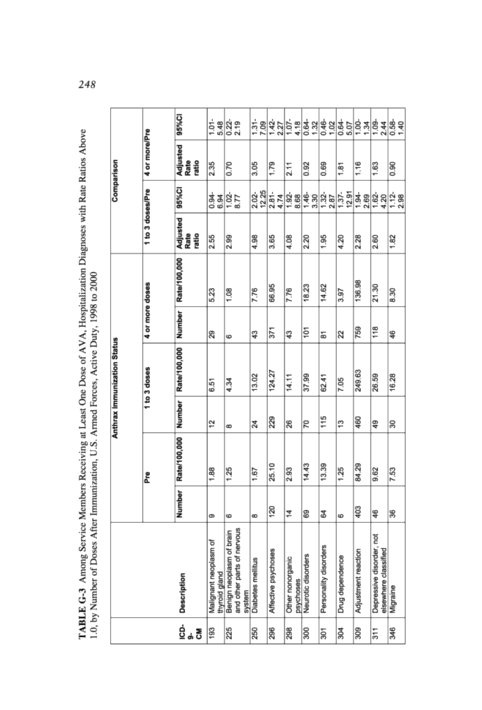
However, the answer to whether anthrax vaccine leads to mental disorders is a resounding YES. The National Academy of Science studied anthrax vaccine for Congress, publishing its report in 2002. Table G-3 of the report summarizes data supplied to the Academy by the military from the Defense Medical Surveillance System database on hospitalization rates in 300,000 soldiers, before and after receiving anthrax immunizations.
In those who received 1-3 doses of vaccine, hospitalizations for affective psychosis were 4.95 times greater after vaccination than before receiving any anthrax vaccine. For other nonorganic psychoses, the rate was 4.82 times higher. Hospitalizations for neurotic disorders were 2.63 times higher. Hospitalizations for personality disorders were 4.66 times higher. Hospitalizations for drug dependence were 5.64 times higher. Hospitalizations for adjustment reaction were 2.96 times higher. For depressive disorder, not otherwise classified, the rate was 2.76 times higher.
Amazing statistics.
However, the answer to whether anthrax vaccine leads to mental disorders is a resounding YES. The National Academy of Science studied anthrax vaccine for Congress, publishing its report in 2002. Table G-3 of the report summarizes data supplied to the Academy by the military from the Defense Medical Surveillance System database on hospitalization rates in 300,000 soldiers, before and after receiving anthrax immunizations.
In those who received 1-3 doses of vaccine, hospitalizations for affective psychosis were 4.95 times greater after vaccination than before receiving any anthrax vaccine. For other nonorganic psychoses, the rate was 4.82 times higher. Hospitalizations for neurotic disorders were 2.63 times higher. Hospitalizations for personality disorders were 4.66 times higher. Hospitalizations for drug dependence were 5.64 times higher. Hospitalizations for adjustment reaction were 2.96 times higher. For depressive disorder, not otherwise classified, the rate was 2.76 times higher.
Amazing statistics.
Anthrax vaccine : efficacy and potency problems
CDC, which performed some vaccine tests, acknowledged in 1968 that, "As to the efficacy of the vaccine, we have no real method of determining the protection afforded." FDA records show that in 1969 the ad hoc committee to license anthrax vaccine found a lack of "scientific evidence for efficacy of the vaccine." The committee chairman, Dr. Margaret Pittman, then noted, "Michigan has filed all required information and material for license except the results of an adequately controlled clinical investigation that establishes efficacy." Michigan was asked to conduct such a trial, but there is no evidence it was ever carried out. This demonstrates that the vaccine was never proven effective in humans.
Potency of the vaccine has been a continuous headache for the manufacturers. Many different potency standards have been submitted to FDA over the years. The potency assay kept changing because it could never be demonstrated to accurately reflect the potency of the product. One license amendment for potency was submitted in 1978. More were submitted prior to the first Gulf War. As recently as May 2001 Bioport was still submitting amendments to the potency test.
Therefore, FDA should have pulled the vaccine's license, since anthrax vaccine was unable to meet FDA standards for potency and human efficacy from the time the license was first issued. It means that FDA has never known whether or how much the vaccine will protect against anthrax.
Potency of the vaccine has been a continuous headache for the manufacturers. Many different potency standards have been submitted to FDA over the years. The potency assay kept changing because it could never be demonstrated to accurately reflect the potency of the product. One license amendment for potency was submitted in 1978. More were submitted prior to the first Gulf War. As recently as May 2001 Bioport was still submitting amendments to the potency test.
Therefore, FDA should have pulled the vaccine's license, since anthrax vaccine was unable to meet FDA standards for potency and human efficacy from the time the license was first issued. It means that FDA has never known whether or how much the vaccine will protect against anthrax.
Friday, August 8, 2008
Clarifying info on the anthrax vaccines Ivins studied
From Eric Lipton in the Aug 9 NY Times:
"There was a real threat, the former colleagues acknowledged, that the anthrax vaccine Dr. Ivins had worked on during that period, known as Anthrax Vaccine Absorbed or AVA, might be pulled from the market
Most troubling were problems at the Michigan manufacturing plant, which had been shut down in 1998 after the Food and Drug Administration uncovered serious flaws.
Dr. Ivins and other researchers, however, had been working on a more advanced alternative vaccine — considered safer and more effective — so there was no reason for such a rash act, his former colleagues say.
“There was a lot of consternation, a lot of pressure to rescue this thing,” said Jeffrey Adamovicz, one of Dr. Ivins’s fellow researchers at the time. “But if AVA failed, he had his next vaccine candidate. It was well on its way to what looked to be a very bright future...”
...The Defense Department denied conducting such experiments on troops and defended the vaccine, saying it was both safe and effective, and necessary to protect the military from a possible attack. Dr. Ivins’s notebooks, which were released to the public, suggested, however, that he had found that the vaccine might be making some of the test animals sick.
“Although all vaccinated monkeys survived, they appeared to be sick over the course of two weeks,” Dr. Ivins’s laboratory report said."
My understanding of this information, though I have not seen the notebooks, is that the vaccinated monkeys, despite their vaccinations, got anthrax after being exposed experimentally--but the illness was less severe than if they had not been vaccinated, and they survived. This is actually an example of poor vaccine effectiveness. In this example, the monkeys were sick from anthrax, not from their vaccinations.
However, Bruce encouraged me to study the safety of anthrax vaccines. If I remember correctly, he continued to encourage me in this endeavor, even after I published a March 1999 review article questioning the safety of some of the vaccines he was developing, as well as questioning the Bioport vaccine.
There may have been nagging, unresolvable conflicts associated with the nature of Bruce's work. (Here I have no direct knowledge and am just speculating). His job was to develop anthrax vaccines, and he was required to publicly support them. As a recipient, he suspected the vaccine had made him and others ill. As a scientist, he knew the vaccines had very limited effectiveness. But to continue in his chosen field, he had to keep taking vaccine boosters.
Yet the atmosphere nationally regarding forced military anthrax vaccinations was charged. Refusers were being court martialled. The Army's PR machine insisted the vaccine was perfectly safe and perfectly effective. Bruce, who worked for the Army, knew the vaccine was neither, and that Bioport plant operations were shoddy, to boot. Yet it fell to him to help Bioport get relicensed.
Bruce was trying to help people by making better vaccines. Bruce had a need to help people. But now the vaccine he was supporting was causing a lot of people to develop chronic illnesses.This may partly explain the pressures Bruce was facing, and the exacerbation of his emotional difficulties, around 1998-9, even before the anthrax letters were sent. An Aug. 11 LA Times article explores Ivins' mental state as well.
Ivins' Lawyer on where the envelopes came from
From the very enlightening NPR interview with Ivins' attorney, Paul Kemp:
"They have a Secret Service document examiner who examined the stamps on these pre-franked envelopes [envelopes with prepaid postage] that contained the anthrax in the anthrax attacks. And because of microscopic defects, you're correct, he was able to tie those to lots or a set of envelopes that were mailed to three post offices that are listed in the search warrant affidavits, that are listed in all three search warrant affidavits: Elkton, Md., Cumberland, Md., and Fairfax, Va., the main post office in Fairfax, post offices that service the entire width of the state of Maryland and then the biggest post office in the state of Virginia.
Yesterday, Mr. Taylor says they came from a post office in Frederick, and that's just, if that's true, then maybe they misrepresented something to three different federal judges in obtaining these search warrants, or he just got it wrong, and I choose to believe it's the latter.
And so there's no connection to any post office that Ivins has ever had an account with and there's no evidence he ever purchased these envelopes in the search warrants that they executed..."
Investigating the FBI
Just for fun, let's investigate some facets of the FBI's case:
1. Leaks last weekend claimed that Ivins was about to be charged with committing the anthrax crime. Turns out, FBI had not yet brought its evidence against Ivins to a grand jury. And one of his attorneys denies that he was told he was to be charged: "It had never been made clear to him nor to us that he was 'the suspect,'" says DeGonia, Ivins' co-counsel.
2. The FBI said it couldn't produce its case till after the victims and their families were briefed, which took until 8 days after Ivins' death. This gave FBI time to create the story and select the evidence it wanted to present.
3. After Ivins died, FBI agents scrambled to obtain two computers Ivins had used a few days earlier, from a Frederick public library. Only this week did they obtain the search warrant normally required.
4. Remember how this story began one week ago? The following were released: pictures and audio from the hearing where a "Peace Order" had been issued against Ivins a week earlier. The order had been obtained by his substance abuse therapist, herself a recovering multi-substance abuser. But the therapist was on probation for substance abuse (DUI's) and had had an FBI agent suggest she get the order, as well as coach her in the crimes that were about to be laid at Ivins' feet. Could she be interviewed directly? No--she had retreated to an undisclosed location, where she apparently remains.
5. Video of a crazed, estranged older brother named Tom Ivins hit the TV screens, though he had not seen Bruce in 23 years. This guy indicated Bruce thought he was God, had been coddled by their mother, and wasn't a real man, as Tom was. Brother Tom was really scary, but the national media were only too happy to put him in front of the cameras to cast aspersions on Bruce.
6. Only two months ago, the Justice Department had settled with "person of interest" Steven Hatfill, for 5.8 million dollars--but they wouldn't exonerate him or admit liability. Suddenly today (after I mentioned how odd it was that FBI refused to acknowledge Hatfill's innocence, given its claim to have an airtight case against Ivins) the formal exoneration appears.
What is the logical conclusion?
FBI was not ready to prosecute a case against Ivins when he fortuitously killed himself the Tuesday before last. If the evidence of Ivins' guilt had been unequivocal, Hatfill would have been cleared a lot earlier. Looks like the FBI was still hanging onto Hatfill as a possible fallback guy, if they couldn't pin the deed on someone else. You know how the line would go: 'the judge made us pay him off, but he's guilty in our book.'
The FBI then scrambled to come up with enough juicy dirt to clinch the case in the media: producing a mad scientist, fixated on women, poisoning people even before the anthrax letters, thinking he's omnipotent. Even though the two people who were used in this audio-video dog and pony show were themselves highly flawed, the media bit: hook, line and sinker. (Looks like the FBI can play the media a lot better than it plays gumshoe.)
Then, when a few folks, followed by the media, pointed out the profusion of fallacy, fluff and absence of hard evidence during 3 days of successive leaks, the FBI started scrambling to find some evidence--quick--and plug some holes. They are still at it.
Looks like Ivins' death was a precondition for FBI to "close the case."
1. Leaks last weekend claimed that Ivins was about to be charged with committing the anthrax crime. Turns out, FBI had not yet brought its evidence against Ivins to a grand jury. And one of his attorneys denies that he was told he was to be charged: "It had never been made clear to him nor to us that he was 'the suspect,'" says DeGonia, Ivins' co-counsel.
2. The FBI said it couldn't produce its case till after the victims and their families were briefed, which took until 8 days after Ivins' death. This gave FBI time to create the story and select the evidence it wanted to present.
3. After Ivins died, FBI agents scrambled to obtain two computers Ivins had used a few days earlier, from a Frederick public library. Only this week did they obtain the search warrant normally required.
4. Remember how this story began one week ago? The following were released: pictures and audio from the hearing where a "Peace Order" had been issued against Ivins a week earlier. The order had been obtained by his substance abuse therapist, herself a recovering multi-substance abuser. But the therapist was on probation for substance abuse (DUI's) and had had an FBI agent suggest she get the order, as well as coach her in the crimes that were about to be laid at Ivins' feet. Could she be interviewed directly? No--she had retreated to an undisclosed location, where she apparently remains.
5. Video of a crazed, estranged older brother named Tom Ivins hit the TV screens, though he had not seen Bruce in 23 years. This guy indicated Bruce thought he was God, had been coddled by their mother, and wasn't a real man, as Tom was. Brother Tom was really scary, but the national media were only too happy to put him in front of the cameras to cast aspersions on Bruce.
6. Only two months ago, the Justice Department had settled with "person of interest" Steven Hatfill, for 5.8 million dollars--but they wouldn't exonerate him or admit liability. Suddenly today (after I mentioned how odd it was that FBI refused to acknowledge Hatfill's innocence, given its claim to have an airtight case against Ivins) the formal exoneration appears.
What is the logical conclusion?
FBI was not ready to prosecute a case against Ivins when he fortuitously killed himself the Tuesday before last. If the evidence of Ivins' guilt had been unequivocal, Hatfill would have been cleared a lot earlier. Looks like the FBI was still hanging onto Hatfill as a possible fallback guy, if they couldn't pin the deed on someone else. You know how the line would go: 'the judge made us pay him off, but he's guilty in our book.'
The FBI then scrambled to come up with enough juicy dirt to clinch the case in the media: producing a mad scientist, fixated on women, poisoning people even before the anthrax letters, thinking he's omnipotent. Even though the two people who were used in this audio-video dog and pony show were themselves highly flawed, the media bit: hook, line and sinker. (Looks like the FBI can play the media a lot better than it plays gumshoe.)
Then, when a few folks, followed by the media, pointed out the profusion of fallacy, fluff and absence of hard evidence during 3 days of successive leaks, the FBI started scrambling to find some evidence--quick--and plug some holes. They are still at it.
Looks like Ivins' death was a precondition for FBI to "close the case."
Thursday, August 7, 2008
Emergent Biosolutions dropped 23% today
Correction
Guess El-Hibry knew what he was doing when he sold 230,100 shares of the anthrax vaccine manufacturer between July 17 and August 6, since the vaccine company Emergent Biosolutions reported poor net earnings despite sales being up 88% this quarter. On sales of 230,100 shares since mid July, he earned about $3 million dollars.
Note that some of the documents released by the FBI yesterday detail many past problems at this vaccine factory.
Guess El-Hibry knew what he was doing when he sold 230,100 shares of the anthrax vaccine manufacturer between July 17 and August 6, since the vaccine company Emergent Biosolutions reported poor net earnings despite sales being up 88% this quarter. On sales of 230,100 shares since mid July, he earned about $3 million dollars.
Note that some of the documents released by the FBI yesterday detail many past problems at this vaccine factory.
More than 100 people had access
The shiny new methods of "microbial forensics," touted by the FBI for months as offering a new break in the case, have in fact revealed little or nothing. As the New York Times' Scott Shane and Eric Lichtblau reveal, "officials admitted that more than 100 people had access to the supply of anthrax that matched the powder in the letters."
But the same article notes that FBI conclusively decided Hatfill had no access to the letters' anthrax, even though he was working at Fort Detrick during the time this strain of anthrax was stored there. If the FBI conclusively decided this (though the evidence appears weak), why haven't they provided Hatfill with a full exoneration? The FBI's logic is incomprehensible. I am not trying to finger Hatfill, who I believe is innocent. Just trying to understand the FBI.
But the same article notes that FBI conclusively decided Hatfill had no access to the letters' anthrax, even though he was working at Fort Detrick during the time this strain of anthrax was stored there. If the FBI conclusively decided this (though the evidence appears weak), why haven't they provided Hatfill with a full exoneration? The FBI's logic is incomprehensible. I am not trying to finger Hatfill, who I believe is innocent. Just trying to understand the FBI.
FBI Subjectivity and Disinformation
If the FBI cannot place Ivins at the scene of the crime (the Princeton mailbox) on the required dates, then who cares what sorority houses might be near the mailbox? The sorority angle becomes irrelevant, since he did not mail the letters in Princeton.
Remember, this is one of the most complex, expensive cases in the FBI's history. So after spending hundreds of thousands of man-hours on the case, you can be sure the FBI has also figured out that the sorority angle leads nowhere. Yet the documents the FBI released yesterday place great emphasis on Ivins' obsession with kappa kappa gamma sorority. The only explanation is the FBI's desire to publicly sully Ivins' character, not solve the case.
The FBI has been unable to provide a sensible explanation for how Ivins' testing for anthrax contamination outside the biosafety suites implicates him, when they found not a spore in his home or car. Fort Detrick has a long history of anthrax contamination (which led to the death of an electrician, Joel E. Willard, 50 years ago). Many anthrax samples were brought to Detrick for testing after the letters were sent. Why weren't the halls and other areas formally tested for contamination after all that traffic? The FBI spent a lot of time showing Ivins to be an obsessive guy: but when his obsessive testing of the Detrick facility found contamination, the FBI blamed him for producing it, rather than for detecting it. And Ivins' testing and cleaning occurred many months after the letters were sent.
The FBI claims that Ivins deliberately gave them improper samples, tried to put the blame on another scientist, gave them scads of false information. But we have only their word on this. Why wasn't the polygraph evidence released?
Why has the special preparation of the spores become such an area of confusion and disinformation? Because there was no way Ivins could have obtained the recipe, and the FBI is doing its darnedest to plug the holes in its case?
For an FBI desperate to get this case closed; an FBI that told Ivins' children their dad was a mass murderer and offered his son a $2.5 million reward to turn his dad in; an FBI that may have deliberately hounded Ivins because he looked like he would crack, thus obligingly closing their case; it's the objective evidence that's missing. Can we trust the FBI's morass of subjectivity?
Remember, this is one of the most complex, expensive cases in the FBI's history. So after spending hundreds of thousands of man-hours on the case, you can be sure the FBI has also figured out that the sorority angle leads nowhere. Yet the documents the FBI released yesterday place great emphasis on Ivins' obsession with kappa kappa gamma sorority. The only explanation is the FBI's desire to publicly sully Ivins' character, not solve the case.
The FBI has been unable to provide a sensible explanation for how Ivins' testing for anthrax contamination outside the biosafety suites implicates him, when they found not a spore in his home or car. Fort Detrick has a long history of anthrax contamination (which led to the death of an electrician, Joel E. Willard, 50 years ago). Many anthrax samples were brought to Detrick for testing after the letters were sent. Why weren't the halls and other areas formally tested for contamination after all that traffic? The FBI spent a lot of time showing Ivins to be an obsessive guy: but when his obsessive testing of the Detrick facility found contamination, the FBI blamed him for producing it, rather than for detecting it. And Ivins' testing and cleaning occurred many months after the letters were sent.
The FBI claims that Ivins deliberately gave them improper samples, tried to put the blame on another scientist, gave them scads of false information. But we have only their word on this. Why wasn't the polygraph evidence released?
Why has the special preparation of the spores become such an area of confusion and disinformation? Because there was no way Ivins could have obtained the recipe, and the FBI is doing its darnedest to plug the holes in its case?
For an FBI desperate to get this case closed; an FBI that told Ivins' children their dad was a mass murderer and offered his son a $2.5 million reward to turn his dad in; an FBI that may have deliberately hounded Ivins because he looked like he would crack, thus obligingly closing their case; it's the objective evidence that's missing. Can we trust the FBI's morass of subjectivity?
Wednesday, August 6, 2008
Beyond a Reasonable Doubt?
U.S. Attorney Jeffrey Taylor said at a Justice Department news conference, "We regret that we will not have the opportunity to present evidence to the jury."
Everybody else regrets it too--since what came out today was another pastiche of innuendo and circumstantial evidence, with an awful lot of holes. Time for the FBI to present all of what it has to the court of public opinion, don't you think? A major benefit for the FBI of sharing its case would be restoration of confidence in the US' system of justice, the Justice Department and its FBI.
I worked all day at the hospital, but want to get something out tonight, in a hurry, regarding the strength of some of the evidence presented today. I'll no doubt have more to say once I have read the rest of the "evidence".
Here goes:
1. Ivins had just been immunized against anthrax. He was required to have yearly immunizations, and some anthrax scientists have chosen to be vaccinated every six months for safety, since the vaccine's efficacy is weak--and Ivins had proven its weakness in several animal models. In his career he had probably received about 33 separate anthrax vaccinations.
2. Earlier, we heard the envelopes came from the specific post office he frequented. Today the affidavit states it is "reasonable to conclude" they were purchased in Maryland or Virginia.
3. Choosing a strain that would direct suspicion at Ivins. The perpetrator(s) were tremendously careful to leave no clues vis a vis the envelopes. For example, block lettering was used, which is the hardest to identify with handwriting analysis. Second, stamped envelopes were chosen to avoid using saliva. Third, there were no fingerprints on anything.
Why would the person(s) who took such care select an anthrax strain that would focus suspicion on himself? In 2001, strain analysis was possible. It had been discussed many times as a forensic tool for biowarfare, including in a paper I wrote in 1992, which Ivins had read, and in which I thanked him for his contributions.
4. Ivins was the "sole custodian" of the strain. But the strain was grown in 1997, and many people had access to it over that four year period. Having received a sample, or obtained it surreptitiously, they would be "custodians" of it too.
5. Ivins was in the lab alone at night for prolonged periods--much more so than at other times. Perhaps so. But the document states he spent exactly the same amount of time in the biosafety suite each night for 3 nights running just when the first letters were sent (September 14-16): 2 hours and 15 minutes, each time. That is a funny coincidence, when he spent variable amounts of time in the building. To me it suggests a clerical error.
Between September 11, 2001 and the first anthrax letter being found, there was a LOT of talk about a biological attack being next. I was deluged with queries about this at the time. So if Ivins was trying to work harder under the cloud of an impending attack, it makes sense to me, because I was working harder.
6. If the motive is that he was mentally disturbed, agitated, out of control, then the care he took with those envelopes is paradoxical.
7. He was under pressure to help Bioport with its substandard anthrax vaccine. So he wanted to help Bioport by creating an attack? That doesn't make sense. He had proven Bioport's vaccine had limited efficacy. He knew about the safety data implicating the vaccine in chronic illnesses, particularly autoimmune illnesses. His colleague at Detrick, Phil Pittman, MD, took the possibility the adjuvant was causing illness seriously, and had published on this. Bruce told me he thought he might have a blood illness due to the anthrax vaccinations he had received.
But most critically, Bruce had created new anthrax vaccines designed to replace Bioport's (now Emergent Biosolutions') vaccine. Why would he want to do Bioport a favor?
And the vaccine that was used after the attack was Bioport's (licensed in 1970, when Ivins was still in school) not Ivins', since Ivins' vaccines were not licensed or fully tested.
8. The affidavit carefully wordsmiths around Ivins' lack of knowledge for making weaponized anthrax, by emphasizing that he might have known some of the things needed to make such a product. The statement is this: "Dr. Ivins was adept at manipulating anthrax production and purification variables to maximize sporulation and improve the quality of anthrax spore preparations. He also understood anthrax aerosolization dosage rates and the importance of purity, consistency and spore particle size due to his responsibility for providing liquid anthrax spore preparations for animal anthrax spore challenges." After 28 years making anthrax, it would be odd if he weren't expert in all these areas.
9. We still need to know about the finished spore preparation in the letters. I am one who tends to believe the first reports in contrast to the later ones: the ones that come out before someone decides the story needs to be shaped. So it is logical to conclude that a very small amount of an additive, or a special treatment, was used to prepare the Daschle/Leahy letter spores in order to make the spores repel one another. This was multiply reported by scientists who had first crack at the sample. Later, other scientist who got to study the spores may have said there was no additive. But were they given the same spores? Had the effect worn off? The 2006 Beecher (FBI) paper claimed there was no additive, but curiously cited no research to back up this claim. To me, this was written by FBI in a crude attempt to shape the story, and was soon disputed by a UN official, Dr. Mereish. If you can show me what the real preparation was, and how Ivins could have learned to make it, I would find the story a lot more convincing.
10. The Naval Medical Research Center held all the samples, under contract to FBI. This is a trivial point, but the Army and Navy are longstanding competitors.
11. Mental health. If Ivins was so out of control, so scary, why was he allowed to keep working in a high containment lab with access to some of the world's deadliest pathogens for so long? Is it true, as has been reported, that it was an FBI agent who suggested Ms. Duley ask for a protection order? The wording on the order suggests she was coached by the FBI; how else would she know Ivins was to be charged with capital murder? More information on her finances and pre-existing legal troubles, and whether they had been remedied recently, is needed.
12. Ivins cursed about giving journalist Gary Matsumoto information requested in a Freedom of Information Act request. Matsumoto is a most peculiar journalist. We had a number of conversations. He would not get off the phone, sometimes staying on for an hour or more. He would harass me, in an attempt to shape the story. He worked very hard, trying to force me to say that the only problem with anthrax vaccine was its squalene adjuvant, although there were many reasons to question that assertion. I hung up on him more than once, exasperated, and no doubt I used some foul language describing our conversations to others.
13. The anthrax attacker MUST be able to be placed at the scene of the mailboxes, at the times the letters were mailed. Surely the FBI sought information on these dates and places from everyone with anthrax access in the US and probably abroad, shortly after the letter attacks. Either Ivins had an alibi or he didn't. Put up or shut up: this is the most critical evidence in this case. If Ivins cannot be placed in New Jersey on those dates, he is not the attacker, or he did not act alone.
Furthermore, there were other letters. Some contained other powders. Some were said to contain some anthrax in contemporaneous news reports. Some were warnings. These were mailed from other places, on other dates. The FBI has sat on this collateral evidence. If these envelopes, ink or block print were the same, the attacker would have to be placed at the scene when those letters were mailed. What happened to this evidence? Pony up.
14. The anthrax letters were sent for effect, not to kill. (See my 2002 article for more on this.) Here are the effects that resulted, at least in part, from the letters:
You know who benefited:
Everybody else regrets it too--since what came out today was another pastiche of innuendo and circumstantial evidence, with an awful lot of holes. Time for the FBI to present all of what it has to the court of public opinion, don't you think? A major benefit for the FBI of sharing its case would be restoration of confidence in the US' system of justice, the Justice Department and its FBI.
I worked all day at the hospital, but want to get something out tonight, in a hurry, regarding the strength of some of the evidence presented today. I'll no doubt have more to say once I have read the rest of the "evidence".
Here goes:
1. Ivins had just been immunized against anthrax. He was required to have yearly immunizations, and some anthrax scientists have chosen to be vaccinated every six months for safety, since the vaccine's efficacy is weak--and Ivins had proven its weakness in several animal models. In his career he had probably received about 33 separate anthrax vaccinations.
2. Earlier, we heard the envelopes came from the specific post office he frequented. Today the affidavit states it is "reasonable to conclude" they were purchased in Maryland or Virginia.
3. Choosing a strain that would direct suspicion at Ivins. The perpetrator(s) were tremendously careful to leave no clues vis a vis the envelopes. For example, block lettering was used, which is the hardest to identify with handwriting analysis. Second, stamped envelopes were chosen to avoid using saliva. Third, there were no fingerprints on anything.
Why would the person(s) who took such care select an anthrax strain that would focus suspicion on himself? In 2001, strain analysis was possible. It had been discussed many times as a forensic tool for biowarfare, including in a paper I wrote in 1992, which Ivins had read, and in which I thanked him for his contributions.
4. Ivins was the "sole custodian" of the strain. But the strain was grown in 1997, and many people had access to it over that four year period. Having received a sample, or obtained it surreptitiously, they would be "custodians" of it too.
5. Ivins was in the lab alone at night for prolonged periods--much more so than at other times. Perhaps so. But the document states he spent exactly the same amount of time in the biosafety suite each night for 3 nights running just when the first letters were sent (September 14-16): 2 hours and 15 minutes, each time. That is a funny coincidence, when he spent variable amounts of time in the building. To me it suggests a clerical error.
Between September 11, 2001 and the first anthrax letter being found, there was a LOT of talk about a biological attack being next. I was deluged with queries about this at the time. So if Ivins was trying to work harder under the cloud of an impending attack, it makes sense to me, because I was working harder.
6. If the motive is that he was mentally disturbed, agitated, out of control, then the care he took with those envelopes is paradoxical.
7. He was under pressure to help Bioport with its substandard anthrax vaccine. So he wanted to help Bioport by creating an attack? That doesn't make sense. He had proven Bioport's vaccine had limited efficacy. He knew about the safety data implicating the vaccine in chronic illnesses, particularly autoimmune illnesses. His colleague at Detrick, Phil Pittman, MD, took the possibility the adjuvant was causing illness seriously, and had published on this. Bruce told me he thought he might have a blood illness due to the anthrax vaccinations he had received.
But most critically, Bruce had created new anthrax vaccines designed to replace Bioport's (now Emergent Biosolutions') vaccine. Why would he want to do Bioport a favor?
And the vaccine that was used after the attack was Bioport's (licensed in 1970, when Ivins was still in school) not Ivins', since Ivins' vaccines were not licensed or fully tested.
8. The affidavit carefully wordsmiths around Ivins' lack of knowledge for making weaponized anthrax, by emphasizing that he might have known some of the things needed to make such a product. The statement is this: "Dr. Ivins was adept at manipulating anthrax production and purification variables to maximize sporulation and improve the quality of anthrax spore preparations. He also understood anthrax aerosolization dosage rates and the importance of purity, consistency and spore particle size due to his responsibility for providing liquid anthrax spore preparations for animal anthrax spore challenges." After 28 years making anthrax, it would be odd if he weren't expert in all these areas.
9. We still need to know about the finished spore preparation in the letters. I am one who tends to believe the first reports in contrast to the later ones: the ones that come out before someone decides the story needs to be shaped. So it is logical to conclude that a very small amount of an additive, or a special treatment, was used to prepare the Daschle/Leahy letter spores in order to make the spores repel one another. This was multiply reported by scientists who had first crack at the sample. Later, other scientist who got to study the spores may have said there was no additive. But were they given the same spores? Had the effect worn off? The 2006 Beecher (FBI) paper claimed there was no additive, but curiously cited no research to back up this claim. To me, this was written by FBI in a crude attempt to shape the story, and was soon disputed by a UN official, Dr. Mereish. If you can show me what the real preparation was, and how Ivins could have learned to make it, I would find the story a lot more convincing.
10. The Naval Medical Research Center held all the samples, under contract to FBI. This is a trivial point, but the Army and Navy are longstanding competitors.
11. Mental health. If Ivins was so out of control, so scary, why was he allowed to keep working in a high containment lab with access to some of the world's deadliest pathogens for so long? Is it true, as has been reported, that it was an FBI agent who suggested Ms. Duley ask for a protection order? The wording on the order suggests she was coached by the FBI; how else would she know Ivins was to be charged with capital murder? More information on her finances and pre-existing legal troubles, and whether they had been remedied recently, is needed.
12. Ivins cursed about giving journalist Gary Matsumoto information requested in a Freedom of Information Act request. Matsumoto is a most peculiar journalist. We had a number of conversations. He would not get off the phone, sometimes staying on for an hour or more. He would harass me, in an attempt to shape the story. He worked very hard, trying to force me to say that the only problem with anthrax vaccine was its squalene adjuvant, although there were many reasons to question that assertion. I hung up on him more than once, exasperated, and no doubt I used some foul language describing our conversations to others.
13. The anthrax attacker MUST be able to be placed at the scene of the mailboxes, at the times the letters were mailed. Surely the FBI sought information on these dates and places from everyone with anthrax access in the US and probably abroad, shortly after the letter attacks. Either Ivins had an alibi or he didn't. Put up or shut up: this is the most critical evidence in this case. If Ivins cannot be placed in New Jersey on those dates, he is not the attacker, or he did not act alone.
Furthermore, there were other letters. Some contained other powders. Some were said to contain some anthrax in contemporaneous news reports. Some were warnings. These were mailed from other places, on other dates. The FBI has sat on this collateral evidence. If these envelopes, ink or block print were the same, the attacker would have to be placed at the scene when those letters were mailed. What happened to this evidence? Pony up.
14. The anthrax letters were sent for effect, not to kill. (See my 2002 article for more on this.) Here are the effects that resulted, at least in part, from the letters:
A. The Patriot ActWho benefited? Ivins was no beneficiary. (Had the Bioport vaccine been killed, as planned, maybe Ivins' vaccine would have taken its place.)
B. War against Iraq
C. A new bioterrorism industry, worth over $50 Billion so far, was created
D. The moribund Anthrax Vaccine Program was resurrected
You know who benefited:
- The bioevangelists, who have made a ton of bucks on the threat
- The Neocons, looking for an excuse to attack Iraq. The Iraqis may not have attacked the World Trade Center, but by golly, everyone knew they had anthrax!
- Those seeking to consolidate more power in the executive branch, increase the surveillance of Americans, get rid of Habeus Corpus, and on and on.
- The anthrax vaccine manufacturer, Bioport. Guess what? Its CEO, Fuad El-Hibri and his company Intervac bought Bioport in 1998 with $3 Million down. The day before he bought it, the Army agreed to indemnify it for him, for free. Then contracts totalling hundreds of millions of dollars started rolling in.
- Correction: Twice last week, one day after Ivins went into the hospital with an overdose, and one day after Ivins died, El Hibri sold some of his shares in the company. Did he think the company would get some extra scrutiny and its share price plummet? Although the shares were reportedly sold "automatically," if you review the price fluctuations, that would appear unlikely. Since mid July 2008, the sales totalled about $3 million.
Tuesday, August 5, 2008
FBI Apologizes--CBS News
See what power reporting has? It can solidify a tower of Bullshit, or cause it to collapse.
The bloggers deserve a lot of credit for transforming the Ivins reportage, via impressive investigations and and logical thinking. Their work may have turned this case from one of conviction by innuendo -- into one that will receive a fairer hearing, and has even elicited an apology by FBI for the pathetic and improper leaks over the past 5 days. TIME reporters Amanda Ripley and Massimo Calabresi deserve kudos for telling it like it is:
The bloggers deserve a lot of credit for transforming the Ivins reportage, via impressive investigations and and logical thinking. Their work may have turned this case from one of conviction by innuendo -- into one that will receive a fairer hearing, and has even elicited an apology by FBI for the pathetic and improper leaks over the past 5 days. TIME reporters Amanda Ripley and Massimo Calabresi deserve kudos for telling it like it is:
While the FBI waits to formally release its evidence against Bruce E. Ivins, the microbiologist it claims to have linked to the anthrax mailings seven years ago, who killed himself on July 29, the public is getting a sneak peek — by way of federal leaks to the media. The leaks are piling up almost too fast to keep track of. Some seem damning, others perplexing, but the pause is creating a strange void — in which leaks are followed by rebuttals from Ivins' colleagues and his attorney (who steadfastly denies that his client had any role in the attacks) and then followed by more leaks. The result leaves neither Ivins nor the FBI looking good.And CBS has it right, based on the leaky information so far available:
It is unclear how the FBI eliminated as suspects others in the lab who had access to the anthrax. It's not clear what, if any, evidence bolsters the theory that the attacks may have been a twisted effort to test a cure for the toxin. Investigators also can't place Ivins in Princeton, New Jersey, when the letters were mailed from a mailbox there.So, the FBI caved, at least for today:
FBI official John Miller said that "what we have seen over the past few days has been a mix of improper disclosures of partial information mixed with inaccurate information and then drawn into unfounded conclusions. None of that serves the victims, their families or the public."I'm going to sleep better tonight. And look forward to reviewing the evidence tomorrow.
"Pressure Grows for FBI's Anthrax Evidence"--NY Times
The NY Times' Scott Shane and Nicholas Wade are drilling down on the essentials, elaborating on who had access to the particular anthrax found in Ivins' lab and, purportedly, the letters:
But at least 10 scientists had regular access to the laboratory and its anthrax stock — and possibly quite a few more, counting visitors from other institutions, and workers at laboratories in Ohio and New Mexico that had received anthrax samples from the flask at the Army laboratory.Good work on this! Let me reiterate: No matter how good the microbial forensics may be, they can only, at best, link the anthrax to a particular strain and lab. They cannot link it to any individual.
Monday, August 4, 2008
Jean Duley redux
Bloggers Larisa Alexandrovna (Raw Story.com) and Glenn Greenwald (Salon.com) beat the major press on Jean Duley's background. Seems she has an extensive police record including two arrests for DUI since 2006 and a remote drug paraphernalia charge. I suspected as much, having read that she was involved in treating addicts with Suboxone. Many substance abuse counselors are themselves recovered abusers. In this case, her recovery seems to be in question. And she just graduated college!
This inexperienced lady with a questionable background is the only person to come forward claiming Ivins was a homicidal maniac. And to read the media coverage, you see that this tactic might have succeeded. Why didn't the AP, NY Times, and the other outlets that posted audio of her court testimony and went overboard covering her claims do the simplest background check?
This inexperienced lady with a questionable background is the only person to come forward claiming Ivins was a homicidal maniac. And to read the media coverage, you see that this tactic might have succeeded. Why didn't the AP, NY Times, and the other outlets that posted audio of her court testimony and went overboard covering her claims do the simplest background check?
Anthrax Evidence is Said to be Primarily Circumstantial
Scott Shane, who has always done terrific reporting on the anthrax letters story, first at the Baltimore Sun, later at the NY Times, has again hit a home run. His piece, Anthrax Evidence is Said to be Primarily Circumstantial, lays out the kind of case that may be made against Ivins.
Unfortunately, the evidence reported against Ivins looks much like the evidence collected against Hatfill; and this type of evidence might exist if someone were trying to implicate Ivins. For instance, the envelopes were said to have been purchased at a Frederick post office Ivins frequented. (Is it true the envelopes can be definitively linked to one post office?) But other Detrick workers must also use that PO. Sounds to me like the use of "Greendale" on the letters' return address: which happened to be a suburb near Hatfill's former home in Harare, Zimbabwe.
A reasonable hypothesis is that former Detrick scientists Steven Hatfill and Ayaad Assaad were each independently 'set up' to take the fall on the anthrax letters. The strategy might have succeeded were the case not so high profile, and if each man had not aggressively defended himself. If the same kind of evidence is being used against Ivins, he may have been set up too.
Shane notes that FBI agents lack any evidence that Ivins visited New Jersey on the dates the letters were mailed. But isn't such evidence essential for a determination that Ivins is guilty and acted alone?
CNN carried part of this story but its version omitted some crucial information included in Shane's story: that ten other people also had access to the anthrax strains said to implicate Ivins. Why the creative editing by CNN?
Here is the NYT paragraph:
And Shane makes this most important point:
Unfortunately, the evidence reported against Ivins looks much like the evidence collected against Hatfill; and this type of evidence might exist if someone were trying to implicate Ivins. For instance, the envelopes were said to have been purchased at a Frederick post office Ivins frequented. (Is it true the envelopes can be definitively linked to one post office?) But other Detrick workers must also use that PO. Sounds to me like the use of "Greendale" on the letters' return address: which happened to be a suburb near Hatfill's former home in Harare, Zimbabwe.
A reasonable hypothesis is that former Detrick scientists Steven Hatfill and Ayaad Assaad were each independently 'set up' to take the fall on the anthrax letters. The strategy might have succeeded were the case not so high profile, and if each man had not aggressively defended himself. If the same kind of evidence is being used against Ivins, he may have been set up too.
Shane notes that FBI agents lack any evidence that Ivins visited New Jersey on the dates the letters were mailed. But isn't such evidence essential for a determination that Ivins is guilty and acted alone?
CNN carried part of this story but its version omitted some crucial information included in Shane's story: that ten other people also had access to the anthrax strains said to implicate Ivins. Why the creative editing by CNN?
Here is the NYT paragraph:
While genetic analysis had linked the anthrax letters to a supply of the deadly bacterium in Dr. Ivins’s laboratory at Fort Detrick, Md., at least 10 people had access to the flask containing that anthrax, said the source, who spoke on condition of anonymity because he was not authorized to discuss the investigation publicly.Here is CNN's version:
The DNA linked the anthrax used in the mailing to a flask used in Bruce Ivins' lab at the U.S. Army Medical Institute of Infectious Diseases, said the source, who was not authorized to speak publicly about the case.The media must refrain from acting as judge and jury, and give us the facts, ma'am, just the facts. Note that we are no better off today than all weekend: virtually none of the official sources have been identified. Why is it taking DOJ so long to get its story straight? Bruce died last Tuesday: if DOJ needs to brief the victims' families first, well, they have had six days to do so.
And Shane makes this most important point:
The stakes for the beleaguered FBI and its troubled investigation, now in its seventh year, could hardly be higher.Is that what this is really about? Make the FBI look like a hero with its fancy new forensics, and close the case before the White House changes hands and some new officials start sniffing around?
Op-Ed: The Death of Mr. Ivins
This am's Hartford Courant carries a sensible Op-Ed. It ends,
Congress should press the Justice Department for a full and public accounting of this case. Forcing the FBI to lay out its evidence against Mr. Ivins is the only way the public can be sure the agency's methods were reasonable. It's only fair.
Sunday, August 3, 2008
Anthrax was a strain in Ivins' lab--CNN
CNN notes,
But guess what? Choosing strains is an old trick well known to those in biodefense. Perpetrators specifically select a strain that will throw suspicion on someone else. And scientists share all these strains. Back in 2001, no one knew how many labs had Ames anthrax. And now the FBI plans to indict based on Ivins' mix of strains? Anyone can mix strains.
Bottom line: this proves very little.
The DNA linked the anthrax used in the mailing to a flask used in Bruce Ivins' lab at the U.S. Army Medical Institute of Infectious Diseases, said the source, who was not authorized to speak publicly about the case.Maybe so, though I am awfully tired of all these "unauthorized" sources who talk anyway.
But guess what? Choosing strains is an old trick well known to those in biodefense. Perpetrators specifically select a strain that will throw suspicion on someone else. And scientists share all these strains. Back in 2001, no one knew how many labs had Ames anthrax. And now the FBI plans to indict based on Ivins' mix of strains? Anyone can mix strains.
Bottom line: this proves very little.
Did Ivins have the knowledge and access to produce weaponized, dry anthrax?
The media have reported that some biodefense scientists said Ivins couldn’t produce the powdered anthrax found in the letters, but at least one scientist said he could.
One problem is that the public does not know how the letters’ anthrax was produced, nor whether it contained an additive that promoted dispersion.
Anthrax is produced in liquid culture, and the methods for growing it are readily available in the open literature. However, in this form it does not make a good biological weapon. To cause serious infection it must be inhaled. For optimal effect, the spores need to stay airborne as long as possible, not bind to larger particles in the environment, and be of the right size. The method for producing anthrax that has been optimized for these properties is a closely held secret, as it should be.
It has been illegal to possess biological weapons since 1975; some people believe the possession of any dried anthrax is illegal. (The Biological Weapons Anti-Terrorism Statute of 1989, Title 18, USC 175 was amended on 10/24/01 to include possession without legitimate purpose as a violation.)
Although powdered anthrax was produced at Fort Detrick when the US had a biowarfare program, before 1970, no one still there was part of that program. Whether the letters’ anthrax was produced using Detrick’s old method or something else has not been made public.
In fact, even the scientific literature is contradictory regarding the use of an additive in the anthrax placed in letters. In August 2007, an FBI forensic scientist claimed there was no additive, while a colleague in September 2006 who worked with the material said there was. Media reports from 2001 indicated the spores contained an electrostatic charge, and it was thought this charge was a function of special processing. Now the FBI has indicated this is not so.
It is unlikely that Ivins knew how to prepare weaponized anthrax, but not inconceivable.
However, the amount he would have had to process was larger than needed for his animal experiments. Each letter is thought to have contained 2-3 trillion spores. I can’t recall his animals receiving more than about a million spores each. So roughly one million times as much anthrax was needed for the letters as for an animal experiment. Increasing the scale of fermentation should have been noticed. Drying anthrax would have been noticed, as there was no need to prepare any other anthrax specimens this way. Sudden use of a dryer for large samples would be suspicious. Post-drying processing for the letter anthrax likely took place; were the materials needed available to Ivins?
How the anthrax was produced and processed is crucial to solving the case, but the information is classified. The FBI’s failure to provide briefings to Congress and reliable information to the public means it may be impossible for those outside the investigation to independently evaluate the evidence in the case.
One problem is that the public does not know how the letters’ anthrax was produced, nor whether it contained an additive that promoted dispersion.
Anthrax is produced in liquid culture, and the methods for growing it are readily available in the open literature. However, in this form it does not make a good biological weapon. To cause serious infection it must be inhaled. For optimal effect, the spores need to stay airborne as long as possible, not bind to larger particles in the environment, and be of the right size. The method for producing anthrax that has been optimized for these properties is a closely held secret, as it should be.
It has been illegal to possess biological weapons since 1975; some people believe the possession of any dried anthrax is illegal. (The Biological Weapons Anti-Terrorism Statute of 1989, Title 18, USC 175 was amended on 10/24/01 to include possession without legitimate purpose as a violation.)
Although powdered anthrax was produced at Fort Detrick when the US had a biowarfare program, before 1970, no one still there was part of that program. Whether the letters’ anthrax was produced using Detrick’s old method or something else has not been made public.
In fact, even the scientific literature is contradictory regarding the use of an additive in the anthrax placed in letters. In August 2007, an FBI forensic scientist claimed there was no additive, while a colleague in September 2006 who worked with the material said there was. Media reports from 2001 indicated the spores contained an electrostatic charge, and it was thought this charge was a function of special processing. Now the FBI has indicated this is not so.
It is unlikely that Ivins knew how to prepare weaponized anthrax, but not inconceivable.
However, the amount he would have had to process was larger than needed for his animal experiments. Each letter is thought to have contained 2-3 trillion spores. I can’t recall his animals receiving more than about a million spores each. So roughly one million times as much anthrax was needed for the letters as for an animal experiment. Increasing the scale of fermentation should have been noticed. Drying anthrax would have been noticed, as there was no need to prepare any other anthrax specimens this way. Sudden use of a dryer for large samples would be suspicious. Post-drying processing for the letter anthrax likely took place; were the materials needed available to Ivins?
How the anthrax was produced and processed is crucial to solving the case, but the information is classified. The FBI’s failure to provide briefings to Congress and reliable information to the public means it may be impossible for those outside the investigation to independently evaluate the evidence in the case.
More Information on Ivins' Therapist
From a story in the Frederick News-Post:
Duley's fiance of seven years, Mike McFadden, spoke to The Frederick News-Post on Saturday from their home in Williamsport and provided a statement on her behalf.This report raises a number of interesting questions. Why did she have to quit her job? Why is she unable to work? Ivins is deceased and no threat, if he ever was a threat. Was she instructed to hide out by federal employees?
"Jean is currently at an undisclosed location," McFadden said.
Duley had numerous meetings with the FBI in the past month, McFadden said, but he declined to provide specific information about those meetings.
He said Ivins had threatened Duley's life.
Court documents state that Ivins had made "homicidal threats, actions, plans, threats and actions towards therapist."
Duley, a social worker, led counseling sessions attended by Ivins.
The story of Ivins' death and investigation by the FBI broke early Friday. Since then, McFadden said, Duley has been hounded by the national press.
Someone broke into her car Friday night, McFadden said, though no police report was filed. "Nothing was taken," he said, "but everything was jumbled up."
Duley told the court she had been subpoenaed to testify before a federal grand jury Friday. She was reluctant to become involved in the FBI's investigation of Ivins, McFadden said. "She had to quit her job and is now unable to work, and we have spent our savings on attorneys."
Case closed?
On the one hand, the Justice Department is considering closing the anthrax letters case this week.
On the other hand, the FBI seized computers (and this time with no court order) from the Frederick Public Library this week.
Looks like they were in a hurry. Last two times they examined computers they had a court order. So now the computer sites of a mentally disturbed scientist are going to be some of the evidence that convicts him, post-mortem?
On the other hand, the FBI seized computers (and this time with no court order) from the Frederick Public Library this week.
Looks like they were in a hurry. Last two times they examined computers they had a court order. So now the computer sites of a mentally disturbed scientist are going to be some of the evidence that convicts him, post-mortem?
Journalists, their lying sources, and the anthrax investigation
Glenn Greenwald has written a nice piece today in Salon.com on journalists, anonymous sources and the anthrax letters case. He discusses Ivins at the beginning and end of his long article.
Looking closer at Jean Duley's statements
The AP has reported startling and frightening claims by Dr. Ivins' therapist Jean Duley in several stories, including one just published by Dishneau and Jordan:
Report: Therapist feared scientist poisoned people
She claimed, "As far back as the year 2000, the respondent has actually attempted to murder several other people, either through poisoning. He is a revenge killer. When he feels that he's been slighted or has had — especially toward women — he plots and actually tries to carry out revenge killings," Duley said. She added that Ivins "has been forensically diagnosed by several top psychiatrists as a sociopathic, homicidal killer. I have that in evidence. And through my working with him, I also believe that to be very true."
As a physician who is called to assess psychiatric patients presenting to the ER, I find her statements troubling: if any of these psychiatrists diagnosed Ivins as homicidal, that physician would be required to start immediate proceedings for psychiatric hospital commitment. Patients who are a danger to themselves or others must not be allowed to carry out such activities. That is the law.
Furthermore, if Duley believed Ivins had attempted serial murders, she would be required to consult with her supervising physician and immediately call in the police. Was this done? Who was poisoned? If, as reported, she had only been treating Ivins for six months, what evidence did she have of more remote attacks?
Finally, patients who are actually planning murders (or have attempted them) do not usually tell other patients and a therapist about it in group therapy sessions. Someone who talks about such thoughts is trying to explain how they feel and get help.
One media report said Duley was no longer employed at the mental health center where she treated Ivins. Was she let go for nonprofessional behavior? We need to know more about this woman, the basis for her claims, and whether she carried out her professional duties with regard to them.
Report: Therapist feared scientist poisoned people
She claimed, "As far back as the year 2000, the respondent has actually attempted to murder several other people, either through poisoning. He is a revenge killer. When he feels that he's been slighted or has had — especially toward women — he plots and actually tries to carry out revenge killings," Duley said. She added that Ivins "has been forensically diagnosed by several top psychiatrists as a sociopathic, homicidal killer. I have that in evidence. And through my working with him, I also believe that to be very true."
As a physician who is called to assess psychiatric patients presenting to the ER, I find her statements troubling: if any of these psychiatrists diagnosed Ivins as homicidal, that physician would be required to start immediate proceedings for psychiatric hospital commitment. Patients who are a danger to themselves or others must not be allowed to carry out such activities. That is the law.
Furthermore, if Duley believed Ivins had attempted serial murders, she would be required to consult with her supervising physician and immediately call in the police. Was this done? Who was poisoned? If, as reported, she had only been treating Ivins for six months, what evidence did she have of more remote attacks?
Finally, patients who are actually planning murders (or have attempted them) do not usually tell other patients and a therapist about it in group therapy sessions. Someone who talks about such thoughts is trying to explain how they feel and get help.
One media report said Duley was no longer employed at the mental health center where she treated Ivins. Was she let go for nonprofessional behavior? We need to know more about this woman, the basis for her claims, and whether she carried out her professional duties with regard to them.
Saturday, August 2, 2008
In the interest of not adding to the confusion re Ivins
http://www.courant.com/news/local/hc-anthrax0802,0,2705314.story
My comments to a reporter were misinterpreted and I want to clarify them. The story says, "Ivins was a civilian working in the Army's main bioterrorism program. Nass said Ivins always complained about being treated poorly by some of the military personnel."
Bruce did not ever complain to me about being "treated poorly." I suggested to the reporter that Bruce might have been a relative outsider since he was a civilian in an army institution run and mostly staffed by military officers and soldiers. I had also discussed with Bruce the possibility a chronic illness might be exacerbated by his yearly booster vaccinations. But if you are an anthrax expert, and you need yearly vaccinations to continue in your profession, you don't have many options. I don't know whether he considered this a serious problem.
I probably spoke to Bruce every 1-2 years, meeting up at conferences and sharing scientific information. I liked him. One could rely on the quality of his research. I don't think we spoke for the past six years. I wish we had.
My comments to a reporter were misinterpreted and I want to clarify them. The story says, "Ivins was a civilian working in the Army's main bioterrorism program. Nass said Ivins always complained about being treated poorly by some of the military personnel."
Bruce did not ever complain to me about being "treated poorly." I suggested to the reporter that Bruce might have been a relative outsider since he was a civilian in an army institution run and mostly staffed by military officers and soldiers. I had also discussed with Bruce the possibility a chronic illness might be exacerbated by his yearly booster vaccinations. But if you are an anthrax expert, and you need yearly vaccinations to continue in your profession, you don't have many options. I don't know whether he considered this a serious problem.
I probably spoke to Bruce every 1-2 years, meeting up at conferences and sharing scientific information. I liked him. One could rely on the quality of his research. I don't think we spoke for the past six years. I wish we had.
In Search of the Anthrax Attacker, February 2002
A friend put this article into HTML and added some links to the references. I think it is valuable background for understanding the letters case.
Sourcing
Back in 2002, in preparation for an interview on the anthrax letters for "Unsolved Mysteries," I reviewed the media coverage. As I read article after article, I found that the statements most germane to an understanding of the case were almost entirely unsourced. It was unnerving to conclude that I knew very little about the letters, as so little of the reported "evidence" was derived from people willing to go on the record.
The same appears to be happening in current reporting on Bruce Ivins. Though I deeply respect LA Times reporter David Willman, who has twice won a Pulitzer, his breaking stories on Bruce Ivins are almost entirely unsourced. Did Ivins really stand to gain financially from his anthrax vaccine patents? Historically, government employees do not receive these royalties: the government does. If this modest bench scientist had a financial motive (plus access to weaponized anthrax, plus ability to mail letters from New Jersey and other places such as the UK) it is critical to the case, and the evidence needs to be unimpeachable.
Lest we forget: this case has had 3 false leads, who were probably deliberately set up, before Bruce Ivins: Hatfill, Assaad, and the ex-Detrick scientists who harrassed Assaad.
The same appears to be happening in current reporting on Bruce Ivins. Though I deeply respect LA Times reporter David Willman, who has twice won a Pulitzer, his breaking stories on Bruce Ivins are almost entirely unsourced. Did Ivins really stand to gain financially from his anthrax vaccine patents? Historically, government employees do not receive these royalties: the government does. If this modest bench scientist had a financial motive (plus access to weaponized anthrax, plus ability to mail letters from New Jersey and other places such as the UK) it is critical to the case, and the evidence needs to be unimpeachable.
Lest we forget: this case has had 3 false leads, who were probably deliberately set up, before Bruce Ivins: Hatfill, Assaad, and the ex-Detrick scientists who harrassed Assaad.
Friday, August 1, 2008
He did it to test his vaccine????
The anthrax letters did not test anyone's vaccine. For people exposed to the anthrax letters, anthrax vaccine was given in three doses over 4 weeks. It takes about 4-6 weeks after vaccinations start before recipients develop levels of antibodies to anthrax that may be protective.
The vaccine's label even points out that anthrax vaccine is NOT a treatment for anthrax and does not provide protection for acute exposures. You need to take antibiotics while waiting for vaccine protection to develop...and because vaccine protection is variable, and depends on each person's ability to mount a protective immune response, antibiotics are a much more reliable protection, even after 2-3 doses of vaccine have been administered and 4-6 weeks have gone by.
So no scientist would send anthrax letters to "test a vaccine." It's a ridiculous theory.
Did the person who fed this idea to the media (in a desperate attempt to create a motive that could implicate Bruce Ivins) have anything to do with the anthrax letters? Or perhaps work for the Justice Department?
The vaccine's label even points out that anthrax vaccine is NOT a treatment for anthrax and does not provide protection for acute exposures. You need to take antibiotics while waiting for vaccine protection to develop...and because vaccine protection is variable, and depends on each person's ability to mount a protective immune response, antibiotics are a much more reliable protection, even after 2-3 doses of vaccine have been administered and 4-6 weeks have gone by.
So no scientist would send anthrax letters to "test a vaccine." It's a ridiculous theory.
Did the person who fed this idea to the media (in a desperate attempt to create a motive that could implicate Bruce Ivins) have anything to do with the anthrax letters? Or perhaps work for the Justice Department?
An Improbable Ending: Scientist Bruce Ivins Tried and Convicted by the Media as Anthrax Letter perpetrator, after his suicide
For 7 years the Justice Department couldn't seem to get anything right about the anthrax letters. For years, it harrassed Steven Hatfill, a self-described bodyguard for South African white supremacist Eugene Terrblanche and an unlicensed physician, despite a shocking lack of evidence. He is now $5.8 million richer as a result.
But the White House told press just days after the letters started appearing that the anthrax came from a government lab. Then that claim was buried as the justice department "pursued" the case everywhere else. Only recently were the press informed that government scientists were being investigated regarding the crime.
Ph.D. scientist Bruce Ivins worked at Fort Detrick, the Army's center for biodefense, since about 1980. He was one of a small group of scientists who worked exclusively on anthrax, and most of his career dealt with the development of anthrax vaccines.
I first met Bruce at a conference on biowarfare in the spring of 1991 at the University of Maryland. We happened to sit next to each other, in the front row, and enjoyed chatting. Bruce sent me information relevant to my research on Zimbabwe's anthrax epidemic, and I commented on his work. We continued to correspond occasionally for about ten years. Bruce had a chronic blood disorder, which he thought might have been due to his many anthrax immunizations, and encouraged me to continue investigating the vaccine's side effects. He shared papers with me on the effects of the vaccine's aluminum adjuvant in experimental animals.
Now it turns out that Bruce was one of several scientists the justice department turned its spotlight on, after Hatfill succeeded in not only getting them to leave him alone, but also pay him for destroying his (admittedly tawdry) reputation. Bruce was a gentle guy, the opposite of Hatfill. While Hatfill stirred up a cauldron of controversy, held press conferences and initiated many legal efforts (I was subpoenaed as a witness for his case against the New York Times), Bruce got depressed. Then killed himself, apparently.
Bruce wasn't the anthrax perpetrator. First off, he had no motive. He didn't need to direct money toward the bioterrorism effort, or increase interest in it. He had a very solid job, since he was the army's top expert on anthrax vaccines. He didn't move on to a better job in industry, unlike many of his colleagues at Fort Detrick, after the anthrax letters made bioterrorism a profitable industry.
Second, he had no access to dry, powdered anthrax, according to Fort Detrick spokespersons, who said that only liquid anthrax was used at the Fort Detrick facility in animal aerosolization experiments. If he had been making dry anthrax, it would have been detectable: because anthrax forms a protective spore, the bacteria contaminate the facilities where they are produced. A wet swab can then be used to remove them from surfaces for culture and identification. So if Bruce had made enough anthrax (at least 10-20 grams) to fill the letters, it would have been detectable and the strain would have matched that of the letters. It would not take 7 years to perform the forensics for this experiment, though it could take 7 months. His colleagues would have noted something amiss: half an ounce of dried anthrax requires a lot of fermentation and processing to prepare.
So, we have what appears to be a deliberately botched investigation of the anthrax letters case, and it is all going to end with the suicide of an ill and depressed scientist who lacked a motive and probably lacked access to powdered anthrax.
In my opinion anyway, this case is not closed. Here is a link to an article I wrote about this investigation in early 2002, to provide additional perspective, and a statement made by Bruce's attorney:
Paul F. Kemp
t 301.217.5664
f 301.217.5617
pfkemp@venable.com
August 1, 2008
PRESS RELEASE
For more than a year, we have been privileged to represent Dr. Bruce
Ivins during the
investigation of the anthrax deaths of September and October of 2001.
For six years, Dr.
Ivins fully cooperated with that investigation, assisting the
government in every way that
was asked of him. He was a world -renowned and highly decorated
scientist who served
his country for over 33 years with the Department of the Army. We are
saddened by his
death, and disappointed that we will not have the opportunity to
defend his good name
and reputation in a court of law. We assert his innocence in these
killings, and would
have established that at trial. The relentless pressure of accusation
and innuendo takes its
toll in different ways on different people, as has already been seen
in this investigation.
In Dr. Ivins' case, it led to his untimely death. We ask that the
media respect the privacy
of his family, and allow them to grieve.
But the White House told press just days after the letters started appearing that the anthrax came from a government lab. Then that claim was buried as the justice department "pursued" the case everywhere else. Only recently were the press informed that government scientists were being investigated regarding the crime.
Ph.D. scientist Bruce Ivins worked at Fort Detrick, the Army's center for biodefense, since about 1980. He was one of a small group of scientists who worked exclusively on anthrax, and most of his career dealt with the development of anthrax vaccines.
I first met Bruce at a conference on biowarfare in the spring of 1991 at the University of Maryland. We happened to sit next to each other, in the front row, and enjoyed chatting. Bruce sent me information relevant to my research on Zimbabwe's anthrax epidemic, and I commented on his work. We continued to correspond occasionally for about ten years. Bruce had a chronic blood disorder, which he thought might have been due to his many anthrax immunizations, and encouraged me to continue investigating the vaccine's side effects. He shared papers with me on the effects of the vaccine's aluminum adjuvant in experimental animals.
Now it turns out that Bruce was one of several scientists the justice department turned its spotlight on, after Hatfill succeeded in not only getting them to leave him alone, but also pay him for destroying his (admittedly tawdry) reputation. Bruce was a gentle guy, the opposite of Hatfill. While Hatfill stirred up a cauldron of controversy, held press conferences and initiated many legal efforts (I was subpoenaed as a witness for his case against the New York Times), Bruce got depressed. Then killed himself, apparently.
Bruce wasn't the anthrax perpetrator. First off, he had no motive. He didn't need to direct money toward the bioterrorism effort, or increase interest in it. He had a very solid job, since he was the army's top expert on anthrax vaccines. He didn't move on to a better job in industry, unlike many of his colleagues at Fort Detrick, after the anthrax letters made bioterrorism a profitable industry.
Second, he had no access to dry, powdered anthrax, according to Fort Detrick spokespersons, who said that only liquid anthrax was used at the Fort Detrick facility in animal aerosolization experiments. If he had been making dry anthrax, it would have been detectable: because anthrax forms a protective spore, the bacteria contaminate the facilities where they are produced. A wet swab can then be used to remove them from surfaces for culture and identification. So if Bruce had made enough anthrax (at least 10-20 grams) to fill the letters, it would have been detectable and the strain would have matched that of the letters. It would not take 7 years to perform the forensics for this experiment, though it could take 7 months. His colleagues would have noted something amiss: half an ounce of dried anthrax requires a lot of fermentation and processing to prepare.
So, we have what appears to be a deliberately botched investigation of the anthrax letters case, and it is all going to end with the suicide of an ill and depressed scientist who lacked a motive and probably lacked access to powdered anthrax.
In my opinion anyway, this case is not closed. Here is a link to an article I wrote about this investigation in early 2002, to provide additional perspective, and a statement made by Bruce's attorney:
Paul F. Kemp
t 301.217.5664
f 301.217.5617
pfkemp@venable.com
August 1, 2008
PRESS RELEASE
For more than a year, we have been privileged to represent Dr. Bruce
Ivins during the
investigation of the anthrax deaths of September and October of 2001.
For six years, Dr.
Ivins fully cooperated with that investigation, assisting the
government in every way that
was asked of him. He was a world -renowned and highly decorated
scientist who served
his country for over 33 years with the Department of the Army. We are
saddened by his
death, and disappointed that we will not have the opportunity to
defend his good name
and reputation in a court of law. We assert his innocence in these
killings, and would
have established that at trial. The relentless pressure of accusation
and innuendo takes its
toll in different ways on different people, as has already been seen
in this investigation.
In Dr. Ivins' case, it led to his untimely death. We ask that the
media respect the privacy
of his family, and allow them to grieve.
Saturday, March 15, 2008
Judge Keeps Anthrax Suit Alive
WASHINGTON (AP) — A federal judge Friday kept alive a lawsuit in which two Connecticut Air National Guard pilots said they were forced to resign nine years ago for refusing to be vaccinated against anthrax.
An Air Force panel must spell out the reasons for denying the two compensation for back pay and lost promotions, U.S. District Judge James Robertson ruled.
One of the pilots, Russell Dingle, died in 2005 and he is represented in the lawsuit by the executor of his estate. The other Connecticut Air National Guard pilot is Thomas Rempfer.
A federal court blocked the Pentagon's anthrax vaccination program in 2003, ruling that the vaccine had not been licensed or approved for use against inhalation anthrax. Other courts have ruled differently, affirming the legality of involuntary anthrax vaccination.
Robertson relied on the ruling that halted the vaccination program, saying that at the time the two pilots were refusing an order by their superiors, "it was a violation of federal law for military personnel to be subjected" to involuntary inoculation against anthrax.
The Food and Drug Administration has made changes in the vaccine that resulted in another court ruling two weeks ago by another federal court. That decision concluded the Pentagon can require its troops to be vaccinated against anthrax.
In the lawsuit of Rempfer and Dingle, they were assigned to a unit whose job it was to investigate the Pentagon's anthrax vaccination program in the late 1990s.
Rempfer and Dingle raised questions about the effectiveness and safety of the vaccine, but they said there was no satisfactory response from those higher in the chain of command.
Faced with what they considered an illegal order to be vaccinated or face discipline, both sought reassignment to the U.S. Air Force Reserves and were honorably discharged.
Reports prepared by superiors never mentioned their duties or their objections to the anthrax program.
The Air Force Board for Correction of Military Records must explain its conclusions about the claims by Rempfer and Dingle's family and about their demands for compensation, the judge ruled.
On the Net:
- Air Force Board for Correction of Military Records: http://boards.law.af.mil/AF_BCMR.htm
Tuesday, March 11, 2008
Here is a summary of the presentation I gave to the Maine Commission to Protect the Lives and Health of National Guard Members
Problems with Military Vaccines
Meryl Nass, MD
Although biological warfare is considered a military threat, achieving mass casualties is extremely difficult. Historically, the target has been civilians, not troops. Nonetheless, the Defense Department has undertaken to vaccinate all deploying soldiers to Central Command with anthrax and smallpox vaccines: approximately 1.8 million soldiers have received each in the past ten years.
In retrospect, the current administration used the threat of chemical and biological warfare to buttress a preemptive strike on Iraq in 2003. Initiating smallpox vaccinations for soldiers and civilians may have had more to do with public relations than public health. The civilian program stopped after 40,000 inoculations, due to cardiac complications.
Despite this, the mandatory military smallpox vaccination program has never slowed down. According to the CDC Advisory Committee for Immunization Practices, such vaccination programs require a risk-benefit analysis, which was never performed. The Institute of Medicine’s analysis of the smallpox program noted, “The combination of known vaccine-related problems and an immeasurable disease threat was deeply problematic.”
The smallpox vaccine caused myocarditis in one of every 145 people who received it in a clinical trial, leading to a black box warning in the label. However, the warning fell on deaf ears, since the vaccine remained a requirement for deployment.
Recently, a newer smallpox vaccine, derived from the old vaccine, was licensed. The government announced that stocks of the old vaccine would be destroyed, and the new vaccine would be given to soldiers. But is there really a difference? The new vaccine is said to cause myocarditis in one in 175 recipients.
The anthrax vaccine story is similar: the General Accounting Office reported to Congress in both 1999 and 2006 that the long-term safety of the vaccine is unknown. Crucial data and research remain buried.
Although civilians injured by smallpox vaccine can seek compensation from a government fund, soldiers are barred by the Feres Doctrine from compensation, and their only recourse in the event of illness is the healthcare system of the military and Veterans Administration. Unfortunately, vaccine-induced illnesses generally respond poorly to treatment.
In the absence of both demonstrable threat and effectiveness against biological weapons, these pork barrel vaccine programs exact much too high a price from our service-members and our treasury. It is time to end the politicization of military public health.
Meryl Nass, MD
Although biological warfare is considered a military threat, achieving mass casualties is extremely difficult. Historically, the target has been civilians, not troops. Nonetheless, the Defense Department has undertaken to vaccinate all deploying soldiers to Central Command with anthrax and smallpox vaccines: approximately 1.8 million soldiers have received each in the past ten years.
In retrospect, the current administration used the threat of chemical and biological warfare to buttress a preemptive strike on Iraq in 2003. Initiating smallpox vaccinations for soldiers and civilians may have had more to do with public relations than public health. The civilian program stopped after 40,000 inoculations, due to cardiac complications.
Despite this, the mandatory military smallpox vaccination program has never slowed down. According to the CDC Advisory Committee for Immunization Practices, such vaccination programs require a risk-benefit analysis, which was never performed. The Institute of Medicine’s analysis of the smallpox program noted, “The combination of known vaccine-related problems and an immeasurable disease threat was deeply problematic.”
The smallpox vaccine caused myocarditis in one of every 145 people who received it in a clinical trial, leading to a black box warning in the label. However, the warning fell on deaf ears, since the vaccine remained a requirement for deployment.
Recently, a newer smallpox vaccine, derived from the old vaccine, was licensed. The government announced that stocks of the old vaccine would be destroyed, and the new vaccine would be given to soldiers. But is there really a difference? The new vaccine is said to cause myocarditis in one in 175 recipients.
The anthrax vaccine story is similar: the General Accounting Office reported to Congress in both 1999 and 2006 that the long-term safety of the vaccine is unknown. Crucial data and research remain buried.
Although civilians injured by smallpox vaccine can seek compensation from a government fund, soldiers are barred by the Feres Doctrine from compensation, and their only recourse in the event of illness is the healthcare system of the military and Veterans Administration. Unfortunately, vaccine-induced illnesses generally respond poorly to treatment.
In the absence of both demonstrable threat and effectiveness against biological weapons, these pork barrel vaccine programs exact much too high a price from our service-members and our treasury. It is time to end the politicization of military public health.
Thursday, March 6, 2008
Anthrax Vaccine Lawsuit Dismissed: What Does That Mean?
Federal Judge Collyer last week dismissed a lawsuit challenging Biothrax's license on the basis that efficacy has not been demonstrated. The suit contended that anthrax vaccine had never been approved for its current intended use, inhalation anthrax.
The judge ruled that FDA is, in essence, the arbiter of the science and can interpret the data as FDA sees fit.
However, many articles in the medical literature and popular press over the past several years provide ample evidence that FDA makes judgments about products that are unsupported by scientific evidence. Congressman Jim McDermott, MD's Subcommittee will examine the use of psychotropic medicine on children in foster care next week (March 12)--a drug scandal FDA has chosen to ignore. The state of Alaska is suing the manufacturer of Zyprexa, seeking damages to pay for the care of those the drug made diabetic. Another drug scandal to which FDA turned a blind eye.
Time will tell whether "our" federal agencies will ever be brought to account. If federal agencies choose not to perform the tasks legally required of them, the value the federal government has to its citizens wanes. If we cannot "buy" quality public health, cannot obtain the oversight to ensure our drugs, foods and medical devices are reasonably safe and effective, and their review free of bias, why pay taxes to fund the FDA, CDC, and other public health agencies?
The "Hannah" autism case, in which a number of vaccines were judged by a Vaccine Court Special Master to have lead to a child developing autism, is the latest nail in the coffin of a totally politicized and unreliable federal public health enterprise.
The judge ruled that FDA is, in essence, the arbiter of the science and can interpret the data as FDA sees fit.
However, many articles in the medical literature and popular press over the past several years provide ample evidence that FDA makes judgments about products that are unsupported by scientific evidence. Congressman Jim McDermott, MD's Subcommittee will examine the use of psychotropic medicine on children in foster care next week (March 12)--a drug scandal FDA has chosen to ignore. The state of Alaska is suing the manufacturer of Zyprexa, seeking damages to pay for the care of those the drug made diabetic. Another drug scandal to which FDA turned a blind eye.
Time will tell whether "our" federal agencies will ever be brought to account. If federal agencies choose not to perform the tasks legally required of them, the value the federal government has to its citizens wanes. If we cannot "buy" quality public health, cannot obtain the oversight to ensure our drugs, foods and medical devices are reasonably safe and effective, and their review free of bias, why pay taxes to fund the FDA, CDC, and other public health agencies?
The "Hannah" autism case, in which a number of vaccines were judged by a Vaccine Court Special Master to have lead to a child developing autism, is the latest nail in the coffin of a totally politicized and unreliable federal public health enterprise.
Subscribe to:
Posts (Atom)