Thursday, August 6, 2020

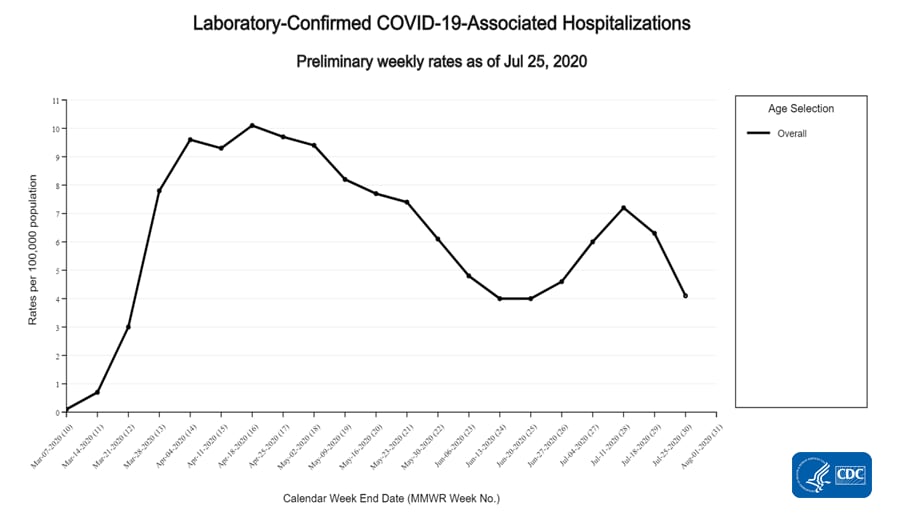
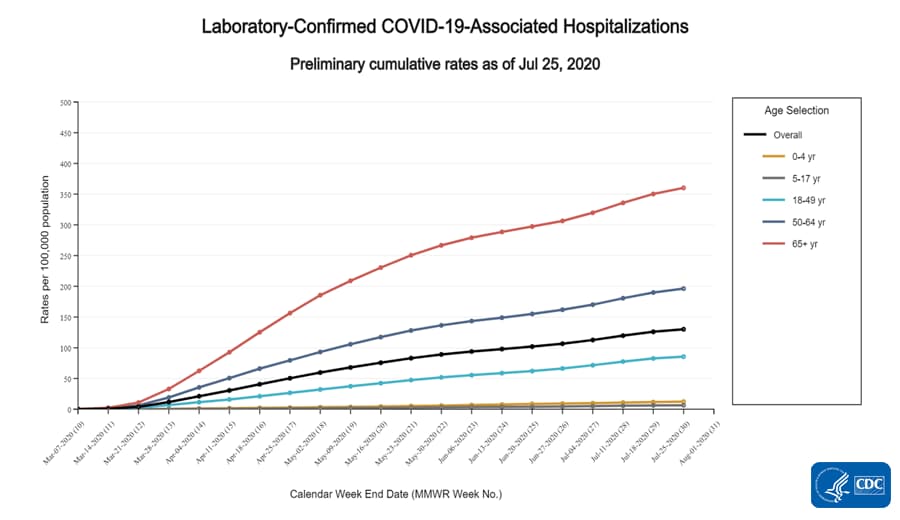
Know Your Risk: Hospitalizations have dropped in US since July 11; See hospitalization rates by age group

Below is entirely copied from the CDC website:
From June 20 (MMWR week 25) – July 11 (MMWR week 28), overall weekly hospitalization rates increased for three consecutive weeks. Data for the weeks ending July 18 and July 25 (MMWR weeks 29 and 30) currently show a decline; however, those data are likely to change as more data for admissions occurring during those weeks are received.
Laboratory-Confirmed COVID-19-Associated Hospitalizations

laboratory-confirmed COVID-19-associated hospitalizations

Wednesday, July 29, 2020

State of Ohio Bans Doctors from using Hydroychloroquine--Governor Reverses Order Next Day After Tremendous Attention Focused on It

On July 29, Ohio's Pharmacy Board announced that beginning the following day, neither chloroquine drug could be dispensed to prevent or treat Covid-19. Prescriptions would require a diagnosis and those for Covid would be rejected.  Not only that, if a prescriber happened to have obtained the drug and wished to provide it to to a patient, they were not allowed to do so.

The morning of July 30, after a massive overnight twitterfest about this action, FDA Commissioner Hahn was interviewed on the Today show and said that drug prescribing was a matter between a doctor and a patient. Shortly thereafter, Ohio's governor withdrew the regulation, citing Commissioner Hahn.

The Oregon Pharmacy Board had issued a similar rule on June 15, which was withdrawn on July 14, after it too drew public attention.

No physician association has supported these restrictions on physician prescribing; the system simply did an end run around them, pulling on the levers it had at its disposal.

The Politics of Hydroxychloroquine. The FDA has suspended a permit for its use. Let doctors decide/ WSJ


Below is a Wall Street Journal article I am reposting in full--Nass

https://www.wsj.com/articles/the-politics-of-hydroxychloroquine-11594831408

OPINION | COMMENTARY
The Politics of Hydroxychloroquine
Trump touted it, so Biden denounces it. The FDA has suspended a permit for its use. Let doctors decide.

By Allysia Finley
July 15, 2020 12:43 pm ET


Hubert Humphrey began his career as a pharmacist before going into politics. Today’s politicians sometimes seem to have the opposite aspiration. President Trump “pushes dangerous, disproven drugs,” Joe Biden declares in his “Plan to Beat Covid-19.” “Our country is now stuck with a massive stockpile of hydroxychloroquine, a drug Trump repeatedly hailed.”

Neither man has any expertise in pharmacology, and Mr. Trump did get out over his skis in promoting the malaria treatment, also known as HCQ, for the novel coronavirus. But since every Trump action prompts a reaction, his political and media opponents launched a campaign to discredit the drug. This politicized environment has produced dubious science and erratic policy.
The Food and Drug Administration issued an emergency use authorization on March 28, allowing hospitals to treat Covid-19 patients outside clinical trials using HCQ donated by manufacturers to the national stockpile. But on June 15 the agency rescinded the authorization. “In light of ongoing serious cardiac adverse events and other potential serious side effects,” the FDA announced, “the known and potential benefits of . . . hydroxychloroquine no longer outweigh the known and potential risks for the authorized use.”
But the scientific basis for the revocation now appears faulty. Most studies didn’t adjust results for confounding variables such as disease severity, drug dosage or when patients
started treatment. Two new peer-reviewed studies find that HCQ can significantly reduce mortality in hospitalized patients. With hospital beds filling up across the American South and West and a limited supply of Gilead Sciences ’ antiviral remdesivir, the FDA should reinstate its emergency-use authorization for HCQ.
HCQ has been safely used for decades to treat patients with lupus and rheumatoid arthritis, both inflammatory autoimmune conditions. The drug has also been found to interfere with the
novel coronavirus’s replication in vitro, and studies this spring from France, Brazil and China showed the drug might help moderately ill patients.

HCQ also has side effects. It can cause cardiac arrhythmias, a particular risk for severely ill Covid-19 patients because the virus can damage heart tissue. But the FDA emergency authorization warned about this and required doctors to monitor patients closely and report adverse side effects to the agency.

In late May, the Lancet published a large-scale international study that claimed hospitalized Covid-19 patients treated with HCQ were 30% more likely to die. But the medical journal retracted the study on June 4 after more than 120 scientists pointed out significant flaws in the data and methodology. The source of the raw data refused to share it with independent reviewers.

Nonetheless, the anti-Trump media claimed vindication later that day when the New England Journal of Medicine published a randomized trial that concluded HCQ didn’t prevent illness in people who had been exposed to the virus. The study’s raw data showed that people who took HCQ within two days of exposure were 38% less likely to develop symptoms. But a third of subjects in the trial took the drug four days after exposure, which obscured its benefits. Since the average viral incubation period is five days, starting the drug four days after exposure is unlikely to do much good.

On June 5, University of Oxford researchers reported that a midpoint review of their HCQ trial had found no clinical benefit. “This result should change medical practice worldwide,” Oxford epidemiologist Martin Landray declared in a press release. It usually pays to be skeptical of such sweeping claims based on a single study.

The Oxford team released a preprint study with more data from its trial on Wednesday. Patients were treated on average nine days after their symptom onset, which may have been too late to improve clinical outcomes. The trial’s protocol also called for dosages two to three times as high as those recommended by the FDA’s emergency use authorization.

In revoking the authorization 10 days later, the FDA cited the New England Journal and Oxford work as well as a British Medical Journal study from China that purportedly found no benefit from the drug. Yet an April draft of the last study concluded that HCQ accelerated “the alleviation of clinical symptoms, possibly through anti-inflammatory properties” and “might prevent disease progression, particularly in patients at higher risk.”

The draft also noted that after adjusting for the confounding effects of other antivirals used to treat patients, “the efficacy of HCQ on the alleviation of symptoms was more evident.” This analysis of HCQ’s benefits was scrubbed from the published version because some editors and reviewers quibbled that it wasn’t called for in the trial protocol.

The first of the new studies showing benefits from HCQ appeared in the Journal of General Internal Medicine on June 30. It found patients treated with the drug at New York’s Mount Sinai Health System hospitals were 47% less likely to die after adjusting for confounding variables such as underlying health conditions and disease severity. Notably, Mount Sinai’s treatment protocol called for lower dosages than in the Oxford trial, and patients on average were treated within one day of hospitalization.

The second, published July 1 in the International Journal of Infectious Diseases, found that patients treated with HCQ at Henry Ford Health System hospitals in Detroit were 50% to 66% less likely to die after adjusting for confounding variables including other treatments. Nearly all patients began treatment within two days of admission, received dosages that hewed closely to FDA guidelines, and were continuously monitored for cardiac arrhythmias.

“Our patient population received aggressive early medical intervention, and were less prone to development of myocarditis, and cardiac inflammation commonly seen in later stages of COVID-19 disease,” the Henry Ford doctors noted.

This shouldn’t be surprising. An FDA safety review published July 1 reported only five adverse side effects from HCQ through the emergency use authorization among tens of millions of doses that were distributed to hospitals. This suggests that the drug isn’t harmful to the vast majority of patients who are treated according to FDA guidelines.

With hundreds of Covid-infected Americans still dying each day, the agency should let physicians decide whether to treat patients with HCQ based on their experience and scientific evidence. Leave politics out of it.

Ms. Finley is a member of the Journal’s editorial board.

Saturday, July 25, 2020

Deaths in the entire United States "involving Covid" equal the number of deaths in NYC at its peak/ CDC

Deaths in the US have been FLAT or DECREASING over the last five weeks. Why aren't you hearing this? Because the media want to instill panic so they talk about rising cases (many asymptomatic, based on often inaccurate lab tests).  We are not having "3 New Yorks" as Dr. Birx claimed.  The fact is that the entire US is now having as many deaths per week as New York City had during its peak in early April.  
Got that?  The entire US equals ONE New York.  See CDC data below. 

Updated Aug 4, 2020

Friday, July 24, 2020

"The Key to Defeating COVID-19 Already Exists. We Need to Start Using It"/ Newsweek/ Harvey Risch, MD, PhD, Yale professor of epidemiology

The following is the text of Professor Harvey Risch's opinion piece in yesterday's issue of Newsweek.
As professor of epidemiology at Yale School of Public Health, I have authored over 300 peer-reviewed publications and currently hold senior positions on the editorial boards of several leading journals. I am usually accustomed to advocating for positions within the mainstream of medicine, so have been flummoxed to find that, in the midst of a crisis, I am fighting for a treatment that the data fully support but which, for reasons having nothing to do with a correct understanding of the science, has been pushed to the sidelines. As a result, tens of thousands of patients with COVID-19 are dying unnecessarily. Fortunately, the situation can be reversed easily and quickly.
I am referring, of course, to the medication hydroxychloroquine. When this inexpensive oral medication is given very early in the course of illness, before the virus has had time to multiply beyond control, it has shown to be highly effective, especially when given in combination with the antibiotics azithromycin or doxycycline and the nutritional supplement zinc.
On May 27, I published an article in the American Journal of Epidemiology (AJE) entitled, "Early Outpatient Treatment of Symptomatic, High-Risk COVID-19 Patients that Should be Ramped-Up Immediately as Key to the Pandemic Crisis." That article, published in the world's leading epidemiology journal, analyzed five studies, demonstrating clear-cut and significant benefits to treated patients, plus other very large studies that showed the medication safety.
Physicians who have been using these medications in the face of widespread skepticism have been truly heroic. They have done what the science shows is best for their patients, often at great personal risk. I myself know of two doctors who have saved the lives of hundreds of patients with these medications, but are now fighting state medical boards to save their licenses and reputations. The cases against them are completely without scientific merit.Since publication of my May 27 article, seven more studies have demonstrated similar benefit. In a lengthy follow-up letter, also published by AJE, I discuss these seven studies and renew my call for the immediate early use of hydroxychloroquine in high-risk patients. These seven studies include: an additional 400 high-risk patients treated by Dr. Vladimir Zelenko, with zero deaths; four studies totaling almost 500 high-risk patients treated in nursing homes and clinics across the U.S., with no deaths; a controlled trial of more than 700 high-risk patients in Brazil, with significantly reduced risk of hospitalization and two deaths among 334 patients treated with hydroxychloroquine; and another study of 398 matched patients in France, also with significantly reduced hospitalization risk. Since my letter was published, even more doctors have reported to me their completely successful use.
My original article in the AJE is available free online, and I encourage readers—especially physicians, nurses, physician assistants and associates, and respiratory therapists—to search the title and read it. My follow-up letter is linked there to the original paper.
Beyond these studies of individual patients, we have seen what happens in large populations when these drugs are used. These have been "natural experiments." In the northern Brazil state of Pará, COVID-19 deaths were increasing exponentially. On April 6, the public hospital network purchased 75,000 doses of azithromycin and 90,000 doses of hydroxychloroquine. Over the next few weeks, authorities began distributing these medications to infected individuals. Even though new cases continued to occur, on May 22 the death rate started to plummet and is now about one-eighth what it was at the peak.
A reverse natural experiment happened in Switzerland. On May 27, the Swiss national government banned outpatient use of hydroxychloroquine for COVID-19. Around June 10, COVID-19 deaths increased four-fold and remained elevated. On June 11, the Swiss government revoked the ban, and on June 23 the death rate reverted to what it had been beforehand. People who die from COVID-19 live about three to five weeks from the start of symptoms, which makes the evidence of a causal relation in these experiments strong. Both episodes suggest that a combination of hydroxychloroquine and its companion medications reduces mortality and should be immediately adopted as the new standard of care in high-risk patients.

Why has hydroxychloroquine been disregarded?
First, as all know, the medication has become highly politicized. For many, it is viewed as a marker of political identity, on both sides of the political spectrum. Nobody needs me to remind them that this is not how medicine should proceed. We must judge this medication strictly on the science. When doctors graduate from medical school, they formally promise to make the health and life of the patient their first consideration, without biases of race, religion, nationality, social standing—or political affiliation. Lives must come first.
Second, the drug has not been used properly in many studies. Hydroxychloroquine has shown major success when used early in high-risk people but, as one would expect for an antiviral, much less success when used late in the disease course. Even so, it has demonstrated significant benefit in large hospital studies in Michigan and New York City when started within the first 24 to 48 hours after admission.
In fact, as inexpensive, oral and widely available medications, and a nutritional supplement, the combination of hydroxychloroquine, azithromycin or doxycycline, and zinc are well-suited for early treatment in the outpatient setting. The combination should be prescribed in high-risk patients immediately upon clinical suspicion of COVID-19 disease, without waiting for results of testing. Delays in waiting before starting the medications can reduce their efficacy.
Third, concerns have been raised by the FDA and others about risks of cardiac arrhythmia, especially when hydroxychloroquine is given in combination with azithromycin. The FDA based its comments on data in its FDA Adverse Event Reporting System. This reporting system captured up to a thousand cases of arrhythmias attributed to hydroxychloroquine use. In fact, the number is likely higher than that, since the reporting system, which requires physicians or patients to initiate contact with the FDA, appreciably undercounts drug side effects.
But what the FDA did not announce is that these adverse events were generated from tens of millions of patient uses of hydroxychloroquine for long periods of time, often for the chronic treatment of lupus or rheumatoid arthritis. Even if the true rates of arrhythmia are ten-fold higher than those reported, the harms would be minuscule compared to the mortality occurring right now in inadequately treated high-risk COVID-19 patients. This fact is proven by an Oxford University study of more than 320,000 older patients taking both hydroxychloroquine and azithromycin, who had arrhythmia excess death rates of less than 9/100,000 users, as I discuss in my May 27 paper cited above. A new paper in the American Journal of Medicine by established cardiologists around the world fully agrees with this.
In the future, I believe this misbegotten episode regarding hydroxychloroquine will be studied by sociologists of medicine as a classic example of how extra-scientific factors overrode clear-cut medical evidence. But for now, reality demands a clear, scientific eye on the evidence and where it points. For the sake of high-risk patients, for the sake of our parents and grandparents, for the sake of the unemployed, for our economy and for our polity, especially those disproportionally affected, we must start treating immediately.
Fauci says "far too many people will die" shortly after cancelling NIAID trial of hydroxychloroquine in early disease

Dr. Anthony Fauci, director of the National Institute of Allergy and Infectious Diseases, testifies on Capitol Hill on Wednesday, Sept. 23, 2020, in Washington.

Writing in the New England Journal
, Dr. Fauci and his deputy, Clifford Lane tell us that despite "appropriate treatment with Remdesivir and dexamethasone, far too many people with Covid-19 will die."  And if Fauci keeps preventing the use of cheap, available and effective treatments, he will be correct. See "The Key to Defeating COVID-19 Already Exists. We Need to Start Using It" in yesterday's Newsweek, by Harvey Risch, MD, PhD and Professor of Epidemiology at Yale, who does not want "far too many people" to die unnecessarily.

1.  The Fauci article implies that so many people dying is partly the fault of observational studies and anecdotal evidence... whereas large prospective clinical trials can provide the answers we need. The authors list a variety of new drugs (all would be expensive) that hold promise for Covid and need to be tested. Fauci took the same approach to HIV treatment, preventing access to known effective drugs for years.  He has not had much luck finding an HIV vaccine, despite spending a king's ransom in taxpayer dollars looking for one. Yet he promises to produce a Covid vaccine at warp speed.  Who is he kidding?

2.  While congratulating the Recovery trial for its results, which allegedly prove that hydroxychloroquine does not work for Covid-19, the authors emphasize the importance of ethically conducted research, never mentioning the overdosing that characterized Recovery's hydroxychloroquine arm, and no doubt contributed to the 396 deaths in that arm. 

3.  Nor do the authors mention that even the Recovery trial's principal investigators only claim that their trial showed hydroxychloroquine did not work in hospitalized patients. Its benefit in early Covid-19 disease, and its value as a preventive for Covid-19 have yet to be proven in western clinical trials.  India says its 3 clinical trials showed the drug worked, and it is now recommended prophylactically for all medical practitioners and first responders in India who may be exposed.

4.  So why did Capos Fauci and Lane halt the long-promised NIAID trial of hydroxychloroquine in outpatients with early Covid-19 disease after enrolling only 20 subjects, a mere 1% of the 2,000 intended, according to the trial's registration materials on Clinicaltrials.gov?  Were they afraid that given the intense scrutiny this subject is now receiving, they would be unable to 'fix' the results of their very own prospective, randomized, controlled clinical trial?  Frightened it would reveal more evidence that hydroxychloroquine actually works well against SARS-CoV-2?

Excerpts from Fauci/Lane's NEJM opinion piece, with my comments in parentheses:

In the RECOVERY trial, the benefit of the glucocorticoid dexamethasone for patients with Covid-19 who were receiving mechanical ventilation at the time of randomization was clearly shown. A 28-day mortality of 29.3% was reported for patients in the dexamethasone group as compared with 41.4% in the usual care (i.e., nothing curative used--Nass) group. In contrast, no benefit for dexamethasone was seen in patients not requiring oxygen at the time of randomization, with 28-day mortality of 17.8% and 14.0% for the dexamethasone group and the usual care group, respectively. For the heterogeneous group of patients receiving oxygen without invasive mechanical ventilation, mortality was 23.3% in the dexamethasone group and 26.2% in the usual care group.

(The MATH+ protocol recommended steroids for late Covid-19 patients back in April.  The patients treated with this protocol received other drugs as well, and reportedly have had much lower mortality rates, but so far the results have not been published.  Mortality rates in the Recovery trial are among the highest reported in the world.--Nass)

These findings, while limited to patients with Covid-19, provides clarity to an area of therapeutic controversy and probably will result in many lives saved. (sic) The use of dexamethasone already has been endorsed by several treatment-guideline panels, including that convened by the U.S. National Institutes of Health. 

(This is the guidelines group put together by coauthor Clifford Lane, who has financial COIs with Gilead, and who placed 15 others with Gilead connections on the guidelines committee, which included himself.--Nass)

The key to the success of the RECOVERY trial has been its pace of enrollment. The ability to rapidly enroll thousands of patients into the trial no doubt was facilitated by the National Health Service in the United Kingdom and the fact that the trial was available to essentially the entire patient population of the country. 

(While the authors crow about the "availability" to patients of being a subject in the Recovery clinical trial, I would posit that being in the trial led to less individualized treatment, use of fewer therapeutic agents, and higher mortality rates.--Nass) 

As noted by the authors, 15% of all the patients who were hospitalized with Covid-19 in the United Kingdom were enrolled in the trial. 
Despite the decreases in death and complications that are likely to result from appropriate treatment of patients with remdesivir and dexamethasone, far too many people with Covid-19 will die.
Scientifically robust and ethically sound clinical research remains the quickest and most efficient pathway to effective treatment and prevention strategies for patients with Covid-19. It is our responsibility in the global medical research community to rapidly design, implement, and complete studies of the most promising therapeutic agents and vaccines against this disease. These agents include monoclonal antibodies, more selective immunosuppressive agents, and vaccines built on platforms ranging from nucleic acids to proteins to recombinant viruses. 

(But if Fauci is to get the opportunity to trial those novel, expensive drugs and vaccines, some of which have yet to be invented, he would need to keep the pandemic going. Which is certainly not ethically sound, nor is it quick and efficient.--Nass)


Thursday, July 23, 2020

Masking Lack of Evidence/ Oxford's Center for Evidence-Based Medicine

Curious about the scientific evidence regarding masking?  It turns out, according to two Oxford professors of Evidence-Based Medicine who reviewed the world literature on this subject, that no reliable scientific evidence supports the use of masks.  No reliable evidence says they don't work, either.  The "science" does not help us understand their pros and cons.  

So why demand them?  Perhaps because the authorities have to DO something?   Anthrax vaccine was required for soldiers, apparently because it immunized commanders against the accusation that they did not do 'everything possible' to protect their troops.  Mask requirements perhaps immunize authorities in the same way.

You can look at the evidence on masks a the Center for Evidence-Based Medicine website.  Or you can listen to an amazing, illuminating discussion by the two professors on masks, lockdowns, data, and disastrous decisions that were made regarding the pandemic.  I cannot recommend it enough.