Showing posts sorted by date for query Emergent BioSolutions. Sort by relevance Show all posts

Saturday, August 20, 2022

Monkeypox virus: some truth about the virus and the horribly false solution

Monkeypox is a real virus that spreads due to skin contact, almost exclusively. If you don’t want to call it a virus, that is okay with me. It is a contagious something that spreads person to person or rarely between animals and humans. If you are not in really closely contact with someone while they are harboring a replicating virus, you won’t get it. Okay, sheets and towels and [smallpox] blankets might spread it, based on experience with smallpox.

The CDC wants to reinvent itself so we can all trust it again. This would require it to produce guidance that is helpful, not harmful, and to be truthful—which it has been unable to do so far, and I don’t think it knows how.

But I can remind the CDC how to make itself useful. Remember the AIDS epidemic, Tony and Rochelle? Aren’t you both supposed to be among America’s top experts on AIDS? That’s your specialty, right?

When NYC faced an HIV epidemic, it closed the bathhouses. It didn’t raise the status of its equity office, Rochelle. Simple, but it made a difference.

Monkeypox is a mild disease but the “pocks” are a great annoyance, because we hate seeing and dealing with them. In some areas, like the mouth and private parts, their downstream effects can be rather painful. The pocks may result in scarring.

Let’s face it: we don’t like dealing with pocks, especially the majority of us who always want to look good. And so the media have taken our distaste and projected it back to us, making the illness appear a lot worse than it actually is. Most cases have only had a few pocks.

The disease (open pocks) lasts from 1-4 weeks. The viral syndrome (fever, malaise) only lasts a few days. CDC said to its ACIP Advisory Committee on June 24 that only symptomatic care is generally needed, and I think that is correct: drink fluids, rest. I don’t think they necessarily want the rest of the population to know that.

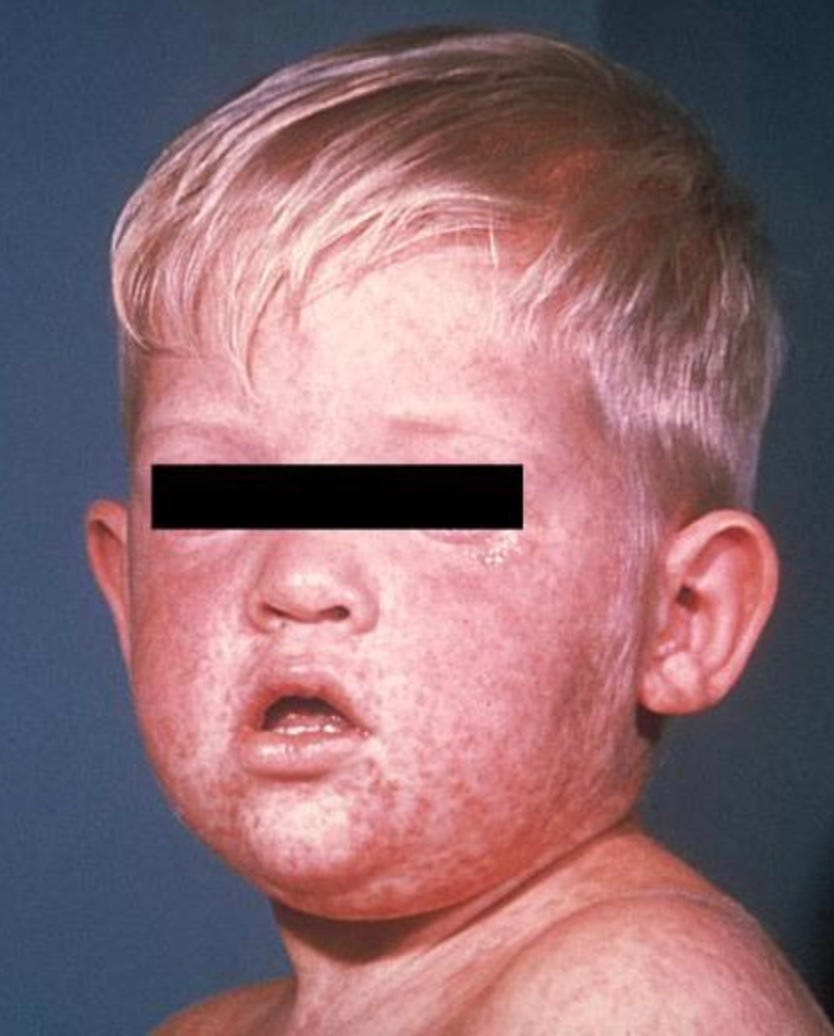
I think my case of measles around age 7 was probably worse—I had the things in my mouth and all over my body and eating and drinking was painful and I felt miserable. Here is what my measles looked like:
I am not sure how long people remain contagious with monkeypox; our public health officials have not informed us yet. From UptoDate:

until the 2022 outbreak, transmission outside of a household and sustained human-to-human spread had been rare….Viral shedding and period of infectiousness — A person is considered infectious from the onset of clinical manifestations until all skin lesions have scabbed over and re-epithelialization has occurred.

A report of seven cases in the United Kingdom between 2018 and 2021 demonstrated polymerase chain reaction (PCR) positivity in blood and upper respiratory tract samples for at least three weeks in three of the patients. However, it is not clear what this means with respect to infectivity, and the correlation of PCR and culture positivity was not described in the report. Thus, PCR testing of throat or blood samples is generally not done for clinical decision making, and the duration of isolation is determined by clinical evaluation.

Which means, treat the lesions like we treat shingles, cause we don’t really know the duration of contagiousness. If they told us you stop being infectious after a few days or a week, it would seem milder, and the powers that be don’t seem to want that.

Instead the PTB and media are really milking it. For example, writing in depth articles about this serious threat to the nation. Like this one from the WaPo, which is desperately helping the USG to stay on top of the narrative, after I and perhaps others spilled the beans about how much vaccine the USG actually owns. (16 million doses, they say, but it could be more, despending how much has been trashed.) My guess is none has been destroyed and we probably have 30-40 million full doses, some of which may have expired. Sitting frozen in Denmark, hidden from view. Excerpts from the in depth article of August 17 are below, with commentary:

Chaplin [CEO of the Jynneos manufacturer] threatened to cancel all future vaccine orders from the United States, throwing into doubt the administration’s entire monkeypox strategy.

“People are begging for monkeypox vaccines, and we’ve just pissed off the one manufacturer,” said one official who spoke on the condition of anonymity because they were not authorized to comment.

Juice up the story by creating a fake conflict. Make sure it hints of future shortages. CYA by making it anonymous. BTW, this WaPo article includes 3 videos of three gay men showing off their lesions. Because the Yuck! factor is critical to sell the vaccines.

a plodding bureaucracy left hundreds of thousands of gay men facing the threat of an agonizing illness

Nobody has died after 10,000 US cases identified, so it better at least be agonizing. Occasionally.

Demetre Daskalakis, a senior official at the Centers for Disease Control and Prevention, was working from home on HIV prevention projects over the May 14 weekend when CDC colleagues summoned him to an urgent call as cases of unusual lesions had begun to appear in Britain.

Daskalakis quickly brushed up on the symptoms and origins of monkeypox.

“I did the yeoman’s work of getting my infectious-disease biology textbook out and just reviewing stuff about monkeypox to be ready,” Daskalakis said.

Are you impressed? Senior CDC official reads a few paragraphs in a textbook to bone up on monkeypox. What about reading the original literature, bonehead, so you actually might know something, given your responsibility for the entire country’s response?

I have to tell you, I was at a discussion of anthrax about 20-25 years ago with scientists from Fort Detrick and CDC scientists (CDC made the decisions about handling the anthrax letters response). David Ashford and Art Friedlander were there. The CDC people were ignorant about anthrax then; they never had bothered to read the primary literature. That’s why CDC let people keep working in the AMI building in Florida for several days after anthrax was discovered, and minimized the risk to postal workers.

Some things never change.

At the time, the national emergency stockpile held 2,400 doses of Bavarian Nordic’s Jynneos, the only vaccine approved by the Food and Drug Administration for monkeypox. While the United States had purchased millions more potential doses, they sat in Bavarian Nordic’s factory in Denmark, either as finished doses in freezers or as raw materials, waiting to be turned into vaccines.

The U.S. stockpile also had hundreds of millions of shots of an older vaccine approved for the related smallpox virus, ACAM2000, although health officials were wary of using that vaccine — given the increased risk of side effects and even inadvertent illnesses — and considered it a fallback.

But the Jynneos doses in the stockpile were losing shelf life because its freezers were capable of storing the doses only at negative 20 degrees Celsius, while Bavarian Nordic’s freezers in Denmark kept doses stored at negative 50 degrees Celsius.

Before, the media and CDC said the ACAM-2000 stockpile was “at least 100 million.” After I pointed out we bought 300 million doses back in the early 2000s and plenty more since, the story got updated to hundreds of millions. The ACAM-2000 production company is now under the ownership of the anthrax vaccine manufacturer, Emergent BioSolutions. Which means there will be no quality control on vaccine production. This company had to throw away nearly 400 million COVID vaccine doses due to contamination. The taxpayer’s loss. Congress said so

Committees’ Report on Emergent BioSolutions Uncovers Extensive Vaccine Manufacturing Failures, Deliberate Efforts to Hide Deficiencies.  May 10, 2022

Okay, so the US had already spent around $1.6 billion on the Jynneos vaccine, intended mainly for smallpox, before monkeypox showed up in May. The company had been producing doses for the USG since 2013 or a bit earlier. But the WaPo, the USG mouthpiece, is hinting to us that the government was too cheap to buy the necessary freezers to store it, and that is the excuse why they have been sitting in Denmark? AYFKM?

No, they weren’t kidding.

Shipping the doses would create additional challenges in keeping the vaccines as cold as possible for their 4,000-mile voyage to the United States.

“Every time we move doses from their freezer to the [stockpile] … we lose two years of shelf life,” said Dawn O’Connell, head of the Administration for Strategic Preparedness and Response, which oversees the national stockpile. “Every time we convert doses from [raw materials] to a vial, we lose seven years of shelf life.”

Wait, what? Nearly the entire stockpile of tens of millions of doses has been produced in the past 9 years, and Assistant Secretary of HHS O’Connell just talked about them losing 9 years of shelf life when they get shipped and bottled. Sounds like they must be starting with more than 9 years of shelf life at minus 50 C. Which suggests virtually none of the stockpile expired, after earlier claims that 20 million doses had expired.

Didn’t the USG know this before spending $1.6 Billion to have them manufactured and stored in bulk in Denmark?

Wasn’t the purpose to buy this huge stockpile of vaccine in case of a smallpox emergency? Don’t you need to get it over here pronto when that happens? Like yesterday? Who is blowing smoke by implying there was no plan to rush this stuff from Denmark into arms in days or at most a few weeks, had smallpox occurred?

Early on, every monkeypox test required physicians to first get permission from a city or state epidemiologist, often an hours-long process that required multiple phone calls or emails — before the sample was sent to a public health laboratory, which could take days to release results.

Just like at the start of COVID, CDC controlled all US monkeypox testing. [I don’t know why they did this, but this is one way to control the number of reported cases. And maybe to let it spread more?] Only CDC had the test, and it wasn’t until around July 1 that CDC shipped tests to public health labs and commercial labs and allowed them to do testing as well.

The restrictions created a chokehold: Only about a dozen tests per day were being performed nationwide in early June, at a time when officials believed hundreds or thousands of daily tests were needed to detect infection clusters and head off an outbreak.

Sound familiar?

And communicating the risks of monkeypox to the public was proving to be a challenge, with officials struggling to warn the gay men who were disproportionately contracting the virus, often through sex with multiple partners, while not stigmatizing them.

This stigmatizing BS is a bad joke. Public health officials have been doing contact tracing for syphilis, for example, forever. No one ever said it would stigmatize the polyamorous, or sex workers. All the data are supposed to be strictly confidential. It’s what you do to save lives and prevent fetal malformations. Warn those at risk, dammit. Don’t stigmatize them. Inform them. Keep it confidential. You already have the syphilis protocols and know how to do this. Stop playing coy. Couldn’t CDC come up with a better excuse for not doing its job?

The job today: explain the nation’s plan to split vaccine doses in fifths and administer them with a new injection method, transforming about 441,000 doses of Jynneos into more than 2 million potential shots. The plan was finalized by the FDA over the pharmaceutical company’s safety concerns and after the company backed away from its CEO’s threat to cancel future orders.

So we are ‘unable’ to quickly get the Denmark 16 plus millions of doses shipped and bottled for use. The vaccine is fully licensed and legally could very well have liability attached to it if injuries occur (and plenty will-I previously wrote about very high numbers of recipients in the clinical trials with elevated cardiac enzymes and worsening HIV status). Hello Rochelle and Tony, was this deliberate? Instead of worrying about stigmatizing, are you warning HIV positive people that the vaccine is known to cause higher HIV virus titers and lower CD4 counts?

And then there is this: the USG is ‘able’ to get the already bottled doses sucked out of vials, diluted and totally rebottled as diluted product, never having undergone testing of the process, whether it works, whether the dose makes sense. The administration announced it will be doing that, which is not simple.

But they can’t just defrost and bottle the bulk vaccine? Seems to me it is a lot more complicated to remove, dilute and rebottle than to simply bottle what we already own. Especially since we own plenty. Buy the freezers, ship the stuff over, and have US companies bottle it. That is, if we really need it and this whole thing is not a clown show.

The diluted product got an EUA on August 9, which removes essentially all liability. How convenient. Maybe that is why the USG is diluting it? Or will they just bottle the old vaccine, call it diluted, and still get the liability waiver?

BTW, the intradermal injection method is the exact same method used when doing a TB test. Not hard to learn or to do.

So many gay men across the country still struggling to get vaccinated. A second dose needed 28 days after the first shot. At least 14 days after the second dose for full protection.

Full protection? STAT, as I previously noted, recently carried an Op-Ed by 2 former top officials at FDA on the monkeypox vaccines. They revealed that the Jynneos vaccine does not prevent transmission! It supposedly reduces severity of the disease. Except it is mild to begin with.

Where have we heard that before? Go get vaccinated, risk myocarditis or a worsening of HIV, wait 42 days for “full protection” from a diluted dose (or not) that has never been tested in humans—and then find out you can still catch and spread monkeypox.

Fool me once, shame on you. Fool me twice…

UPDATE Aug 20:

Breakthrough monkeypox cases emerge

Preliminary reports on monkeypox vaccinations suggest the vaccine is not 100 percent effective, and some breakthrough cases are occurring, the World Health Organization said during an Aug. 17 media briefing. 

In some cases, breakthrough infections are occurring in people vaccinated after a monkeypox exposure, which is intended to reduce disease severity. The breakthrough cases should not come as a surprise, as the WHO was not expecting 100 percent efficacy, according to Dr. Rosamund Lewis, the organization's technical lead for monkeypox. [Is it a surprise to the gay men lining up for hours for a shot at the shot?—Nass]

"We have known from the beginning that this vaccine would not be a silver bullet, that it would not meet all the expectations that are being put on it, and that we don't have firm efficacy data or effectiveness data in this context," she said.

Dr. Lewis cited a limited study from the 1980s, which showed that smallpox vaccines used at the time were about 85 percent effective against monkeypox. [It used a different vaccine, believed to be much more effective than Jynneos, however.—Nass]

She said it's unclear what the current vaccine's overall efficacy will be, but still stressed the importance of vaccination to protect those at high risk.

Saturday, August 13, 2022

When the biodefense experts at Johns Hopkins warn you off ACAM-2000 vaccine for monkeypox, you know it is a really BAD vaccine

When the Johns Hopkins brain trust that lives off the fear of pandemics and biowarfare publishes an Op-Ed calling a TIME-OUT for the use of ACAM-2000 for monkeypox, you know this is a very bad, terrible vaccine. They are scared it will be the coup de grace that ends the vaccine enterprise as we know it.  And they are scared it could end their cozy sinecure as biodefense experts as well, after the COVID disaster brought about by experts. 

All the facts are not correct in the article below, though I cannot imagine why these biowarfare experts would make such obvious mistakes.  Maybe because CDC has also been very cagey about how much of these vaccines we have, and CDC butters JHU's bread.

The USG bought 300 million doses of ACAM2000 after 9/11, and more since.  The WaPo did an investigation in 2021 and revealed that once the anthrax vaccine manufacturer, Emergent BioSolutions bought the vaccine from Sanofi, the Assistant Secretary for Preparedness and Emergency Response, Robert Kadlec, ordered double the number of doses, and more than doubled the per-dose price.  And now the USG is looking for an excuse to offload some of this dangerous product.

After Robert Kadlec was confirmed as President Trump’s top official for public health preparedness in 2017, he began pressing to increase government stocks of a smallpox vaccine. His office ultimately made a deal to buy up to $2.8 billion of the vaccine from a company that once paid Kadlec as a consultant, a connection he did not disclose on a Senate questionnaire when he was nominated.

Under the agreement struck last year with Emergent BioSolutions, Kadlec’s office at the Department of Health and Human Services is paying more than double the price per dose it had previously paid for the drug. Because Emergent is the only licensed maker of the vaccine, Kadlec’s office arrived at the price through negotiations with the company rather than through bidding.

The Johns Hopkins authors are also cagey about the supposed shortage of Jynneos vaccine, the only smallpox vaccine that is also licensed for monkeypox.  As I have previously explained, the US government owns 16 million doses, sitting frozen in bulk storage in Denmark, purchased for a potential smallpox epidemic. Many more doses than this (20 million more?) were purchased since 2003 and have expired...but the USG has used expired vaccine before in an emergency.  If this monkeypox outbreak was a smallpox outbreak, how long do you think it would take before those doses got defrosted and bottled?  

The USG also expects delivery in 2022 and 2023 of 7 million more doses.

The supposed shortage is a scam.  And it now appears the scam is intended not only to turn a licensed vaccine (Jynneos) into a diluted EUA product, but also to push out some of the ACAM-2000 vaccine, which in my opinion is fit for only one thing:  incineration and license revocation.

https://www.statnews.com/2022/08/11/acam2000-full-fda-review-before-widespread-use-against-monkeypox/

 FIRST OPINION

As the United States grapples with monkeypox, which has been declared a public health emergency, one of the key strategies that will be used to control its spread is vaccinating high-risk individuals.

Demand for monkeypox vaccine far exceeds the supply.

When the outbreak began, the U.S. Strategic National Stockpile held a small supply of Jynneos, a vaccine licensed for monkeypox. The federal Administration for Strategic Preparedness and Response has allocated more than 1 million doses of Jynneos to state and local jurisdictions, yet full coverage of those at highest risk would require an estimated 3.2 million doses. Bavarian Nordic, the company that makes Jynneos, isn’t expected to be able to manufacture additional doses in the near term.

As the Washington Post has reported, the shortfall has increased external pressure on the Biden administration to turn to another vaccine, ACAM2000, to close the gap.

The Food and Drug Administration licensed ACAM2000 in 2007 to immunize people at high risk of smallpox infection. There is moderate evidence the vaccine will also work against monkeypox, which is closely related to smallpox.

More than 100 million doses of ACAM2000 were added to the Strategic National Stockpile in the years after the Sept. 11 and anthrax attacks as a hedge against the return of smallpox. Unlike Jynneos, which is not capable of replicating in the human body, ACAM2000 contains live, replication-competent vaccinia virus. Vaccinia is a pox family virus related to smallpox that cannot cause smallpox and leads to milder disease.

If the vaccination site is not cared for properly for the two to six weeks it takes to heal, the vaccinia virus can spread to other parts of the body, including the eyes and genitals.

It is not just the vaccine recipient who is at risk after ACAM2000 inoculation. Household members and others who come into close contact with the recipient are also at risk of developing vaccinia infection. This has special relevance to the current outbreak.

Gay, bisexual, and other men who have sex with men are currently at highest risk of monkeypox infection. They are also disproportionately affected by HIV, which can compromise the immune system if not properly treated. Although it seems unlikely that people living with HIV would be offered ACAM2000 because of the risk of adverse events, vaccinia transmission from a vaccinated person to someone with a compromised immune system is a serious risk. Other risks of ACAM2000 include myocarditis (inflammation of the heart muscle) or pericarditis (inflammation of the sac surrounding the heart), which occur in about 1 in every 175 recipients. Generalized or widespread vaccinia infection can also occur. Although the heart conditions and vaccinia infection are uncommon, they are potentially deadly.

These risks make sense in the context of smallpox, which is more transmissible and more deadly than monkeypox. ACAM2000 is highly effective in preventing smallpox infection and, if smallpox were to reemerge, the protection would far outweigh the risks of ACAM2000 vaccination. For monkeypox, though, the balance of risks and benefits is less favorable.

If demand for vaccines to fight monkeypox grows beyond the supply of Jynneos, officials may begin to turn to ACAM2000. The recent decision to stretch the supply of Jynneos by allowing the use of lower doses may decrease pressure to use ACAM2000 in the near term, but if the epidemic continues to grow, calls for ACAM2000 use may intensify.

Health departments can now order this vaccine from the Strategic National Stockpile to use in the monkeypox response through an existing Expanded Access Investigational New Drug application, and at least one jurisdiction has already requested this product for potential use against monkeypox.

Although swift and decisive action is imperative to contain the current outbreak, the risks of ACAM2000 require a more deliberative approach. Before making the vaccine more widely available, the FDA should review the available evidence on its safety and effectiveness for preventing monkeypox and present those findings to the Vaccine and Related Biological Products Advisory Committee (VRBPAC). If the FDA and VRBPAC experts recommend the use of ACAM2000, the CDC’s Advisory Committee on Immunization Practices (ACIP) should meet to consider its appropriate use.

Evaluation by these two committees is the standard process for licensing vaccines and recommending them for use in clinical practice. Both committees are staffed by independent experts and the proceedings are open for public viewing and comment. Although it is not required in this instance, leveraging those resources would lend transparency and credibility to a difficult and complex decision.

The monkeypox epidemic is a serious and fast-moving crisis that shows no signs of coming under control. Public health officials should consider all options for protecting people at risk while ending domestic transmission. However, we believe that the risks of ACAM2000 are too serious in this setting to deploy the vaccine without the usual expert review governing the use of new vaccines. Existing review processes at VRBPAC and ACIP can be adapted to ensure that the risks and benefits of ACAM2000 are carefully considered before it is made available to members of the public.

Caitlin Rivers is a senior scholar and epidemiologist at the Johns Hopkins Center for Health Security, and served as the founding associate director of the Center for Forecasting and Outbreak Analytics at the Centers for Disease Control and Prevention. Tom Inglesby is an infectious disease physician, director of the Johns Hopkins Center for Health Security, and a former senior adviser to the Biden administration’s White House Covid-19 Response Team.

Sunday, June 12, 2022

How to watch the 4th Doctors for Covid Ethics Symposium

https://live.childrenshealthdefense.org/gold-standard-covid-science-in-practice-an-interdisciplinary-symposium-iv-freedom-is-the-cure

My first talk on anthrax, Emergent BioSolutions and the biodefense industry starts at 2 hrs 46 minutes 30 seconds. I am also on the panel after the talk.

My second talk starts at 5 hours 35 seconds.  It is about how to win against the Great Reset.  I emphasize the need to call out the many deceitful narratives that have been used to justify the Reset agenda, starting with Global Warming.  I hope you find it interesting.  I am on a panel after this talk also. 


Saturday, May 28, 2022

Here's what you should know about the latest Money Pox

Smallpox, money pox, and the vaccines they will try to frighten you into receiving


The WHO released a clever statement to introduce the idea of mass money pox vaccination to the public:

The World Health Organization (WHO) maintains that the growing monkeypox outbreak remains "containable," and that there's no immediate need for mass vaccination against the orthopoxvirus; since May 7, a total of 131 confirmed cases and 106 suspected cases have been reported in countries where it usually does not spread. (Reuters)

No immediate need. Let that statement ferment in your unconscious. It seems like a benign sentence, but implicit in it is the idea that soon there may well be a need to mass vaccinate the population against money pox, a disease that has never before spread due to casual contact.

I don’t think we even know the actual mortality rate for money pox. Has a westerner ever died from it?

Could this possibly be the same money pox that occurs in Africa? If so, how did it suddenly appear in so many countries at once? This fact alone—its novel, never-before-seen pattern of spread, should make us question whether it is a biowarfare agent being seeded deliberately. Probably not meant to kill us, maybe not even to harm us much. We can’t tell yet, based on the minimalist info coming out of our esteemed public health agencies. Perhaps it’s here just to nudge us to get another shot?

Below I give you the basics on smallpox, monkeypox and the newest vaccines coming to a clinic near you:

1.  If there is a money pox vaccine (and FDA has apparently approved one that the army helped develop) it has not been tested for efficacy, because there have not been enough human cases to do so.

  • Efficacy testing requires that you vaccinate people and then see how many cases of the disease occur in the vaccinated versus the placebo group. If you were able to vaccinate a million people but disease frequency was such that you couldn’t even get a handful of cases occuring, you cannot perform an efficacy test.

  • Instead, in order to get vaccines approved or authorized, antibody tests are done that are claimed to demonstrate the presence of immunity. But oft times (as in the COVID or anthrax vaccines) the antibody that is selected for this purpose may not be a reliable indicator of immunity…as admitted at the booster VRBPAC meeting by FDA staff and committee members.

2.  The smallpox vaccine is said to be 85% effective against monkeypox...but without many human monkeypox cases, that 85% number cannot possibly have been established.

3.   The smallpox vaccine causes a huge number of myocarditis cases and other known cardiac problems, making it almost certainly more dangerous than the risk of getting monkeypox. One in 220 recipients developed an obvious case of myocarditis in a US military study published in 2015, and one in 30 got a subclinical case.

Why would ANYONE take such a high risk of cardiac damage to avoid a miniscule risk of money pox? Only because they were misinformed.

4.  Smallpox vaccine, when used routinely in babies, was considered the most dangerous vaccine available. It led to the deaths of several people per million administrations.

5.  I received smallpox vaccines in 1951 and 1972 and believe I had insignificant reactions.  I expect I am fully immune to smallpox.  Tests done in people in 2003 published in NEJM suggested immunity was lifelong.

6.  The US smallpox vaccine last used routinely in civilians was the NY Department of Health version, and it was made similarly to the vaccine of the 1700s.  Infectious fluid from a related orthopox virus was scratched on the belly of a calf, and then when new vesicles developed the material was collected as the vaccine substrate, and could only be minimally purified.

7.  Ever wonder why the smallpox vaccine is scratched on while all others are injected? Because it was so dirty, contaminated with other animal viruses and unspecified materials, which might cause a serious infection if injected beyond the skin.

8.  It was hoped, 20-30 years ago, that a newer, cleaner, purified vaccine would avoid the many severe side effects. Two newer vaccines (ACAM 2000, purified from the NY DOH Dryvax vaccine and MVA) were purchased by the Clinton and Bush administrations for all Americans.  It turned out, unfortunately, that the cardiac side effects persisted.  They were due to the actual vaccine antigen, not to the 'junk.' The MVA (Modified Vaccinia Ankara) vaccine, which is less reactogenic but may be less effective than ACAM2000, had its US name changed to Jynneos, and has now been designated the official MoneyPox vaccine.

Regarding ACAM2000 and the licensing of Jynneos, FDA said in 2019 (on page 4):

ACAM2000 is contraindicated for use in individuals with severe immunodeficiency who are not expected to benefit from the vaccine… In 2003, a monkeypox
outbreak was confirmed in the U.S. This was the first time human monkeypox was
reported outside of the African continent.
(Not true but close—Nass) Currently, there is no approved treatment
or licensed vaccine for monkeypox, although the Advisory Committee on
Immunization Practices (ACIP) recommends that ACAM2000 be used for prevention of monkeypox in individuals at high risk of exposure (e.g., lab workers who handle monkeypox virus). Thus, there is an unmet need for a monkeypox vaccine.

9.  The US government initiated a smallpox vaccine program in 2003 that rapidly failed—people refused to be vaccinated due to high rates of heart attacks, heart failure and myocarditis. The National Academies of Science (NAS) wrote a series of about 8 critical “Letter Reports” on the government program, and the magazine Science wrote about the final report here. However, both the NAS and Science pulled their punches, failing the fully emphasize the dangers and to reflect the widespread skepticism about the program, which used a dangerous vaccine for a nonexistent or at least unproven threat.

10. According to Medpage, CDC says both Jynneos and ACAM2000 vaccines will be available to respond to the money pox event. Yet even CDC currently admits that the chance of myocarditis is huge (greater than one in 200 vaccine recipients) from the ACAM2000 vaccine, in an MMWR from November 2021:

Because ACAM2000 is replication-competent, there is a risk for serious adverse events (e.g., progressive vaccinia and eczema vaccinatum) with it; myopericarditis also occurs with ACAM2000 (estimated rate of 5.7 per 1,000 primary vaccinees based on clinical trial data), but the underlying mechanism is unknown (7,8).

11. From the same MMWR article , the CDC perhaps inadvertently admitted it had no reliable evidence for either safety or efficacy:

The effectiveness of JYNNEOS was inferred from the immunogenicity of JYNNEOS in clinical studies and from efficacy data from animal challenge studies. [But humans do not necessarily respond the same as lab animals—Nass] Occurrences of serious adverse events are expected to be minimal because JYNNEOS is a replication-deficient virus vaccine. However, because the mechanism for myopericarditis following receipt of ACAM2000 is thought to be an immune-mediated phenomenon, it is not known whether the antigen or antigens that precipitate autoantibodies [causing myocarditis or other adverse events—Nass] are present in JYNNEOS as well.

Later down, CDC admits again that it has no idea what it is doing with the Jynneos vaccine:

Because a correlate of protection has not been established and there is no known antibody titer level that will ensure protection, titer results should be interpreted with caution in such cases to avoid providing a false sense of security.

12. Despite knowing there is virtually no reliable information about how the vaccine might prevent monkeypox nor how safe it is, the Quebec government has begun rolling out the vaccine for the prevention of money pox. According to CBC:

…the smallpox vaccine — which hasn't been routinely offered in Canada for decades — will be offered to those at high risk of contracting the disease, such as those who have been in contact with confirmed cases.

[Quebec’s top health officer] Boileau said the province has access to hundreds of doses at the ready, but vaccination will only occur after a recommendation from public health. It will not be open to the general public.

13. Whitney Webb wrote last week about two of the Beltway Bandits poised to make yet another killing on money pox, Emergent BioSolutions and SIGA Technologies.

I will be adding to this post.

Monday, May 23, 2022

MULTIPLY UPDATED May 24: This post is a winding story of current events and their linkages to hidden agendas. I am in hospital with a fractured hip and it is hard to write. This is not polished but is full of important information

MY RECENT HISTORY

I arrived in Europe May 12 with hopes to attend several conferences, but only got to one.  The Scandinavian Freedom / Northern Light conference was wonderful. I made many new friends and encountered so many zoom friends whom I finally met in person.  Being in the same room with people you like or love is absolutely necessary for our species.  Don't allow any more imposed separations and dislocations, ever again.

The Northern Light conference, cosponsored by CHD Europe, was focused on how to stop the totalitarian changes being initiated under the guise of a pandemic response. The cost of online access to the event is minimal, €20 or $21 US.  The advertising was limited and few people knew it was happening outside Scandinavia. I suggest you view the events, which I am told will be available up to three months. I will post my PowerPoint presentation when I am able. 

After the conference, I spent two days with Dr. Heiko Schoning, who has written a book about the anthrax letters case, including many links between the anthrax letters and the Covid response. And he has identified dozens of guilty conspirators. His book will come out in English in late summer. It is currently available in German only.  We had lots to share.

And then I managed to trip, fall and break my hip. I had assumed that frequent walks, consumption of adequate vitamin D and my large frame would protect me but I was wrong.  

The WHO, WHA, IHR

A trip to Geneva had to be cancelled, where the world health assembly is holding its 75th meeting this week, from May 22-28. The WHA is the governing body of the world health organization, including about 194 countries. Over the past few months there have been warnings of strange doings at the WHO.

The US state department has long been an arm of the CIA and deep state. This story is twisty so pay attention.

The US state department drafted a dozen AMENDMENTS to an existing international health treaty that had been adopted in 2005, termed the International Health Regulations (IHR).  These US-drafted amendments would enable the WHO to assume control over the pandemic response to future pandemics on a worldwide basis. This is the US writing new rules that would give up its own sovereignty (and everyone else's) to the WHO, in the event of a pandemic or health emergency.  In February, very quietly, the proposed amendments were sent out to the WHA members for review, pending a vote this week.  A thoughtful discussion of them can be found here.

I can promise you the US never gives up even a speck of sovereignty; and that the purpose of the state department is to maintain and expand US power.  The only conclusion I could draw is that the US Government and/or the global elites were confident they could control the WHO, and since using the guise of a pandemic to grab power, influence and money had worked so well for them so far, they were expanding the program to the whole world via the WHO.  People like Astrid Stuckelberger, James Rogusky and others predicted this was the mechanism to achieve a worldwide coup.

Concurrent with the presentation of these amendments to the WHA, a new WHO treaty has been in the process of being negotiated since last fall, and was expected to accomplish essentially the same thing:  a means to transfer national control over health and medical care from individual nations to the WHO under the guise of a pandemic or medical emergency.

And a creative concept termed 'One Health' that has been a pet project of the WHO, CDC, etc., may be the mechanism to assert centralized control over agriculture, natural lands, mining and human activities that intersect with nature.  I explain this below.

The intent of diplomatic language is often deliberately obscure, and I have not been able to fully understand the implications of the proposed amendments. Furthermore, the new WHO treaty is still being written.

Then suddenly last week a few dozen cases of monekypox--MONKEYPOX!?--were in the news.  And exactly 2 days days before the scheduled WHA meeting on May 22, an emergency WHA meeting on Monkeypox was scheduled for May 20. 

Yesterday I learned that most of the proposed amendments have been scrapped, retaining the single amendment that speeds up the required process of ratification by nation states from 18 or 24 months down to six months, after which time nations may no longer remove themselves from the treaty’s provisions. 

Presumably this is a result of polling the WHA nation states and failing to get a 2/3 majority in favor of the rest of the package proposed by the US. Alternatively, it may mean that the other amendments were primarily a smokescreen, which were planned to be jettisoned as needed during "tough" negotiations. Or ?

Let's wait a bit longer to see what this provision, locking nations into the IHR at warp speed, is actually about.  We will know if it passes this week.

MONKEYPOX

The WHA was called into emergency session last Friday allegedly because of monkey pox. It is unclear what the emergency was and how the WHA could have ameliorated it.  Perhaps the idea was to brief everyone and achieve some agreement on the narrative to be issued. It is extremely suspicious that monkey pox, a rare condition with about 1% mortality that spreads minimally from person to person and results from contact with laboratory monkeys, showed up in at least one dozen countries simultaneously, on 4 continents. That does not happen due to raves, group sex or whatever prurient story the authorities have dreamed up.

What tests are being used to diagnose monkeypox?  Usually when a new disease appears, there are no accurate tests available.  The tests for the delta and earlier strains of COVID are not accurate for the Omicron strain:  at least one of two PCR probes no longer matched.

So who even had an accurate test for the new monkeypox variant?  Who was updating their monkeypox tests? Who needed such tests? 

Are they using PCR tests, in which the cycle threshold and other test parameters can be calibrated to detect high (many false positive) or low (many false negative) numbers of cases by adjusting test sensitivity?  Are the CDC, WHO and maybe the Charite hospital in Berlin the ones defining what constitutes a case and designing the tests?  We know from our COVID experience they can't be trusted to do either.  Medpage reveals that only CDC can confirm the diagnosis for US cases.

It was also reported that the monkeypox virus has been sequenced and showed 99.9% homology with the Israel 2018 strain, apparently confirming it is derived from a known lab variant.  Homology means it is 99.9% identical to this lab strain.  It is probably too early for this to be definite, however.

One obviously wonders if monkeypox' appearance relates to the WHO meetings, but I cannot give you any additional information at this time.  Are people really so naive to believe that monkeypox appeared by accident?  I was told about it by 2 young aides in the hospital, who clearly thought it was a psyop.  Surely the WHO diplomats are no less naive?  I would expect the African WHA members to be angered by this caper, as they are always being blamed for rare diseases, with negatively impacts on tourism and their economies.

And today the European CDC is warning monkeypox, like COVID, may never disappear.  A genital rash disease that becomes endemic (in other words, people will always be at risk from it) could really get under peoples' skin:

There is a risk that monkeypox could become endemic in Europe if the current outbreak isn’t brought under control and the virus spills back into susceptible animal species, the European Centre for Disease Prevention and Control said Monday as it issued a risk assessment of the unprecedented event.

Apparently monkeypox is intended to invoke the specter of HIV, which deeply affected Americans' behavior, and kept them apart by providing yet another reason not to have sex. 

There is another angle I totally forgot about with respect to monkeypox, but luckily the unsurpassable Whitney Webb has reminded me of the first law of investigative reporting:  Qui bono?  (Who benefits?)  She wrote (and please read her entire piece):

Regardless of how the monkeypox situation plays out, two companies are already cashing in. As concern over monkeypox has risen, so too have the shares of Emergent Biosolutions and SIGA Technologies. Both companies essentially have monopolies in the US market, and other markets as well, on smallpox vaccines and treatments. Their main smallpox-focused products are, conveniently, also used to protect against or treat monkeypox as well. As a result, the shares of Emergent Biosolutions climbed 12% on Thursday...
Emergent has usually managed a spectacular recovery whenever things have gone sour for them (a frequent occurrence that repeated itself 2 weeks ago when the NY Times revealed the scope of its disastrous manufacturing of COVID vaccines, and the consequent loss of 400 million doses worth up to 10 billion dollars).  The White House had covered this up.  Emergent was always a generous friend to politicians and others with influence.  Its CEO died a month ago at 64, and I thought that might take the wind out of its lobbying sails, but apparently I was wrong again.

Emergent had purchased the smallpox vaccine production plant from the US's previous producer in 2017, when Emergent's (and the CIA's?) guy Robert Kadlec became the Assistant Secretary of Health and Human Services for Preparedness and Emergency Response, known inside the Beltway as the ASPR.

He gave loads of contracts for smallpox vaccines to his friends at Emergent (twice the volume and twice the per-dose price as before), and then the lack of PPE when COVID came was blamed on these purchases, as the funds came from the same pot (about $1 billion/year to replenish the National Strategic Stockpile) which coincidentally Kadlec is supposed to have designed, along with designing the post of ASPR, when he was a Congressional aide a couple of decades ago.

Nicole Lurie was the ASPR under Obama, when she approved the no-bid contract for $433 Million-$2.8 Billion for a smallpox drug purchased from SIGA Technologies. No one knew if it worked.  SIGA's primary owner was generous political donor Ronald Perelman.

Congress balked at the purchase, which was halted...for about 16 months... and then it quietly was concluded

THE LANCET's role and Jeffrey Sachs

There has been more strange recent news.  Jeffrey Sachs is a Nobel prize-winning economist who had signed on as the director of the (self-anointed) Lancet COVID Commission.  Peter Daszak was appointed the leader of the most important of the Commission's dozen task forces, which was both designed to a) investigate the virus origins and to b) promote the One Health solution to pandemics.

Here is the link to the Lancet Commission/Daszac Task Force's initial report.  Note that all members are Daszak cronies and Stanley Perlman (a biodefense scientist from U. Iowa with an MD) has been linked to both questions about COVID's origin and the ACE-2 humanized mice in which it was no doubt generated.  Perlman was recently placed as a temporary member of the FDA's VRBPAC vaccine advisory committee, to rubber stamp COVID vaccine approvals and authorizations.

But after Daszak became a hot potato, Daszak left the Commission and his task force went into hibernation.

Remember that the Lancet published a mostly Peter Daszak-ghostwritten "Correspondence" in February 2020 that was designed to tar anyone who questioned the origins of the virus as a conspiracy theorist who would damage the west's ability to work with China to solve the pandemic.  It was obviously (to me) carefully worded propaganda and the article and its theme were pushed out to a massive audience.

Then on May 22, 2020 the Lancet published an entirely fabricated article claiming that using HCQ or CQ for COVID led to about 35% increased death rates.  I read it that day and blogged about it--it was so obviously phony, but then why hadn't the Lancet, the world's most-read medical journal, noticed?  Lancet held tight, but after hundreds of complaints about obvious fabrications, finally the paper was retracted after 13 days.  This was sufficient time to allow the damage to HCQ's reputation to have been done.  The original story had gotten worldwide attention, while the unmasking of the fraud went unnoticed.  And efforts were made (for instance by the WaPO but by others too) to make it seem the original paper still stood.  How such a clearly fabricated paper, based on the world' largest patient database that no one had ever heard of, had gotten into print in the world's foremost medical journal, in record time, has never been explained.

Then the Lancet Commission published a massive 23 page report in the Lancet on September 14, 2020 that seemed to me to be establishing Sachs' group as credible, and buttressing a variety of what we have come to know as globalist narratives and agendas.

Professor Sachs therefore appeared to be a globalist flunky. And when I looked at the publications from his massive Commission, I learned the majority had to do with pushing COVID vaccinations.

So I was surprised to learn a few days ago that Professor Sachs himself had supposedly gone rogue, and published a paper in the PNAS, noting how the US  government and institutions were hiding information about COVID's origins.  He and his coauthor wrote:

EHA [Daszak], UNC [Ralph Baric], NIH [Fauci], USAID [one of many funders of EHA and Wuhan], and other research partners have failed to disclose their activities to the US scientific community and the US public, instead declaring that they were not involved in any experiments that could have resulted in the emergence of SARS-CoV-2...

a US-based investigation need not wait—there is much to learn from the US institutions that were extensively involved in research that may have contributed to, or documented the emergence of, the SARS-CoV-2 virus. Only an independent and transparent investigation, perhaps as a bipartisan Congressional inquiry, will reveal the information that is needed to enable a thorough scientific process of scrutiny and evaluation.
Most likely, Sachs is trying to reassert his leadership regarding the original Lancet Commission investigation that was halted due to the notoriety of Daszak and EcoHealth Alliance. He may also be seeking funding for such investigation, and/or trying to repair his tattered reputation.  Will he team up with Robert Zelikow to whitewash any future origins investigation? Stay tuned.

ONE HEALTH

I used to think One Health was just a silly concept designed to justify more funding for the EcoHealth Alliance type of voracious grant hunter.  Certainly EcoHealth was a major proponent of the concept.  But well-fed One Health adherents suddenly appeared, tucked into many corners of the world (here is one South American example), including CDC, the World Bank and WHO.  I had been wrong.

One Health is an idea plucked out of thin air:  that in order to manage the health of the planet, we can't think about people in isolation.  We have to consider them in the context of animals too, both livestock and wild animals, and also "ecosystems".  This might have been a good idea if a significant chunk of human disease came from animals, but in fact, zoonoses (infections spread to humans from animals) are pretty rare. Think anthrax. Rabies. Monkeypox.  And while flu viruses do reassort in animals, the risk of influenza has been factitiously ginned up by public health agencies for decades.  I now suspect the reason was to acclimate the public to the idea of yearly booster shots.

It seems that One Health is an integral part of the globalist plan (proposing false health narratives with the aim of usurping authority), so I thought I had better give you a brief summary of this concept as I know it.  Here is what WHO has to say about a free online course in the subject:

You will be introduced to new concepts from the field of epidemiology, social anthropology, disease ecology, veterinary sciences, global health policy, and others, as well as approaches such as One Health, Eco-Health and Planetary Health. The course also outlines innovative tools and frameworks used to study and tackle some of these global health challenges in light of the Sustainable Development Goals.

Section 8 of the course, which was produced jointly by WHO and the UN Convention on Biological Diversity (CBD), is dedicated to the interlinkages between human health and climate change, ecosystem management and biodiversity, and the materials can be freely accessed after enrollment...

Latin American proponents of One Health described it thusly.  I can't find the meat on this bone.

The One Health concept was developed to encourage sustainable collaborative partnerships and to promote optimal health for people, animals, plants, the environment, and the whole planet. The dissemination of scientific discoveries and policies, by working directly with diverse communities, has been one of the main goals for Global One Health. The One Health concept has also been referred or related to as “One Medicine, One Medicine-One Health, One World-One Health, EcoHealth,” and Planetary Health,” depending on each fundamental view and approach.

I have previously collected and presented on this blog, and in talks, evidence that both Peter Daszak and Tony Fauci have been spuriously and repeatedly linking the COVID pandemic to climate change, to the encroachment of humans into wildlife areas, and to other normal and necessary human activities, such as agriculture, mining, and road-building. Here is one example. The activity of humans has been positioned to take the fall for this and future pandemics...and has been claimed to be the cause of earlier pandemics... a claim that foremost of the outbreaks mentioned was evidence-free.  While I have many examples, ones that stand out are a Fauci-Morens article published in Cell, and an extremely long piece by the Lancet COVID Commission published in the Lancet on September 14, 2020.

While I have seen no evidence that One Health is a useful concept, nor that human activity (except via labs and monkey/bat hunting) have caused recent outbreaks, a huge network has been created to push this concept and to have it become an essential underpinning of epidemic understanding, international policies and legislation. 

From CDC's One Health website:

One Health is a collaborative, multisectoral, and transdisciplinary approach—working at the local, regional, national, and global levels—with the goal of achieving optimal health outcomes recognizing the interconnection between people, animals, plants, and their shared environment.

CDC’s One Health Office leads the agency’s One Health efforts in the United States and abroad.

One Health has been positioned for a stealth takeover of how humans think about and interact with nature, with food production, and many other things. It was invented at CDC in 2009 and promoted internationally first in 2012, at Davos of course.

The Global Risk Forum sponsors the first One Health Summit

February 19-22, 2012, the first One Health Summit was held in Davos, Switzerland. The Summit presented the One Health concept as a way to manage health threats, focusing on food safety and security. The conference ended by approving the “Davos One Health Action Plan,” which pinpointed ways to improve public health through multi-sectoral and multi-stakeholder cooperation.

I recall seeing examples of the Obama administration sending tentacles into what it referred to as the 'global health security' arena, but I had no idea where it was going, then. Below is what CDC says about One Health.  It has always had trouble actually justifying the concept, but given significant fluff and funding that seems irrelevant. The One Health-ers are generally light on specifics.  From CDC:

The One Health Office works to promote the One Health approach and increase awareness of CDC’s role in One Health in the United States and around the world.  One Health Office experts work closely with human, animal (domestic and wildlife), and environmental health partners in the United States, in other countries, and with international organizations to build strong partnerships; develops tools and trainings to advance One Health; and leverages CDC’s expertise to assist partners in strengthening One Health efforts.

The CDC One Health Office serves as the head of the World Organisation for Animal Health (OIE) Collaborating Centerexternal icon for Emerging and Reemerging Zoonotic Diseases. One Health Office staff also serve as agency liaisons to the Food and Agriculture Organization of the United Nationsexternal icon (FAO) and OIE.

One Health Focus Areas

  • Zoonotic and emerging infectious diseases
  • Pandemic preparedness and response
  • One Health emergencies at the human-animal-environment interface
  • One Health pan-respiratory disease surveillance
  • Global health security and capacity building
  • Strengthen One Health coordination in the United States
  • Strategic One Health partnerships
  • Prevent zoonoses shared between people and pets

Below is the Daszak Task Force summary plan for its One Health work:

3. Identifying One Health solutions to future
pandemic threats
.

All prior pandemics, and most known emerging
diseases have originated in non-human animals,

usually wildlife, and emerged due to environmental

and socioeconomic changes like land use change,

agricultural expansion, the wildlife trade, and

increased international travel.  [* This is simply a dangerous fantasy upon which One Health pins its hopes to transform society--Nass]

These drivers bring
people, our livestock, and wildlife into closer contact

across large areas of the planet, and are the factors

behind the emergence and spread of HIV/AIDS,

pandemic influenza, Ebola, SARS, Nipah virus, and

likely COVID-19.
[*This is another lie underpinning the One Health agenda.--Nass]

In particular, the identification of
the first large case cluster of COVID-19 at a seafood

and wildlife market mirrors the emergence of SARS

in the live animal markets of Guangdong in 2003,

but some data suggest that earlier cases occurred.

Likewise, the rapid environmental changes with

declines in biodiversity in rural China mirror those

across tropical and subtropical regions that have

led to spillover of a number of novel bat-origin

diseases. The COVID-19 pandemic has led to

occasional spillover into pet and zoo animals and

further involvement of farmed animals, with

large scale outbreaks and high transmissibility

of SARS-CoV-2 in mink farms in Europe and the

USA.  [
*Why were mink culled so dramatically when COVID could affect many animals but animal reservoirs were never a significant contributor to human disease?  Was the cull to gain publicity and support for the zoonosis/One Health pandemic theory?--Nass]

This virally-mediated connection among the
environment, animals and people is a One Health

problem that underpins pandemic risk.

In this taskforce, we will use our findings to identify

One Health approaches to controlling future

pandemics that will:


Identify potential synergistic effects and return-
on-investments of taking a multisectoral

approach to outbreak investigation and

pandemic prevention that includes human

health, animal health, and environmental health

aspects.
 

Identify key strategies, policies, organizations
and mechanisms to fund and deliver a

coordinated One Health approach to preventing

future pandemics at the national, regional, and

international level.

 
Recommend public information programs
focused on key messages to raise awareness

in the general population and build support

for relevant policies that can facilitate a

transformative change of behaviors and actions

 
Identify the sustainable development benefits
of One Health solutions to prevent pandemics.

And now a headline from the May 25, 2022 Guardian, a CIA-linked publication:

"Climate change is likely to exacerbate the rapid spread of viruses and pathogens as humans encroach on the natural world"

I hope I have given you enough information that you will be on the lookout when you hear the term One Health or hear about how it is human activity that causes pandemics, and therefore our activites must be curbed... presumably by Tedros and friends, the experts who brought you 2400 mg/24 hour hydroxychloroquine overdoses in nearly 1000 patients in order to sink the use of the drug for COVID.  And don't forget Tedros's work with his Tigray tribe's genocidal wars and the coverup of cholera epidemics when he was the Minister of Health and then of Foreign Affairs in Ethiopia. He has also been accused of seeking weapons for the Tigrays while serving as the WHO Director General.  

Is he the right person to lead global health?  The first WHO D-G who was not a physician?  He is about to be re-elected to his second 5 year term.