Monday, September 7, 2015

The Real Afghanistan Surge is in Heroin Production and Tripled Opium Cultivation since the US military arrived/ UN and US Government documents


Recently I worked in another Maine city and was astonished at the number of patients I encountered who were using heroin. I had never seen anything like it, during a lifetime practicing medicine. In New Hampshire, it was said, deaths from heroin now exceed deaths from car accidents. Massachusetts (population under 7 million) had 1,000 deaths related to (all) opioids in 2014, "the highest ever recorded. According to CDC, in the two years between 2010 and 2012, heroin overdose rates in the Northeast tripled.  

The US now has 600,000 heroin users, triple the amount of five years earlier, according to the Drug Enforcement Agency.  Or it may instead have between 800,000 and 2.6 million, according to RAND report estimates published by the White House in 2014.

I've heard stories on NPR about insufficient state funding of heroin treatment facilities. I've heard about plans to make the antidote Narcan (naloxone) available to drug users, for overdoses. (Since I wrote this piece, a nasal spray version of Narcan has been approved for narcotic overdoses by FDA, and the drug may now be purchased without a prescription.) Another popular angle I've seen repeated over and over (and one currently pushed by the US Drug Enforcement Agency and the White House Office on National Drug Control Policy) claims legal prescriptions for narcotics increased, then became harder to get, so users switched to heroin, which was also cheaper.

Marijuana used to be claimed the "entry" drug to heroin, but now prescription narcotics have assumed that role. How times change. 

The narrative that has been presented to us implies that massively increased heroin use has nothing to do with increased supply. (This violates the laws of arithmetic and economics, not to mention common sense.) In Europe, West Asia and Russia, everyone knows their rising numbers of addicts reflects a huge increase in available heroin.  But the media obscure that fact, here.

If increased prescriptions for controlled substances was the primary cause of the heroin epidemic, then Americans would also be using more cocaine.  The massive increase in ADHD drug prescriptions (presumed "entry" drugs for cocaine) should have caused a cocaine explosion.

While prescriptions for narcotics (hydrocodone and oxycodone) increased 4.5-fold between 1991 and 2007 in the US, prescriptions for ADHD stimulants rose even more, by 7-fold, according to National Institute on Drug Abuse testimony to Congress in 2008


Total number of prescriptions dispensed by US retail pharmacies  - shows trends increasing from 1991 to 2007, see caption

But in fact, the DOJ-DEA 2014 National Drug Threat Assessment Summary notes that cocaine availability "remains stable at historically low levels throughout most domestic markets along the East Coast."  A RAND Report noted, "From 2006 to 2010, the amount of cocaine consumed in the United States declined by about 50 percent — an unprecedented change over five years."  There has been a parallel decline in methamphetamine use.

So prescription drug users are switching to heroin, but not switching to cocaine.  Might this be because we have no large military-CIA presence currently in cocaine-trafficking areas, as we did during the 1980s Contra war in Nicaragua, when cocaine use was at high levels? (Coca plants are only grown in South America's Andes.) According to a 2010 UN document"Based on seizure figures, it appears that cocaine markets grew most dramatically during the 1980s, when the amounts seized increased by more than 40% per year".  (See this 1987 Senate hearing and this for evidence of CIA and State Dept. connivance with cocaine trafficking by the Contras.)

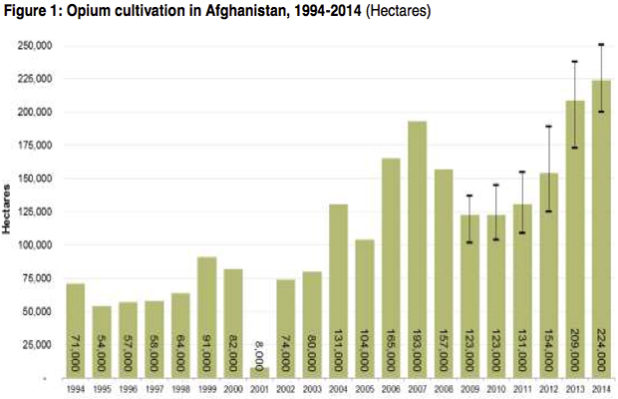
You can frame stories about the current heroin problem in many ways.  But the real heroin story isn't being discussed--which is that since the US military entered Afghanistan in 2001, its opium production doubled, per the UN Afghanistan Opium Survey 2014, page 34.  The area under opium cultivation in Afghanistan has tripled. And the resulting heroin appears to more easily make its way deep into our rural, as well as urban communities. CDC noted, "Between 2002 and 2013, the rate of heroin-related overdose deaths nearly quadrupled, and more than 8,200 people died in 2013." By 2014 there were 10,500 heroin overdose deaths, 6 times as many as in 2001.

The graph below is from the 2014 UN Opium Survey:


The world supply of opium increased 5-fold between 1980 and 2010according to the UN."Afghanistan account[s] for around 90% of global illicit opium production in recent years. By itself, Afghanistan provides 85% of the estimated global heroin and morphine supply, a near monopoly."(see pp 37-38).    
“The narcotics trade poisons the Afghan financial sector and undermines the Afghan state’s legitimacy by stoking corruption, sustaining criminal networks, and providing significant financial support to the Taliban and other insurgent groups,” John F. Sopko, the Special Inspector General for Afghanistan reconstruction, said in an October 2014 letter to the heads of the Departments of Defense, State and Justice, which have all played major roles in the failed drug intervention effort. “Despite spending over $7 billion to combat opium poppy cultivation and to develop the Afghan government’s counter-narcotics capacity, opium poppy cultivation levels in Afghanistan hit an all-time high in 2013."
Despite the (now) US $8.4 billion spent to defeat this trade, it just keeps growing.  The costs of US reconstruction efforts in Afghanistan total "$110 billion, after adjusting for inflation, [which] exceeds the value of the entire Marshall Plan effort to rebuild Western Europe after World War II" according to the Special Inspector General for Afghanistan Reconstruction, speaking in May 2015.

The Special Inspector General noted elsewhere that, "US reconstruction projects, particularly those devoted to “improved irrigation, roads, and agricultural assistance” were probably leading to the explosion in opium cultivation."

Only 1.2% of the acreage used for Afghan opium production (which is estimated at 224,000 hectares or 554,000 acres) was eradicated in 2014, according to the UN. Burma (now Myanmar) is the world's second largest producer of opium, according to the UN, currently growing only about 10% as much as Afghanistan. But Mexico has increased production and is #3.

According to the UN World Drug Report, in the 1990's Afghanistan supplied opium that was converted into half the world's heroin production.  According to University of Wisconsin Professor Alfred McCoy, the rapid 1980s rise in Afghani opium production came about through CIA efforts to create, arm and fund the mujahedeen using opium sales. (After defeating the Soviets in Afghanistan the mujahedeen morphed into Al Qaeda).  By 2010, Afghanistan supplied 90% of the world's total heroin.

But the DEAWhite House and other official US sources claim that US heroin derives almost entirely (96%) from Latin American-grown opium (based on seizures of shipments); the DEA in 2014 claimed that Latin America was the source for the vast majority of US heroin, with southwest Asia (i.e., Afghanistan) accounting for only 4% of US heroin in 2012. 

This is highly unlikely.  In 2008, the UN estimated that the US and Canada accounted for 13% of global heroin use.  Ninety-five percent of global heroin derives from Afghanistan, Burma, Thailand and Laos. Latin America (mainly Mexico, with a small amount from Colombia) does not produce enough to supply even half of US heroin, let alone 96%. In fact, the White House Office of National Drug Control Policy undercut its own claim when it noted Mexico had (only) 10,500 hectares under poppy cultivation in 2012 and Colombia 1,100 hectares in 2009, while Afghanistan had 154,000 hectares in 2012 and 224,000 hectares in 2014 per UN estimates.

This DEA claim, based on heroin interdiction, suggests something entirely different: that heroin shipments coming by air from Afghanistan are at lower risk of being seized than heroin coming from Latin America. Might some be entering via official government channels, when so much materiel and so many people (soldiers, aid workers, diplomats and contractors) fly directly between the US and Afghanistan? [At the same time, some Afghan-origin heroin does enter the US by way of Mexico.]

Putting aside the issue of the provenance of the US heroin supply for the moment, surely we can look at heroin as we would any other global commodity.

Congruent with the 1980s mujahedeen fight against the Soviets [here is the bland UN phrasing] : "...the Soviet invasion in 1979, [which] triggered the mass production of opiates in Afghanistan"and then -- in a repeat performance -- congruent with the US presence in Afghanistan since 2001, Afghanistan rapidly expanded opium production, and the global supply of heroin increased concomitantly. The price dropped as a result. New buyers entered the market. And the US now has, at least, several hundred thousand new addicts.  Russia and the rest of Europe (with overland access to Afghanistan) have even more. The resulting social problems are hugely tragic and hugely costly for millions of families, and for our societies as a whole. 

If we start being honest about why there is a major heroin epidemic, maybe we can get serious about solving the problem with meaningful eradication and interdiction. Aerial spraying of crops with herbicides or similar methods has been prohibited in Afghanistan, but it works. In 2014, Britain's former Ambassador to Afghanistan (2010-2012) called for legalization and regulation of illicit drugs as one means of attacking the problem.  

Looking beyond the Mexican border for heroin, and inspecting all flights from southwest Asia, including military and CIA flights, could have a large impact on supply as well.

Serious measures are needed.  Total world production of opiates always gets consumed: historically, the market for opiates has been extremely elastic.  Land under poppy cultivation (in Afghanistan, Southeast Asia's Golden Triangle and Mexico) continues to increase. Without meaningful efforts to reduce opium production and entry of narcotics into the US, the epidemic of heroin addiction could become a considerably bigger problem than it is today.

UPDATE:  From the Sept 7 Wall Street Journal, we learn that a US "friendly fire" airstrike in southern Afghanistan on Sept 6 "hit a 30 member elite counternarcotics police unit as they were on a mission...


At least 11 died in "one of the deadliest friendly fire incidents in the country in recent years." Here is the Reuters story. The US denied the strike in Helmand province, but admitted to airstrikes in the adjacent province of Kandahar. According to the Guardian, "The US is the only member of the NATO coalition known to have carried out bombing raids in Afghanistan this year." The AP/WaPo on 9/8/15 reported that, "Brigadier General Shoffner [Deputy Chief of Staff for Communications in Afghanistan] said 'based on information we received [on 9/8], we feel it is prudent to investigate the airstrike our forces conducted in Kandahar.'"


The airstrike killed approximately as many people as died in counternarcotics efforts in all Afghanistan throughout 2014.


UPDATE:  Helmand is the major opium-producing province in Afghanistan; military efforts in Helmand are managed primarily by the UK.  In 2010, the magazine The Week accused UK soldiers of importing heroin back to Europe and Canada in military planes.

UPDATE:  I have marshalled considerably more evidence about the false narratives that been spread regarding the current heroin epidemic.  Their purpose is to misdirect us away from the true cause (massively increased heroin entering the US) and solutions (interdicting or destroying the Afghan opium crop).  

Since I wrote this piece, the US's top General in Afghanistan, John Campbell, told Congress we need a five year plan for US and NATO involvement in Afghanistan. What precisely are we doing there?  What does CIA do there? Why has the US military been prevented from stopping opium production in territories it controls?  Does an even worse Afghan heroin epidemic in Russia affect US strategic thinking?  What did Hillary Clinton know and do about rising Afghan heroin production during her time as Secretary of State?  Why aren't these questions being asked of our Presidential candidates?

Let me credit Professor Alfred McCoy's work, which provided me historical background: he is probably the world's foremost scholar on the subject of the global production and trade in illicit drugs.
 

Saturday, September 5, 2015

"One Less" country--Japan--swallows Merck's lies about its HPV vaccine; Japan establishes guidelines and special clinics to treat HPV vaccine-injured girls/ Medscape

Vaccine injuries are real.  They can be serious and often fail to respond to treatment. The most serious injuries are usually to the brain. Vaccine injuries may cause death. The US' federal vaccine injury compensation program has paid out $3.18 billion dollars in compensation for vaccine injuries since the program was established in 1988. 
Yet with the stoking of fears over measles and the claimed desperate need for vaccine mandates in 2015, these truths about vaccine injuries have been overlooked, or deliberately ignored by the media.
It is hard to believe, but there is lack of proof that HPV vaccines actually prevent cervical cancer.  That is why I have published an excerpt from FDA's initial Gardasil approval letter below.  Gardasil HPV vaccine was licensed under "fast-track" authority by FDA in 2006 with limited data and its manufacturer, Merck, was required by FDA to collect data through 2017 to determine whether Gardasil really does prevent cancer:
  1. You have committed to collaborate with the cancer registries in four countries in the Nordic Region ( Sweden, Norway, Iceland, and Denmark) to assess long-term outcomes following administration of GARDASI®. In this study, approximately 5,500 subjects enrolled in Protocol 015 (one half from the placebo group that will have been vaccinated shortly after approval) will be followed for a total of 14 years. Two major goals of this study are: 1) to assess the long-term effectiveness of GARDASIL® by evaluating biopsy specimens for presence of HPV 6/11/16/18-related incident breakthrough cases of CIN 2/3, AIS and cervical cancer, VIN 2/3 and vulvar cancer, and VaIN 2/3 and vaginal cancer; and 2) to assess whether administration of GARDASIL® will result in replacement of these diseases due to vaccine HPV types with diseases due to non-vaccine HPV types. This study is designed to accomplish these goals as discussed in the June 6, 2006, submission to your BLA. The final protocol for this study will be submitted by December 8, 2006. Patient accrual for this study was previously completed in the context of Protocol 015. This study will be completed by December 31, 2017, (14 years from initiation of the last patient enrolled in Protocol 015 in the four Nordic countries). The final study report will be submitted by December 31, 2018...--from FDA to Merck
Furthermore, the Gardasil label explicitly notes that recipients must still have regular PAP smears, precisely because it is not clear Gardasil prevents the development of cancer, while PAP smears enable early detection and treatment before a cervical lesion evolves into cancer:
"...Limitations of GARDASIL Use and Effectiveness:• GARDASIL does not eliminate the necessity for women to continue to undergo recommended cervical cancer screening..."
So the vaccine may work.  Or it may not.  But that has not stopped some states and countries from recommending or requiring this vaccine (intended for a sexually transmitted disease) for all children in junior high school.  Rhode Island just mandated HPV vaccine for all 7th grade students in July 2015. 

How safe are HPV vaccines? We lack reliable data, but there are many reports of serious injuries. 

Now Japan (after 358 vaccine injuries judged serious and 2,000 adverse event reports) has not only rescinded its recommendation that girls receive this vaccine, but has also established guidelines and special clinics for evaluating and treating illnesses caused by the Gardasil and Cervarix HPV vaccines.
From Medscape:
"Japan has put in place a scheme to manage symptoms, especially generalized chronic pain, that have arisen after human papillomavirus (HPV) vaccination given to adolescents to protect against cervical cancer.
Although there have been assurances on the safety of HPV vaccination from many official medical bodies since the vaccines were first introduced — Gardasil (Merck & Co.) in 2006 and Cervarix (GlaxoSmithKline) in 2009 — there have also been persistent reports of rare cases of adverse events. These include case reports in the medical literature of complex regional pain syndrome and postural orthostatic tachycardia syndrome, as previously reported by Medscape Medical News.
In July 2015, the European Medicines Agency announced that it was conducting a safety review of HPV vaccines, which was requested by Denmark, where reports of adverse events after HPV vaccination have been widely reported in the media.
Japan withdrew its recommendation for HPV vaccine in 2013, and has not reversed that decision because of concerns from the public about adverse events, which included long-term pain and numbness, as previously reported by Medscape Medical News.
Since then, various symptoms, especially generalized chronic pain after injection, have been reported.
Last month, guidelines for the evaluation and management of symptoms that begin after HPV vaccine injection were issued to healthcare professionals. The guidelines were edited and approved by the Japan Medical Association (JMA) and the Japanese Association of Medical Sciences (JAMS).
In addition, the Japanese Ministry of Health, Labor, and Welfare has issued a list of medical institutions where people can visit when they have symptoms after HPV injection; there is at least one in each prefecture. Healthcare workers at those selected institutions are educated by the JMA. However, this does not mean other institutions cannot accept those people with symptoms. The ministry has also issued information regarding HPV vaccine-related health problems and questions, with a telephone helpline..."

Wednesday, July 22, 2015

CDC Director Calls for another COMPREHENSIVE REVIEW of lab safety six months after the last one


UPDATE:   575 shipments, 192 total labs received live, incompletely irradiated Dugway anthrax.  Congressional hearing held 7/28/15.

(The subjects in my Cheer! below are among those mentioned by USAT on July 21, 2015--Nass)

The CDC Cheer 

When anthrax spores are flying through its halls, whaddaya do?

You know what to do:  It's a Comprehensive Review!

If the House is holding a hearing, whaddaya do, whaddaya do?

You know what to do:  It's a Comprehensive Review!

If USA Today is asking questions, whaddaya do?

You know what to do:  It's a Comprehensive Review!

When CDC hides Dugway's woes, whaddaya do, whaddaya do?

You know what to do:  It's a Comprehensive Review!

When 100 labs you regulate get cited, whaddaya do?

Do a Review!

Do a Review!

Do a Review!
.......................................................
Here is the last review of lab safety at CDC** also requested by the Director, dated January 13, 2015.  The ink is barely dry.  But since it was so much fun, why not do it again?


Posted: Jul 21, 2015 1:13 PM EDTUpdated: Jul 21, 2015 1:13 PM EDT
(USA TODAY) - The Centers for Disease Control and Prevention is launching a comprehensive review of how it regulates safety and security at bioterror labs in the wake of an ongoing USA TODAY Media Network investigation that has prompted congressional probes into the agency’s effectiveness.
CDC Director Tom Frieden ordered the review last week as USA TODAY prepared to report on newly obtained documents showing that the agency’s inspectors have allowed labs to keep experimenting with bioterror pathogens despite failing to meet key requirements on inspection after inspection, sometimes for years. The action also comes as the agency faces a hearing in the House next week.
“This review will be wide-ranging and includes a review of regulatory authority and the exercise of that authority so that we can identify potential modifications to the methods used to inspect labs,” the CDC said in a statement this week...
“We hope this latest review signals that the agency is finally taking this issue seriously," the bipartisan leaders of the subcommittee and full committee said in a statement late Tuesday about CDC's examination of its lab inspection program. "While we applaud CDC’s intent to investigate this matter, previous assessments have failed to meaningfully address the root causes of why these safety lapses keep happening..." 
And this story as reported by U Minnesota's CIDRAP
**   from the earlier review:  **  CDC lacks a culture of safety.  Just 6 months ago, an advisory committee to the CDC Director issued its recommendations to improve safety at CDC.  The report began with the following words: "Observation: Leadership commitment toward safety has been inconsistent and insufficient at multiple levels. Safety, including lab safety, is viewed by many as something separate from and outside the primary missions of public health and research.

The committee's final observation began: "We are very concerned that the CDC is on the way to losing credibility. The CDC must not see itself as "special." The internal controls and rules that the rest of the world works under also apply to CDC."  

Monday, July 20, 2015

21st Century Cures Act Dismantles Meaningful Federal Regulation of Drugs and Devices

The 21st Century Cures Act was passed (unanimously) out of Committee on July 7, 2015 and passed by the House on July 10, by a vote of 344 to 77.  

It could have been called the Stealth Act:  There was very little preceding discussion of this bill, despite its potentially huge effects on US healthcare.  TV's Katie Couric, having been affected by cancer, "wrote" a piece in the HuffPo about the bill's importance, published one day before the vote.  Forbes opined against the bill, discussing Jerry Avorn's piece in the NEJM.  That was about the extent of discussion in the media.


Jerry Avorn, a Harvard med school professor and drug industry critic, noted for example:

An underlying premise of the bill is the need to accelerate approval for new products, but this process is already quite efficient. A third of new drugs are currently approved on the basis of a single pivotal trial; the median size for all pivotal trials is just 760 patients. More than two thirds of new drugs are approved on the basis of studies lasting 6 months or less... 
More problematic proposals include encouraging the use of “shorter or smaller clinical trials” for devices and the request that the FDA develop criteria for relying on “evidence from clinical experience,” including “observational studies, registries, and therapeutic use” instead of randomized, controlled trials for approving new uses for existing drugs...
The bill would also encourage the FDA to rely more on biomarkers and other surrogate measures rather than actual clinical end points in assessing the efficacy of both drugs and devices. The FDA already uses surrogate end points in about half of new drug approvals...
Another section would allow device makers to pay a third-party organization to determine whether the manufacturer can be relied on to assess the safety and effectiveness of changes it makes to its devices, in place of submitting an application to the FDA. Thus certified by the external company, a device maker would be authorized to continue to assess its own products on an ongoing basis... 
The effects of this bill would force untested and unregulated drugs and medical devices on the public.  It would dismantle much of pharmaceutical regulatory science and practice in the US. 

This bill's provisions exemplify 'regulatory capture' on steroids.


This single bill--just one law approved by 82% of our federal House members-- would dismantle in one step patient protections that have been established over a century, established in response to medical disasters that killed thousands of Americans, and which are accepted worldwide.


Perhaps we should be grateful that the corruption in Washington has become so naked, and so bold.

How Not to Fix the F.D.A./ NYT explains that the Cure is Worse than the Disease: 21st Century Cures Act passes House

Another giveaway to health industries (and woe to patients) is embodied in the so-called 21st Century Cures Act.   It passed the House of Representatives this week before you knew it existed.

Usually industry's best friend, the NY Times surprisingly editorialized against this shameful bill today.  Here is what the Times wrote:

"A bill passed by the House and ostensibly designed to streamline the Food and Drug Administration is loaded with bad provisions and may not even be necessary. The Senate should either eliminate or rewrite the flawed provisions before passing its version of the legislation.
The bill would weaken the F.D.A.’s already flimsy regulation of medical devices, posing a threat to future patients who have devices implanted that cannot easily be removed if found defective. It would allow a drug to be tested on humans based on only limited evidence that it is safe and effective.
It would expedite the use of new antibiotics by providing financial incentives to hospitals to use them — benefiting manufacturers but also driving up costs and encouraging overuse, potentially breeding resistant superbugs. It would extend exclusive rights for manufacturers to market high-priced, brand-name drugs if they gain a new approval to treat a rare condition. And it would open a wide loophole in rules requiring companies to report payments they make to doctors to get them to prescribe their drugs.
While the bill has some valuable provisions — like making experimental drugs available more quickly to patients who have illnesses that cannot be cured, and promoting the development of treatments based on an individual’s genetic data — those elements don’t justify the bill’s passage in its current form.
The F.D.A. was once routinely vilified for sluggishness and timidity, but with the help of industry funding it has made enormous progress in speeding up its reviews and approvals. The agency testified in April that its drug review times are consistently faster than those of all other advanced regulatory agencies around the world, with the result that American patients receive new drugs sooner than people elsewhere. In 2014, the F.D.A. approved the largest number of new drugs in almost 20 years and also reduced the review times for devices.
A big reason the bill won bipartisan support in the House is that it would increase funding for the National Institutes of Health by $8.75 billion over the next five years, ending a decade of mostly stagnant funding. And any improved Senate version should certainly include new money.
Special interest money also played a role, with many of the top supporters of the legislation having received hundreds of thousands of dollars in contributions from the pharmaceutical industry and the medical device industry last year, according to the nonpartisan Center for Responsive Politics.
The Senate will take up a similar bill later this year. When it does, it needs to cure its many flaws, while also providing sufficient funds to the F.D.A. to meet its ever-increasing workload.

U.S. Health Department *Retracts* Statement on Emergent (anthrax vaccine mfr) getting an Ebola contract/ Bloomberg and WaPo


Jul 16, 2015 4:40 pm ET

USG gives contract to anthrax vaccine manufacturer to develop an Ebola drug/ Bloomberg


Recall that the current anthrax vaccine manufacturer has never developed and brought to market a single drug.  The anthrax vaccine was developed by the US army.  The company has purchased other companies, such as Cangene, that do have a few marketable products, though the market for them is small. It is also marketing a nerve gas decontamination skin cream developed by the Canadian government.

But Emergent BioSolutions, the anthrax vaccine manufacturer, has understandably high hopes and great expectations.  The company has been repeatedly smiled upon by the US government, earning billions of dollars for anthrax vaccine itself, for testing the vaccine, for developing new vaccines, for storing the vaccine, and for promises.  Now the company is making another promise, to produce drugs for Ebola.  You see, the company gets paid for the promise to try and develop such a product. The company will earn considerably more if a product actually emerges and is manufactured.  But so far, all the other products EBS was paid to develop have not panned out. 

But why should that get in the way of giving them yet another contract to develop a desperately needed product?  From Bloomberg:
Emergent BioSolutions, the maker of an anthrax vaccine, will develop and produce an experimental Ebola drug, the US government said Wednesday.   
The Department of Health and Human Services reached a two-year agreement that gives Emergent $19.7 million to develop the drug for clinical trials and, if successful, to scale up production for potential stockpiling, the agency said in an e-mailed statement.
Emergent, based in Gaithersburg, Maryland, makes the only anthrax vaccine cleared by the U.S. Food and Drug Administration, according to the product website. It also makes treatments for patients with blood disorder hemophilia B and hepatitis B.
The Ebola drug to be developed is similar to ZMapp, the experimental drug made by San Diego-based Mapp Biopharmaceutical Inc., which was given to American health worker Kent Brantly and other Ebola victims last year until supplies ran out.
ZMapp is a cocktail of three antibodies grown in modified tobacco plants. Emergent’s version uses the same antibodies but will grow them in mammalian cells, which can produce higher quantities of the molecules.
HHS and Emergent didn’t immediately respond to requests for comment on when human trials may begin.

Monday, July 6, 2015

XKeyscore/ The Intercept

What information exactly does the NSA (and its Five Eyes partners) have access to?  At least as much as noted below.  How long is the information stored?  Maybe that is a function of the storage available, which we know is increasing rapidly. From The Intercept:
One of the National Security Agency’s most powerful tools of mass surveillance makes tracking someone’s Internet usage as easy as entering an email address, and provides no built-in technology to prevent abuse. Today, The Intercept is publishing 48 top-secret and other classified documents about XKEYSCORE dated up to 2013, which shed new light on the breadth, depth and functionality of this critical spy system — one of the largest releases yet of documents provided by NSA whistleblower Edward Snowden...
These newly published documents demonstrate that collected communications not only include emails, chats and web-browsing traffic, but also pictures, documents, voice calls, webcam photos, web searches, advertising analytics traffic, social media traffic, botnet traffic, logged keystrokes, computer network exploitation (CNE) targeting, intercepted username and password pairs, file uploads to online services, Skype sessions and more...

Sunday, July 5, 2015

CDC Says USA Today Will Have to Wait 3 Years to Learn About CDC's Pathogen Mishandling

From USA Today
The Centers for Disease Control and Prevention — which has publicly disclosed three serious laboratory accidents during the past year involving Ebola, anthrax and a deadly strain of bird flu — says it will take three more years before it will release copies of all incident reports for the agency's labs in Atlanta and Fort Collins, Colo...The agency initially said it anticipated responding by June 4...
But OTOH, CDC has time to redact a 14 page report, if USAT will accept that instead! 
On May 26, the CDC sent a letter to USA TODAY offering to provide a redacted version of the 14-page lab-incident summary report instead of the full incident reports the newspaper asked for in January. "If you are amenable to accepting these records as a final response please let us know and we will send these records to you immediately... "
For full coverage of USA TODAY's investigation of safety at high-containment laboratories, go to: biolabs.usatoday.com

Public Health Gone Awry: Birth Dose of Hepatitis B Vaccine (IOM chimes in on lack of good vaccine data)


Hepatitis B is a serious disease.  It is highly prevalent in many countries in Asia (nearly 10% of Chinese carried the illness in 1992), but fortunately is of low prevalence in the US.  Per CDC, the overall reported US incidence rate for 2013 was 1.0 case per 100,000 population. After adjusting for under-ascertainment and under-reporting, an estimated 19,764 acute hepatitis B cases occurred in the US in 2013. 

Hepatitis B is due to a virus transmitted by sex, vertical transmission from mother to newborn, from blood products and iv drug abuse primarily. There is no casual transmission. The graphs below show that disease rates in all age groups were dropping even before hepatitis B vaccine was recommended for children with no risk factors, in late 1991.

Acute hepatitis B cases in children are now extraordinarily low: according to CDC, they have fallen "from 1.2 cases per 100,000 population in 1990 to 0.02 cases per 100,000 population in 2007," or one new, acute case per 5 million children per year.  (The same CDC report notes there were 87 perinatal cases reported from 22 states in 2007, a higher incidence. I am guessing that the perinatal cases were detected via maternal screening, while the prior estimate was derived from new clinical cases in older children.)

The reduction in disease incidence is fantastic. CDC's recommendation that all pregnant women be screened for hepatitis B in 1988, and that they and their newborns be treated, is likely the major reason for the decline in pediatric and young adult cases.

But CDC didn't stop there.  CDC made stepwise recommendations for hepatitis B vaccinations for all children (who were by age at lowest risk of hepatitis B) during the 1990s, and specified a dose at birth for all newborns in 2002, even though the risk to newborns with hepatitis B negative mothers was close to zero even then. (A well-publicized controversy in France over hepatitis B vaccine-induced multiple sclerosis in the mid 1990s had affected vaccination acceptance here.  The multiple sclerosis issue was never fully resolved, while the birth dose of hepatitis B vaccine may have contributed to greater vaccine uptake in the US, according to CDC.)

What do other countries with low prevalence of the disease do with respect to vaccinating newborns, a strategy that only helps those from Hepatitis B-infected families? Data on vaccine policy for all countries in Europe can be found on the ECDC website. 


Only 5 of europe's 31 countries recommend a dose of hepatitis B vaccine for newborns whose mothers are Hepatitis-B negative: Estonia, Lithuania, Poland, Portugal, and Romania.

Incidence* of acute hepatitis B, by age group and year --- United States, 1990--2007
* Per 100,000 population.


Incidence* of acute hepatitis B, by sex and year --- United States, 1990--2007
* Per 100,000 population.
 The bars indicate the rate per 100,000 (left y-axis) by sex; the line is the ratio (right y-axis) of the incidence rate among males compared with that among females.

But here's the thing:  

Public health decisions must balance risk and benefit to the entire population when determining policy.  In the case of vaccinations, it can be devilishly difficult to ascertain vaccine causality: the true rates, types and severity of adverse reactions remain questionable, since they may be delayed by weeks, months or even years following a vaccination. (Local reactions, rarely severe, such as redness, swelling, or tenderness at the injection site are easy to assign to a vaccine, while systemic reactions are not.)

When a disease is common in the population, in order to reduce its incidence via vaccinations, one can accept a certain degree of (estimated) adverse events due to vaccinations.  

When a disease is rare, but you are still vaccinating the same number of people, the number of  vaccine-induced adverse events does not drop--but your population benefit is reduced, since you are preventing fewer cases.  Given the reduced benefit, the adverse reactions may no longer be counterbalanced by the population benefit.  But have CDC's public health professionals reevaluated their hepatitis B vaccine policy in light of current disease rates? 

There is a big, big problem at the heart of vaccination policies: there simply are no reliable adverse reaction data.  In the specific case of hepatitis B vaccine, a newborn gets vaccinated on the first day of its life, and since the parents have no prior experience with that baby, it is especially difficult to identify a systemic adverse reaction to the initial dose of vaccine.

One "non-systematic" review reported:  "After reviewing the literature, we observed that complications seen after Hepatitis B vaccination are sudden infant death syndrome, multiple sclerosis, chronic fatigue syndrome, idiopathic thrombocytopenic purpura, vasculititis, optic neuritis, anaphylaxis, systemic lupus erythematosus, lichen planus and   neuro-muscular disorder."  Observed.  Not measured.  Who knows what it means?


The label for Glaxo's Engerix-B vaccine is vague regarding causality and severity of adverse events. A WHO information sheet on Hepatitis B adverse reactions is equally troubling, as the literature it cites is full of contradictions. Hand-waving by WHO to dismiss unwanted findings is unconvincing, when a vaccination policy appropriate for reducing hepatitis B transmission to newborns in low resource areas of the world (areas without assured screening during pregnancy) has been imposed in the US on our high resource, highly screened population of mothers and infants.

I know that what I am writing seems difficult to believe.  How could vaccines be licensed by FDA without good adverse event data?  But the fact is that when they are licensed, all the data FDA evaluates have been generated by the manufacturer.  Later, it is usually not beneficial to the manufacturer to actively seek evidence of harm.

The US government requests advice from the Institute of Medicine (founded in 1970 and part of the National Academy of Sciences, chartered by Congress in 1863) regarding issues of public health.

In 2012, an Institute of Medicine which had been asked to investigate the adverse event literature for Hepatitis B and other vaccines, issued this report

Adverse Effects of Vaccines: Evidence and Causality

Editors

Committee to Review Adverse Effects of Vaccines; Institute of Medicine; Stratton KFord ARusch EClayton EW, editors. Washington (DC): National Academies Press (US); 2012.
The report's conclusions state:
The committee acknowledges that some readers may have concerns about two aspects of the report. First, the committee does not make conclusions about how frequently vaccine adverse events occur. Secondly, the committee concluded, for most analyses, that the evidence is inadequate to accept or reject a causal relationship and some readers might interpret the committee's language in different and inaccurate ways. The committee offers concluding comments to address these two issues.
This report is not intended to answer the question “Are vaccines safe?”. The committee was not charged with answering that question. Other bodies make that determination and contribute to ongoing safety monitoring, including governmental agencies, care providers, and industry, as they determine the benefits and risks of marketing a product. At all levels, policy determining vaccine use requires a balancing of risks and benefits. As described in Chapter 1 and the Preface, that is outside the bounds of this committee's assignment. It should also be noted that where the committee has found evidence of a causal relationship, it does not make conclusions about the rate or incidence of these adverse effects.
Determining the rate of specific adverse events following immunization, in the general population or a subset thereof, is challenging. It would be possible, for example, to estimate a rate of the occurrence of a specific adverse effect in a vaccinated population or susceptible subgroup of interest. This could be done using a summary relative risk or absolute risk difference (e.g., estimated from a set of consistent reports reviewed by the committee) if there were large population-based studies of the occurrence of the adverse event in unvaccinated individuals (e.g., in the general population or susceptible subgroups of interest) who do not substantially differ from those vaccinated on any known, important confounders (e.g., age and exposure to other vaccinations or other agents or factors known to cause the adverse event). None of these preconditions is fully met for the adverse events reviewed in this report.
The committee also notes here that large epidemiologic studies that report no cases of the adverse event of interest in vaccinated study participants, if included in our analyses, raise particular concerns. If at least some cases of the adverse event occurred in a study's unvaccinated comparison population, an upper limit of the 95% confidence interval (CI) for the study's relative risk or absolute risk difference could be estimated, but one would be unable to rule out a possibly increased risk unless the vaccine was significantly protective against that particular adverse effect. Also, including such studies may have exacerbated problems with detection biases unless precautions were taken to ensure equal surveillance for the adverse event in the unvaccinated and vaccinated populations being compared...

So there it is.  In the absence of good data, it is hard to make good public health decisions--but they get made nonetheless, and the decision-making is population-based, independent of any individual's unique risk-benefit profile.

But for an individual, you can make an assessment that includes your risk factors for the disease, the vaccine efficacy (very good for Hepatitis B vaccine, although duration of protection is uncertain)
 and see how that balances with the (unknown) degree of risk from the vaccination.  If you are at more than infinitesimal risk for the disease, include a factor for the considerable health risks inherent in the disease, were you to develop it in the absence of vaccination. Caveat emptor.