Wednesday, August 12, 2020

Pediatric deaths: Covid (American Academy of Pediatrics data) and Influenza (CDC data and estimates, 2018-19)

According to the AAP, 86 American children have died from Covid-19 through July 30, 2020. (UPDATE Aug 16:  186 was a mistake)

According to the CDC in its latest year reporting on flu deaths, 

"During the 2018–2019 season, 136 deaths in children with laboratory–confirmed influenza virus infection were reported in the United States. However, influenza-associated pediatric deaths are likely under-reported as not all children whose death was related to an influenza virus infection may have been tested for influenza. By combining data on hospitalization rates, influenza testing practices, and the frequency of death in and out of the hospital from death certificates, we estimate that there were approximately 480  deaths associated with influenza in children during 2018–2019."

Sunday, August 9, 2020

Asymptomatic cases may be of great value in containing the pandemic


Summary of testing studies from around the world showing the share of people who tested positive for the coronavirus but had no symptoms

From the August 9, 2020 Washington Post:

So, when you start screening asymptomatic people who you think may have been exposed, you find lots of positives.  They are then called cases.  But they were not sick.  Did they spread the infection farther?  

If they did not spread it farther, then we can all stop worrying about asymptomatic spread, which is relatively rare in other viral infections.

These 'cases' add to the totals, but most importantly add to the immunes.  The asymptomatic cases won't catch it again during this pandemic, and they will also help to limit spread in their communities, by reducing the number of susceptible people. (I know the media claim there may be no immunity, but that is because researchers have not looked for T cell immunity, relying solely on antibody tests. Which is simply ignorant.)

Is anyone isolating virus from asymptomatic cases (especially from those prisons and Tyson food factories) to learn what the mutations are that led to so many asymptomatic cases, and see if these viruses might serve as attenuated strains for a vaccine?

Once T cell tests are widely available, we will be able to find out how many people are really immune.

Saturday, August 8, 2020

The hybrid scenario: kids return to school several days per week: Are You Kidding Me?

Covid has brought out the finest in government mismanagement.  Now it is being applied to schools.

Does anyone believe the notion that students will be safer attending school two and a half days a week, instead of five? Who dreamed this up? Do they think if your child inhales 1/2 as much virus, or uses the public bathrooms half as often, they will be appreciably safer? Do the schools think that a "deep cleaning" (whatever that is, since it was never specified) even done daily, is going to stop viral transmission? There are no data that say it will.

“Hybrid" schooling still prevents parents from going back to work, so it does serve the purpose of reducing economic activity.  In other words, it perpetuates the economic crash that the lockdowns initiated.  This, by the way, has a very adverse effect on lots of children.

One school I heard about is planning to build plexiglass partitions around each desk, on 3 sides, with 6 feet between the children.  I think they are also cancelling lunchroom, recess, music and sports.  Some are requiring masks all day, even on kindergartners.

The 6' distance rule is a totally arbitrary creation invented by CDC, after their prior 3' rule, combined with inadequate PPE recommendations, did not adequately protect healthcare workers during the Ebola epidemic. See my 2014 post on this. There is no science to support it. You heard me right.  It is invented out of thin air, an expensive charade, to make everyone think that Covid risks can be controlled. But, only with extreme measures...like halving classroom size and ruining the economy. The World Health Organization, however, thinks 1 meter (i.e., 3 feet, or to be precise, 39.37 inches) for social distancing is sufficient:  
"Maintain at least 1 metre (3 feet) distance between yourself and others. Why? When someone coughs, sneezes, or speaks they spray small liquid droplets from their nose or mouth which may contain virus. If you are too close, you can breathe in the droplets, including the COVID-19 virus if the person has the disease."
If the WHO is correct, then our classrooms can safely accommodate all the students who wish to attend, and we don't need the new "hybrid" system.

Most schools are stuck with inadequate ventilation systems. Their students and teachers will be exposed to viral transmission via aerosols (small particles containing virus that can remain suspended in air for hours). But only rarely is this discussed. Fixing schools' air handling systems might be more valuable than keeping children' desks 6 feet apart.

UPDATE March 7:  For the first time, on February 26, 2021, it was reported that CDC advised better ventilation to reduce the risk of Covid, for example by opening windows. Duh! And now CDC recommends opening windows to celebrate St. Patrick's Day.  Why did it take our premier public health agency a year to inform us that opening windows reduces exposure to aerosolized indoor Covid virus?  Were they afraid the truth might reduce nonsensical mask wearing outdoors?  Or that it might reduce Covid cases?

We are supposed to think the extreme measures being imposed are going to solve the transmission problem. However, kids will be kids, no matter what rules are imposed. Their masks will do nothing, if they even stay on. They will find ways to play with each other. We can't turn them into robots, and we should not be trying. 


UPDATE Aug 12:  45,000 Maine families were polled about returning their children to school.  Some results:
"while 60 percent of parents believe their schools can implement state-required measures to prevent the coronavirus’ spread, less than 40 percent of parents had faith that students would adhere to the rules. Just 34 percent thought students would be able to avoid congregating, 35 percent thought they would be able to avoid physical contact, 35 percent thought they would maintain social distancing and 38 percent thought students would wear masks in school."
So why are our political leaders imposing an inhumane 'hybrid' experiment on parents, teachers and children?  
Can we please have some common sense regarding schools?

As of July 14, only ONE child in Canada had died from Covid. As of July 19, only 29 Americans under age 14 had died of Covid. UPDATE Aug 10: The American Academy of Pediatrics reports that 86 US children have died from Covid, while 20 states report no child deaths through July 30.

Between 110 and 188 American children died yearly from influenza in the past four years. CDC estimates the actual numbers may be 2.5 times higher.

Click on image to launch interactive tool

So far, Covid has been a rare disease for children. I read in two places that a) 50% and b) 70% of children who died from Covid had a preexisting condition. Multiple studies that have examined child to child, and child to adult transmission of Covid, are published in the current issue of the journal Pediatrics, They found that spread of Covid by children is a rare event. The review concludes:

"Almost 6 months into the pandemic, accumulating evidence and collective experience argue that children, particularly school-aged children, are far less important drivers of SARSCoV-2 transmission than adults. Therefore, serious consideration should be paid toward strategies that allow schools to remain open, even during periods of COVID-19 spread. In doing so, we could minimize the potentially profound adverse social, developmental, and health costs that our children will continue to suffer until an effective treatment or vaccine can be developed and distributed or, failing that, until we reach herd immunity."
Public health is supposed to be about balancing risks and benefits, and choosing interventions that will clearly provide a net overall benefit. Hybrid schooling is not a public health measure. It’s just another degrading and expensive charade.

While some children and teachers will no doubt get Covid in schools, and a few will die, that is what happens in life. Some students and teachers die each year from flu, or pneumonia, and other viruses.  We can't stop this.  We should stop pretending that we can. 


And we should admit that an untested and unprecedented educational experiment, the "hybrid" school, is unlikely to provide students an education comparable to the past.

Once children have been exposed to Covid, the vast majority (probably 99+%) will have asymptomatic disease or a mild case.  And then they will be immune, and then we can relax our fear for them.  Isn't that a better outcome?

Either keep children locked up at home, or send them back to a regular school program, in which the risk to children and teachers exists, but is very low. 

Can we follow the facts, and have an honest discussion about this?

UPDATE Aug 13:  Scotland is sending its children back to regular school this week, without masks. The rest of the UK will also be reopening regular schools. "New York City is poised to be the only one of the country’s 10 largest school districts to open schools for the start of the 2020-2021 school year." As of Aug 28, things seem to be going well.


UPDATE Aug 28:  An Aug 25 British Medical Journal article (current name is BMJ) reviewed the 6 foot distancing rule, and produced 4 key messages:
  1. Current rules on safe physical distancing are based on outdated science
  2. Distribution of viral particles is affected by numerous factors, including air flow 
  3. Evidence suggests SARS-CoV-2 may travel more than 2 m through activities such as coughing and shouting
  4. Rules on distancing should reflect the multiple factors that affect risk, including ventilation, occupancy, and exposure time

Friday, August 7, 2020

Masks: Data and Opinions in the US and Europe


There is a lot of published evidence that surgical masks, which are equivalent to dust masks, and are basically the same as the cloth masks we are now wearing, provide little or no protection to the wearer against respiratory viruses.

Current dogma is that they are supposed to protect others from your exhaled viruses and secretions.  While there is no reliable evidence that they do so, it makes sense that they trap your 'globs' of saliva. Then the globs are slowly released as smaller particles, back into your airway as well as out to others'.  


Possibly masks provide a modicum of protection to the wearer, but they do not provide much.  Too many studies (over ten) have shown this. 


While the N95 masks do protect the wearer, the data showing this relied on doctors and nurses using them ONCE, for one patient, going into their room (usually a negative pressure room, which itself reduces viral and bacterial counts) ONCE.  BRIEFLY. Then the 75 cent mask is thrown away.


The masks that were effective were absolutely dry, the level of mask contamination, if any, was low grade, and the healthcare workers knew where the contamination might be coming from.  They did not wear the masks for long periods and expect them to prevent aerosol (aka tiny particle) transmission, which might be coming from any direction.  They did not fiddle with the masks to improve comfort, because they probably only wore them for, say, 5 minutes at a time.  They did not contaminate their fingers by repetitively taking them on and off, as I no doubt did when I shopped at half a dozen stores yesterday.


Also, hospitals are required to 'fit test' employees with the masks.  You are tested with a visible gas, to ensure you maintain a tight fit around the entire mask-skin margin.  If air leaks in around (rather than just coming through) the mask, the mask is not expected to work.  People with beards are considered unable to use N95 masks correctly.


Governments had to "do" something, so they imposed masks.  It is a visible symbol of governments assisting in Covid prevention, and a symbol that we, as individuals, are sharing in a mutual assistance effort.  


Does masking cause harm?  It probably reduces the level of activity that is possible for those with substantial heart or lung disease.  It is a problem for those with claustrophobia and some other types of anxiety.  There are reports of other medical problems, but since universal masking, especially outdoors, has never happened before, there is not a lot of reliable data.


The mask gives us the desperately sought sense that we are not powerless against the ravages of this virus.  

---------------


Remember, back in late February, the CDC advised against wearing facemasks to prevent Covid. Later, CDC changed its tune.

What is Going on in the Rest of the World?


“All these countries recommending face masks haven’t made their decisions based on new studies,” said Henning Bundgaard, chief physician at Denmark’s Rigshospitale, according to Bloomberg News. (Denmark has since updated its guidelines to encourage, but not require, the use of masks on public transit where social distancing may not be possible.)  
Denmark is not alone.
Despite a global stampede of mask-wearing, data show that 80-90 percent of people in Finland and Holland say they “never” wear masks when they go out, a sharp contrast to the 80-90 percent of people in Spain and Italy who say they “always” wear masks when they go out.
Dutch public health officials recently explained why they’re not recommending masks.
"From a medical point of view, there is no evidence of a medical effect of wearing face masks, so we decided not to impose a national obligation," said Medical Care Minister Tamara van Ark.
Others, echoing statements similar to the US Surgeon General from early March, said masks could make individuals sicker and exacerbate the spread of the virus.
“Face masks in public places are not necessary, based on all the current evidence,” said Coen Berends, spokesman for the National Institute for Public Health and the Environment. “There is no benefit and there may even be negative impact.”
In Sweden, where COVID-19 deaths have slowed to a crawl, public health officials say they see “no point” in requiring individuals to wear masks.
“With numbers diminishing very quickly in Sweden, we see no point in wearing a face mask in Sweden, not even on public transport,” said Anders Tegnell, Sweden’s top infectious disease expert.
---------------
Wearing a mask helps us feel we have some control in this crazy, upside down world that we now inhabit. It is a talisman, and a badge of solidarity with our fellow humans.  It comforts us, making us feel safer. And in our heightened surveillance state, it often defeats facial recognition algorithms.  But it probably does very little else.

UPDATE:  From the BBC:
Fifty million face masks bought by the UK government in April will not be used in the NHS because of safety concerns. The government says the masks, which use ear-loop fastenings rather than head loops, may not fit tightly enough.They were bought for NHS England healthcare workers from supplier Ayanda Capital as part of a £252m contract.Ayanda says the masks met the specifications No 10 had set out. The PM said he was "disappointed" that any protective kit should be unfit for use.
UPDATE:  More information on making an effective mask from ConsumerLab can be found here.  Also, CL writes
An analysis of rates of growth of COVID-19 infection in U.S. states found that the mandated use of masks in public issued by 15 states in April and May, 2020 was associated with a decline of about 1% in the daily COVID-19 growth rate within the first week of the mandates and a 2% decline 21+ days after mandates were issued.

Why doctors and researchers need access to hydroxychloroquine / The Hill


https://thehill.com/opinion/healthcare/510700-why-doctors-and-researchers-need-access-to-hydroxychloroquine

BY PETER A. MCCULLOUGH, M.D., OPINION CONTRIBUTOR —  08/07/20 10:30 AM 

THE VIEWS EXPRESSED BY CONTRIBUTORS ARE THEIR OWN AND NOT THE VIEW OF THE HILL 

On July 6, a team of doctors from Henry Ford Hospital,
supported by physicians from Baylor University Medical Center, submitted an urgent request to the Food and Drug Administration (FDA) to reauthorize use of hydroxychloroquine (HCQ) for early treatment of COVID-19. Since that day, more than 25,000 more Americans have died from the virus as COVID-19 continues to burn through communities across America. If the results of a recent Henry Ford Hospital study are accurate, at least half of these patients might have been saved by HCQ.
Since the pandemic from China first hit America with brute force early in March, it has become apparent to physicians that the medicine works best when — as with any anti-infective agent — it is given early in the course of the infection. Moreover, hospitalization can be avoided if treatment starts within the first day of symptoms.  
While HCQ alone has been found by numerous studies to reduce mortality rates, severity of symptoms, and length of hospital stays, it also can be combined with zinc and either azithromycin or doxycycline, followed by corticosteroids (prednisone, dexamethasone), and in some cases anticoagulants — all working together for improved outcomes. For each one of these drugs, there is both a good scientific rationale and either early clinical trials completed or planned with sufficient promise.
Of these drugs, only HCQ was singled out as a political football early in spring — right after President Trump urged the medical community to consider HCQ. At the time, one of Trump’s top medical advisers, Dr. Anthony Faucistated that if a COVID-19 patient were under his care, he would use HCQ, preferably in a clinical trial protocol. Fauci, however, has since backed away from that statement and his opposition has become a rallying cry of the left-leaning mainstream media’s “Hydroxy Hysteria.”
The politicization of HCQ is an ongoing tragedy. The Federal Emergency Management Agency (FEMA) has more than 60 million HCQ tablets sitting in its warehouses. Absent a new Emergency Use Authorization, FEMA cannot ship this valuable medicine for appropriate “off-label” treatment of COVID-19 patients. Nor can hospitals or clinics easily recruit patients for the kind of randomized clinical trials needed to ultimately settle the question of how HCQ might best be used in the fight against COVID-19. Should it be purely in early treatment, as a prophylactic for health care workers or senior home patients at risk, in outpatient versus hospital settings, or in other settings?
Positive HCQ studies have been dismissed in medical journal editorials as “flawed” because they were “observational” rather than randomized. The few randomized trials of HCQ reported to date have been a debacle because of the failure to distinguish clearly between early treatment (one to seven days after the onset of symptoms), when the medicine should work, versus later treatment, when it is unlikely to help. To make matters worse, in a classic “statistical type two error,” many of the preventive and early illness trials of HCQ changed primary endpoints, reduced sample sizes, and became unable to see the benefit of HCQ, if indeed it was there.  
For example, the University of Minnesota, in a collaboration with other centers, published randomized prevention and early treatment trials. While both trials were stopped early and thereby had small samples, both made definitive claims that HCQ was not effective. However, careful review of their data shows just the opposite — numerically (but not statistically significant) lower numbers of infections and hospitalizations in those who were randomized to HCQ.
Further clouding the issue, the National Institutes of Health opened an outpatient trial of HCQ and azithromycin in May but closed it in June, stating they could not recruit subjects into the study. This was a highly disingenuous claim, given the overwhelming numbers of COVID-19 patients desperate for treatment. 
My own conclusion from a review of the literature is that HCQ has not failed the randomized trials, but researchers have failed HCQ. Many doctors who understand the science and the threats to validity in the HCQ literature continue to prescribe HCQ appropriately “off-label” to COVID-19 victims at home, in senior centers, and early in the hospital. The Association of American Physicians and Surgeons is suing the FDA for access to HCQ.
In thinking carefully about all the negative news that you may have heard about HCQ, keep in mind this drug has been used in the U.S. since 1955. It has a completely established safety record for lupus, rheumatoid arthritis, and malaria prevention and treatment. Prescribed under a physician’s good judgment, it is unlikely to cause harm.
So how did HCQ become considered dangerous? The first false safety concerns arose early in the pandemic in reports that doctors prescribed HCQ not in an early treatment setting at the first sign of symptoms but rather in a late-stage setting to more severely ill patients in the hospital.   This form of treatment bias — that is, giving medicine to the sickest before death — created a false association between HCQ and mortality. Unfortunately, the mainstream media picked up on these reports and did great damage by promulgating a false narrative without understanding the epidemiological underpinning of confounding by indication.  
In what would be a death blow to public trust of HCQ, the prestigious Lancet journal published a massive worldwide study that purported to show excessive deaths in patients treated across six continents — only to have the paper later retracted. The New England Journal of Medicine had a similar unprecedented retraction — more evidence of HCQ becoming a political football in medical science. While the studies were fraudulent and discredited within a few weeks, the media coverage, and earlier flawed studies, led both the FDA and World Health Organization (WHO) to withdraw endorsements of the drug for 
We now know, based on the large New York and Detroit experiences at Ford and Mt. Sinai hospitals, that HCQ is safe. To date, there has not been a single credible report that the medication increases the risk of death in COVID-19 patients when prescribed by competent physicians who understand its safety profile.
It is time for the FDA and state medical boards to support the use of HCQ in conjunction with other commonly used drugs — steroids and antithrombotics — against COVID-19, treated early at home to help avoid hospitalization and death. As President Trump has said, what have you got to lose by reinstating an Emergency Use Authorization? As to what might be gained, appropriate research and prescription (combined with other medications) could spare hundreds of thousands of hospitalizations and save tens of thousands of American lives.
Peter A. McCullough, MD, MPH, is vice chairman of medicine at Baylor University Medical Center and a professor of medicine at Texas A&M College of Medicine in Dallas. An internist, cardiologist and epidemiologist, he is the editor in chief of “Cardiorenal Medicine” and “Reviews in Cardiovascular Medicine.” He has authored over 500 cited works in the National Library of Medicine.

Thursday, August 6, 2020

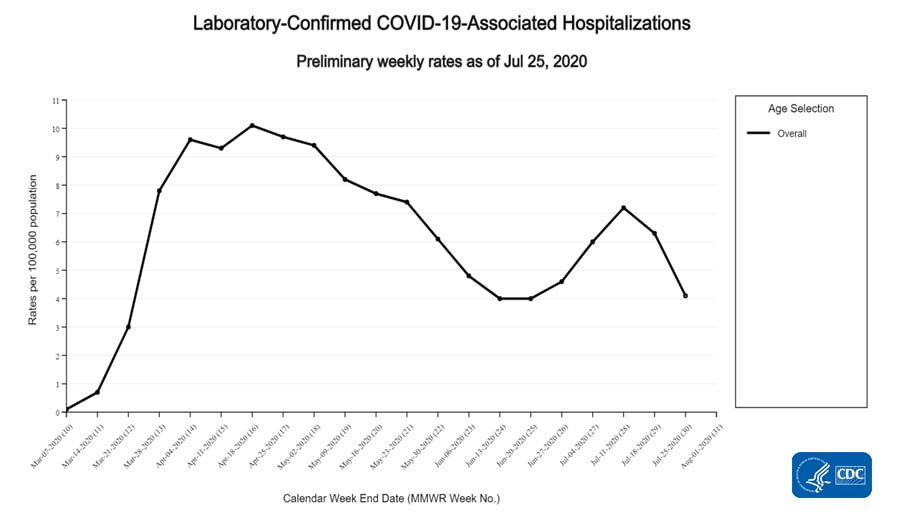
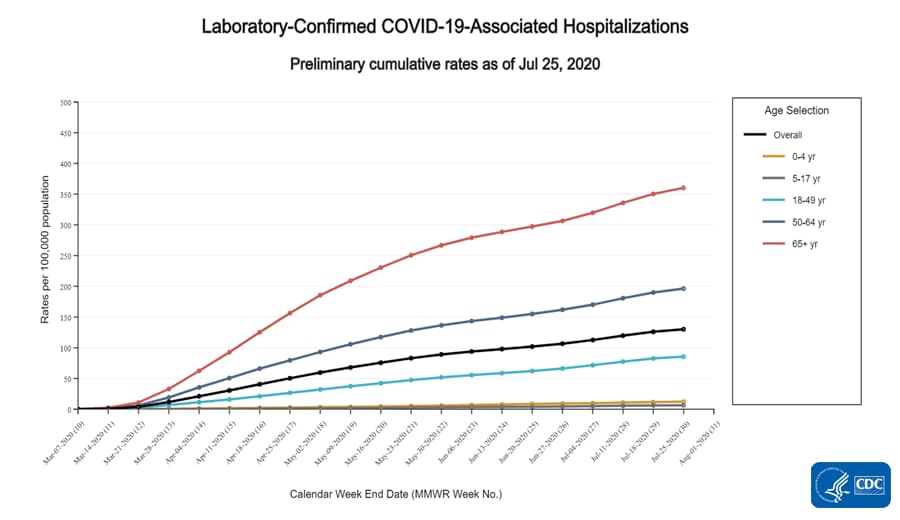
Know Your Risk: Hospitalizations have dropped in US since July 11; See hospitalization rates by age group

Below is entirely copied from the CDC website:
From June 20 (MMWR week 25) – July 11 (MMWR week 28), overall weekly hospitalization rates increased for three consecutive weeks. Data for the weeks ending July 18 and July 25 (MMWR weeks 29 and 30) currently show a decline; however, those data are likely to change as more data for admissions occurring during those weeks are received.
Laboratory-Confirmed COVID-19-Associated Hospitalizations

laboratory-confirmed COVID-19-associated hospitalizations

Wednesday, July 29, 2020

State of Ohio Bans Doctors from using Hydroychloroquine--Governor Reverses Order Next Day After Tremendous Attention Focused on It

On July 29, Ohio's Pharmacy Board announced that beginning the following day, neither chloroquine drug could be dispensed to prevent or treat Covid-19. Prescriptions would require a diagnosis and those for Covid would be rejected.  Not only that, if a prescriber happened to have obtained the drug and wished to provide it to to a patient, they were not allowed to do so.

The morning of July 30, after a massive overnight twitterfest about this action, FDA Commissioner Hahn was interviewed on the Today show and said that drug prescribing was a matter between a doctor and a patient. Shortly thereafter, Ohio's governor withdrew the regulation, citing Commissioner Hahn.

The Oregon Pharmacy Board had issued a similar rule on June 15, which was withdrawn on July 14, after it too drew public attention.

No physician association has supported these restrictions on physician prescribing; the system simply did an end run around them, pulling on the levers it had at its disposal.

The Politics of Hydroxychloroquine. The FDA has suspended a permit for its use. Let doctors decide/ WSJ


Below is a Wall Street Journal article I am reposting in full--Nass

https://www.wsj.com/articles/the-politics-of-hydroxychloroquine-11594831408

OPINION | COMMENTARY
The Politics of Hydroxychloroquine
Trump touted it, so Biden denounces it. The FDA has suspended a permit for its use. Let doctors decide.

By Allysia Finley
July 15, 2020 12:43 pm ET


Hubert Humphrey began his career as a pharmacist before going into politics. Today’s politicians sometimes seem to have the opposite aspiration. President Trump “pushes dangerous, disproven drugs,” Joe Biden declares in his “Plan to Beat Covid-19.” “Our country is now stuck with a massive stockpile of hydroxychloroquine, a drug Trump repeatedly hailed.”

Neither man has any expertise in pharmacology, and Mr. Trump did get out over his skis in promoting the malaria treatment, also known as HCQ, for the novel coronavirus. But since every Trump action prompts a reaction, his political and media opponents launched a campaign to discredit the drug. This politicized environment has produced dubious science and erratic policy.
The Food and Drug Administration issued an emergency use authorization on March 28, allowing hospitals to treat Covid-19 patients outside clinical trials using HCQ donated by manufacturers to the national stockpile. But on June 15 the agency rescinded the authorization. “In light of ongoing serious cardiac adverse events and other potential serious side effects,” the FDA announced, “the known and potential benefits of . . . hydroxychloroquine no longer outweigh the known and potential risks for the authorized use.”
But the scientific basis for the revocation now appears faulty. Most studies didn’t adjust results for confounding variables such as disease severity, drug dosage or when patients
started treatment. Two new peer-reviewed studies find that HCQ can significantly reduce mortality in hospitalized patients. With hospital beds filling up across the American South and West and a limited supply of Gilead Sciences ’ antiviral remdesivir, the FDA should reinstate its emergency-use authorization for HCQ.
HCQ has been safely used for decades to treat patients with lupus and rheumatoid arthritis, both inflammatory autoimmune conditions. The drug has also been found to interfere with the
novel coronavirus’s replication in vitro, and studies this spring from France, Brazil and China showed the drug might help moderately ill patients.

HCQ also has side effects. It can cause cardiac arrhythmias, a particular risk for severely ill Covid-19 patients because the virus can damage heart tissue. But the FDA emergency authorization warned about this and required doctors to monitor patients closely and report adverse side effects to the agency.

In late May, the Lancet published a large-scale international study that claimed hospitalized Covid-19 patients treated with HCQ were 30% more likely to die. But the medical journal retracted the study on June 4 after more than 120 scientists pointed out significant flaws in the data and methodology. The source of the raw data refused to share it with independent reviewers.

Nonetheless, the anti-Trump media claimed vindication later that day when the New England Journal of Medicine published a randomized trial that concluded HCQ didn’t prevent illness in people who had been exposed to the virus. The study’s raw data showed that people who took HCQ within two days of exposure were 38% less likely to develop symptoms. But a third of subjects in the trial took the drug four days after exposure, which obscured its benefits. Since the average viral incubation period is five days, starting the drug four days after exposure is unlikely to do much good.

On June 5, University of Oxford researchers reported that a midpoint review of their HCQ trial had found no clinical benefit. “This result should change medical practice worldwide,” Oxford epidemiologist Martin Landray declared in a press release. It usually pays to be skeptical of such sweeping claims based on a single study.

The Oxford team released a preprint study with more data from its trial on Wednesday. Patients were treated on average nine days after their symptom onset, which may have been too late to improve clinical outcomes. The trial’s protocol also called for dosages two to three times as high as those recommended by the FDA’s emergency use authorization.

In revoking the authorization 10 days later, the FDA cited the New England Journal and Oxford work as well as a British Medical Journal study from China that purportedly found no benefit from the drug. Yet an April draft of the last study concluded that HCQ accelerated “the alleviation of clinical symptoms, possibly through anti-inflammatory properties” and “might prevent disease progression, particularly in patients at higher risk.”

The draft also noted that after adjusting for the confounding effects of other antivirals used to treat patients, “the efficacy of HCQ on the alleviation of symptoms was more evident.” This analysis of HCQ’s benefits was scrubbed from the published version because some editors and reviewers quibbled that it wasn’t called for in the trial protocol.

The first of the new studies showing benefits from HCQ appeared in the Journal of General Internal Medicine on June 30. It found patients treated with the drug at New York’s Mount Sinai Health System hospitals were 47% less likely to die after adjusting for confounding variables such as underlying health conditions and disease severity. Notably, Mount Sinai’s treatment protocol called for lower dosages than in the Oxford trial, and patients on average were treated within one day of hospitalization.

The second, published July 1 in the International Journal of Infectious Diseases, found that patients treated with HCQ at Henry Ford Health System hospitals in Detroit were 50% to 66% less likely to die after adjusting for confounding variables including other treatments. Nearly all patients began treatment within two days of admission, received dosages that hewed closely to FDA guidelines, and were continuously monitored for cardiac arrhythmias.

“Our patient population received aggressive early medical intervention, and were less prone to development of myocarditis, and cardiac inflammation commonly seen in later stages of COVID-19 disease,” the Henry Ford doctors noted.

This shouldn’t be surprising. An FDA safety review published July 1 reported only five adverse side effects from HCQ through the emergency use authorization among tens of millions of doses that were distributed to hospitals. This suggests that the drug isn’t harmful to the vast majority of patients who are treated according to FDA guidelines.

With hundreds of Covid-infected Americans still dying each day, the agency should let physicians decide whether to treat patients with HCQ based on their experience and scientific evidence. Leave politics out of it.

Ms. Finley is a member of the Journal’s editorial board.

Saturday, July 25, 2020

Deaths in the entire United States "involving Covid" equal the number of deaths in NYC at its peak/ CDC

Deaths in the US have been FLAT or DECREASING over the last five weeks. Why aren't you hearing this? Because the media want to instill panic so they talk about rising cases (many asymptomatic, based on often inaccurate lab tests).  We are not having "3 New Yorks" as Dr. Birx claimed.  The fact is that the entire US is now having as many deaths per week as New York City had during its peak in early April.  
Got that?  The entire US equals ONE New York.  See CDC data below. 

Updated Aug 4, 2020